There are many better ways to reduce congestion in your city than expensive roadway expansion projects. Win-win strategies reduce congestion and provide many other benefits.



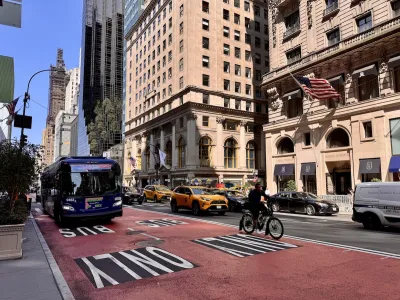
This is the third of a three-part series on how to define, evaluate and solve traffic congestion. Read parts one and two.
When somebody purchases a vehicle, they expect governments to provide roads and businesses to provide parking for their use, and complain if those facilities become congested. How should communities respond? Although congestion is costly, misguided solutions are much worse.
A basic planning principle is that individual short-term decisions should support long-term goals. Smart congestion relief reflects this principle by favoring win-win solutions that achieve additional objectives such as affordability, community livability and fairness. Current planning ignores this. Congestion cost studies such as the “Urban Mobility Report” are biased in favor of highway expansions, as described previously. They exaggerate congestion problems and frame congestion as a cost that motorists bear, implying that drivers are victims who deserve more public investment. However, for most planning purposes, congestion should be considered a cost that motorists impose on other road users due to their greater space requirements compared with other modes, which justifies more multimodal planning and Transport Demand Management incentives.
Conventional planning overlooks some of the best congestion solutions. For example, the Texas Transportation Institute’s “Mobility Improvement Strategies” website has glaring omissions: it advocates roadway expansions without discussing their induced travel impacts; ignores decongestion pricing despite successes in New York, London and Stockholm; and its Smart Growth strategy pages are blank, demonstrating disinterest. Planners need better guidance.
My “Smart Congestion Relief” report uses a comprehensive framework to evaluate potential congestion reduction strategies. Its key findings are summarized below.
Comparing congestion reduction strategies
Roadway expansions
Roadway expansions can reduce congestion in the short term, but study after study show that the additional capacity soon fills with induced travel which increases future traffic problems, including downstream congestion, crashes, pollution and sprawl-related costs.
Urban road expansions are expensive. Considering planning, land acquisition and construction, they typically cost $10-30 million per lane-mile, which averages about $1 per additional peak-period vehicle-mile. Expanding roads to eliminate congestion for the typical urban auto commuter would cost about $4,600 annually, about three times the Urban Mobility Report’s estimated congestion costs, which is many times what motorists pay in road user fees and the subsidies for transit commuters, and far more than most drivers are willing to pay for small travel time savings. Most urban road expansion costs are subsidized by general taxes, which is inefficient and unfair.
To fund enough roadway expansions to significantly reduce urban congestion problems, user fees or general tax subsidies would need to triple, resulting in about $1.60 per gallon fuel taxes or $1,500 per capita higher general taxes. That’s politically unrealistic: citizens are not demanding, “raise my taxes to finance urban highway expansions!”
In addition, roadway expansions take many years to plan and build, cause construction delays and community disruptions, and wider roads with faster traffic increase the barrier effect (pedestrian delay and risk). Ignoring these effects significantly exaggerates roadway expansion benefits.
Conclusions: Unpriced urban roadway expansions may reduce congestion in the short-term, but by inducing more vehicle travel they increase future traffic problems, and their total costs often exceed their benefits.
New technologies
Improved travel information significantly reduces congestion costs. Before mobile phones and the internet, urban travel was unpredictable, so motorists needed lots of buffer time to ensure on-time arrival. Travellers have much better information now. Apps like TomTom, Wayz and Google Maps can accurately predict traffic conditions and help optimize travel time, mode and route to minimize delay. This significantly reduces congestion costs.
Advocates claim that autonomous vehicles can reduce congestion, but their impacts are likely to be mixed. They reduce driver stress and allow motorists to rest or work, so delays are less onerous, but their cautious and sometimes erratic operation often slows traffic, and they are expected to induce more vehicle travel, for example, when programmed to return home or drive in circles to avoid parking fees. They can increase road capacity by platooning, with several vehicles driving close together, but that is only possible if given dedicated lanes and costly new control systems, which will take time and money to develop.
Conclusions: Better travel information reduces congestion costs. Autonomous vehicles can reduce user delay costs but are likely to increase overall congestion problems.
Multimodal planning
Transportation agencies currently spend most of their resources on roads; multimodal planning increases support for space-efficient modes, as summarized in the table below.
Typical space-efficient mode improvements
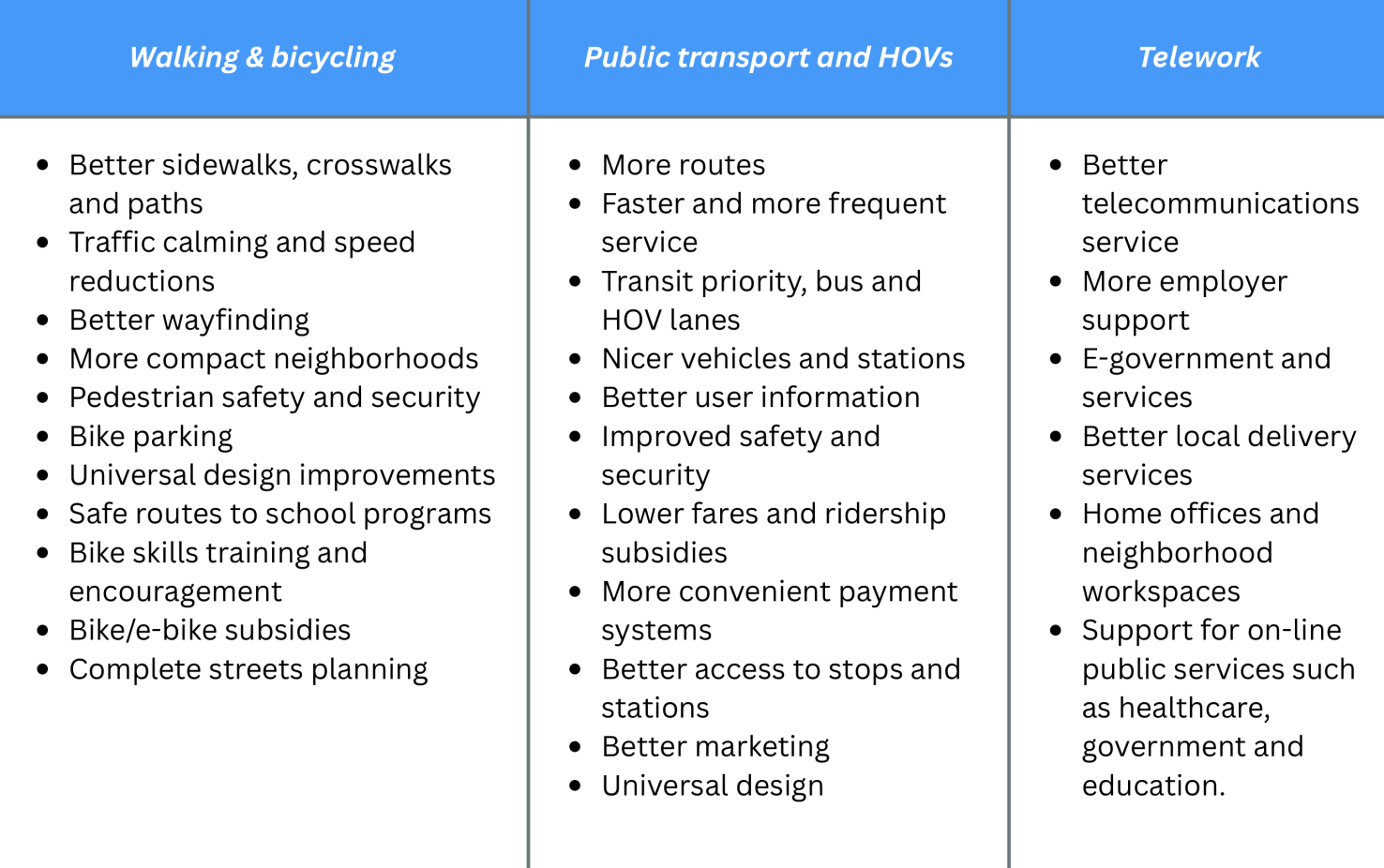
Multimodal planning reduces congestion in several ways. Travellers who shift from driving to another mode experience less congestion, and the quality of non-auto travel affects congestion equilibrium levels: if alternatives are inconvenient, uncomfortable or expensive travellers will drive despite severe congestion, but as non-auto modes improve, travelers are more likely to choose them, reducing traffic delay.
Over the long-term, multimodal planning can create communities where residents own fewer cars and drive less, which further reduces traffic. Even if denser development increases local congestion, residents generate fewer vehicle trips elsewhere.
In auto-dependent areas about 15% of peak-period trips are to chauffeur non-drivers; improving non-auto modes gives non-drivers more independent mobility, reducing car trips. For example, improving sidewalks, crosswalks and bikeways can reduce auto trips to schools, and provide access to public transit which reduces auto commute trips. Since most chauffeuring trips have empty backhauls, each avoided passenger-mile usually reduces two vehicle-miles of travel.
Multimodal planning provides many additional benefits, as summarized below. Improving non-auto travel allows households to save thousands of dollars in annual vehicle expenses, and businesses save on parking costs. It also reduces crash risk, improves public fitness, provides independent mobility for non-drivers and reduces pollution.
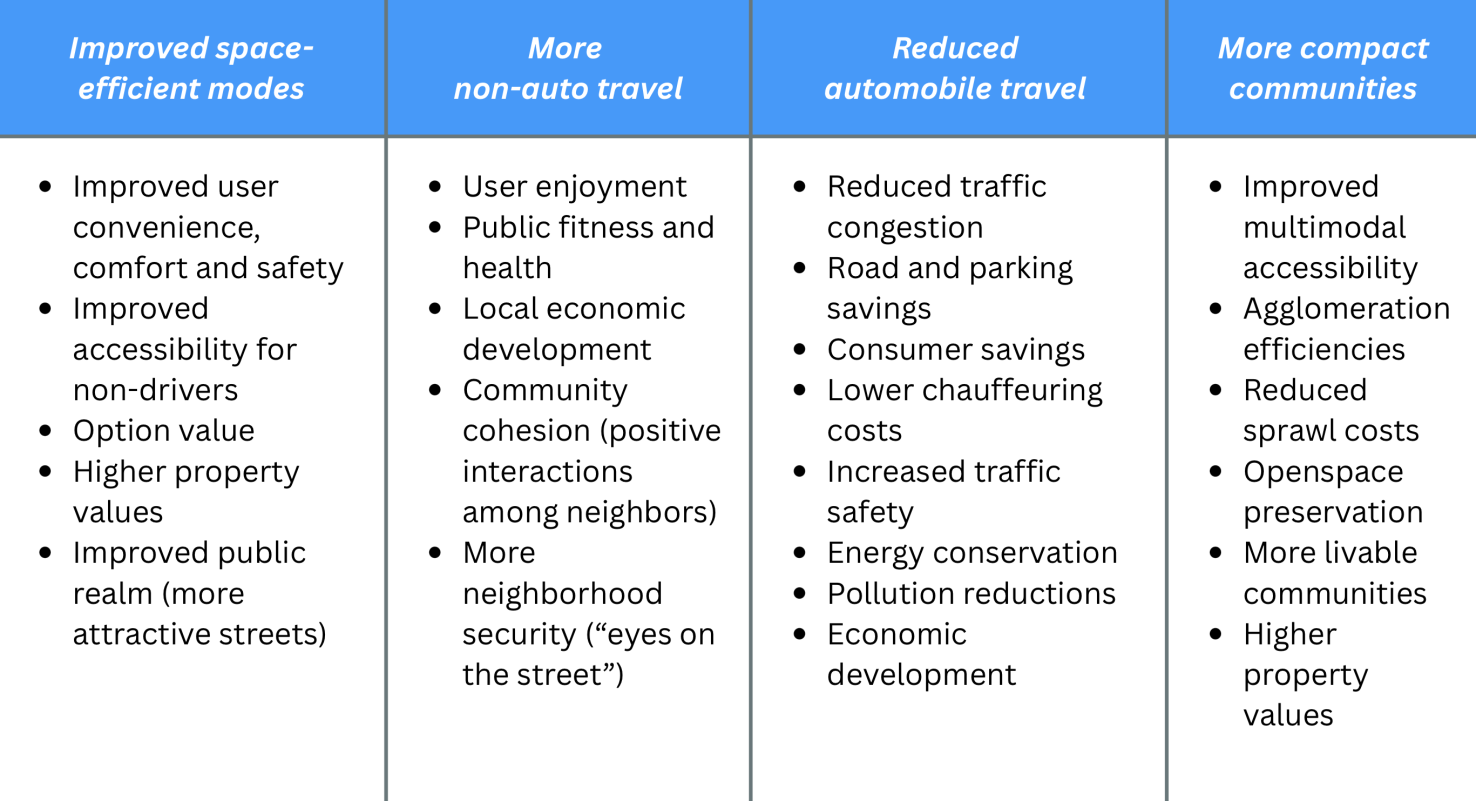
Conclusions: Multimodal planning can reduce congestion costs for travelers who shift mode, reduce delays to motorists by reducing congestion equilibrium and provide many co-benefits.
Transportation Demand Management incentives
Transportation Demand Management refers to policies and programs that encourage travelers to choose the best option for each trip: walking and bicycling to local destinations, public transit when traveling on busy corridors and automobiles when they are truly optimal considering all impacts. The table below lists typical strategies.
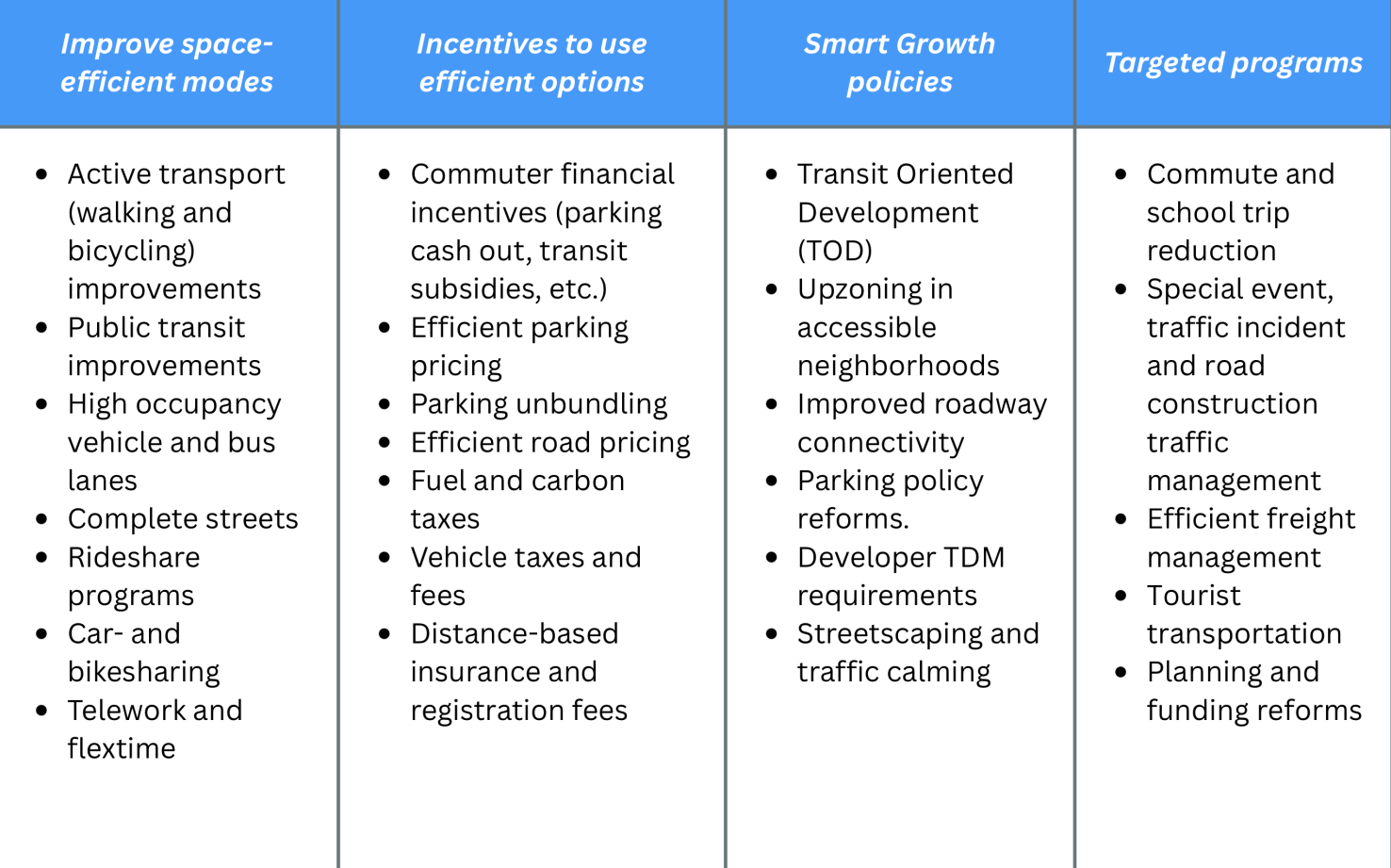
Pricing reforms can be particularly effective. Congestion pricing (which I prefer to call decongestion pricing) refers to tolls that increase during peak periods. This provides several benefits; it reduces congestion, increases economic efficiency by giving priority to higher-value trips, and provides revenue that can finance non-auto mode improvements. Efficient parking pricing can also reduce congestion, making it a second-best solution where road tolling is infeasible. Experience in New York, London and Singapore shows that such pricing significantly reduces affected traffic problems, provides comparable increases in traffic speeds, transit ridership and traffic safety, and gains popular support once people experience the benefits.
TDM also includes targeted programs to manage particular types of trips such as work and school commutes, special events, tourist travel, traffic incidents and construction projects.
Most TDM strategies only affect a minority of total traffic so their congestion reductions may seem small, but their impacts are cumulative and synergistic — they become more effective and beneficial if implemented together. For example, non-auto mode improvements, trip reduction programs, parking reforms and infill development may only reduce a few percent of total vehicle travel individually, but together significantly reduce traffic problems.
Conclusions: TDM can significantly reduce congestion costs and provide many co-benefits.
Smart Growth
Smart Growth policies create compact, multimodal communities where residents drive less and have better mobility options. Although this can increase congestion intensity, that is offset by shorter trips and better non-auto travel, so residents have better accessibility, spend less time and money on travel (particularly for commuting), and experience less total congestion delay.
Conventional planning tends to ignore these benefits by using intensity indicators such as roadway level-of-service and the travel time index, that overlook the congestion avoided by mode shifts. As a result, many cities limit development density in a misguided attempt to reduce congestion, although by increasing total vehicle travel this increases total traffic problems. More comprehensive analysis recognizes Smart Growth savings and benefits, including improved accessibility and reduced per capita congestion costs.
Conclusions: Smart Growth may slightly increase congestion intensity but significantly reduces per capita congestion costs and provides many co-benefits.
Solutions for individuals
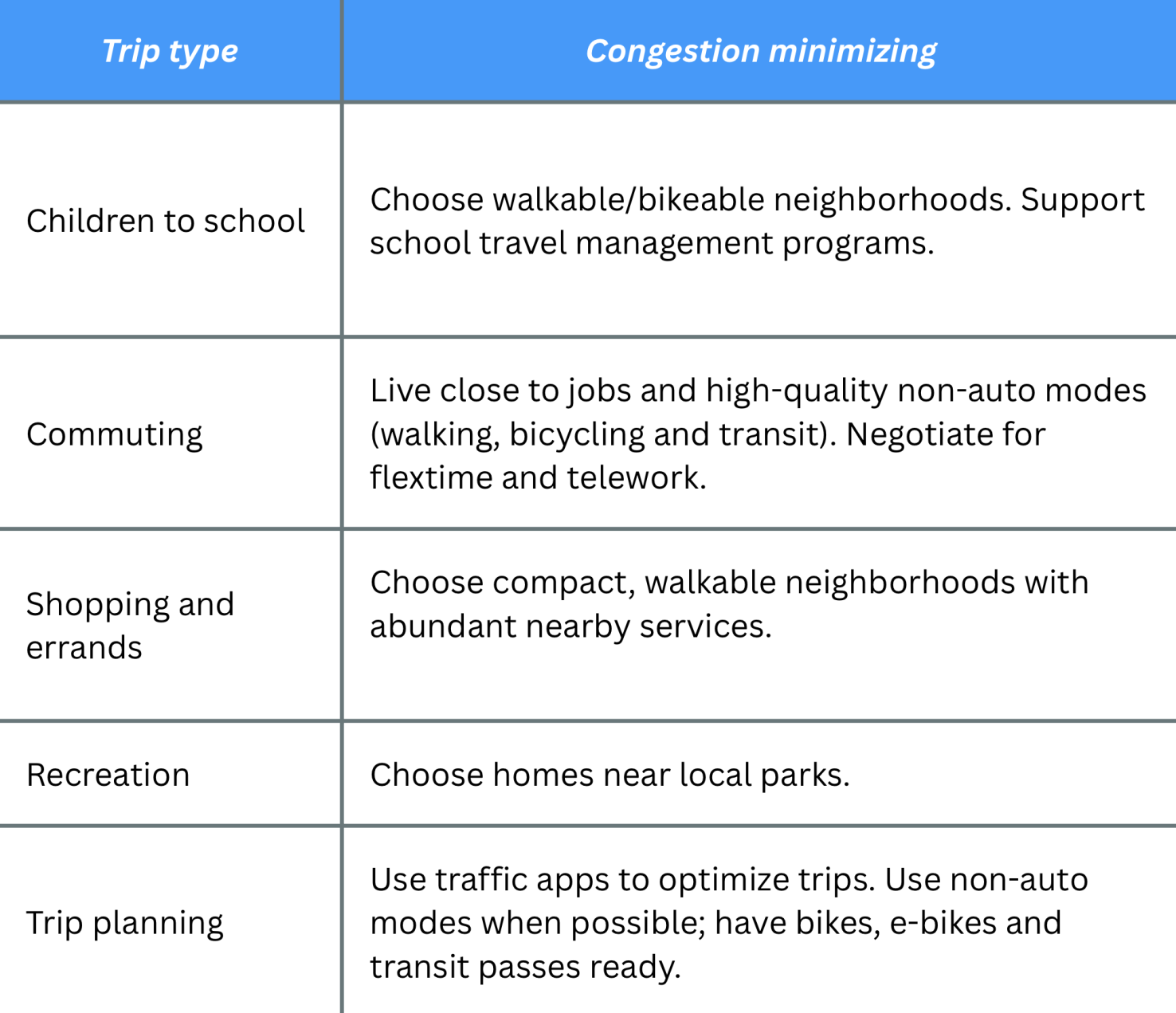
Individual travelers can significantly reduce their congestion costs by living and working in accessible, multimodal neighborhoods, and adjusting habits to minimize urban-peak driving, using indicators such as Walk Score, Close City, the H+T Affordability Index and the Commute Duration Dashboard to identify areas where less driving is needed.
Individuals can also reduce congestion costs with traffic and multimodal navigation apps that show traffic conditions and travel options, by negotiating flextime and work-at-home options with employers, and using telework (online shopping and learning, e-medicine, etc.) to avoid peak-period driving. The table below identifies strategies to minimize congestion for common household trips. A typical household can cut its congestion costs in half by living in an accessible neighborhood with local services and non-auto travel options, and more by applying other congestion exposure reduction strategies.
Household congestion minimizing strategies
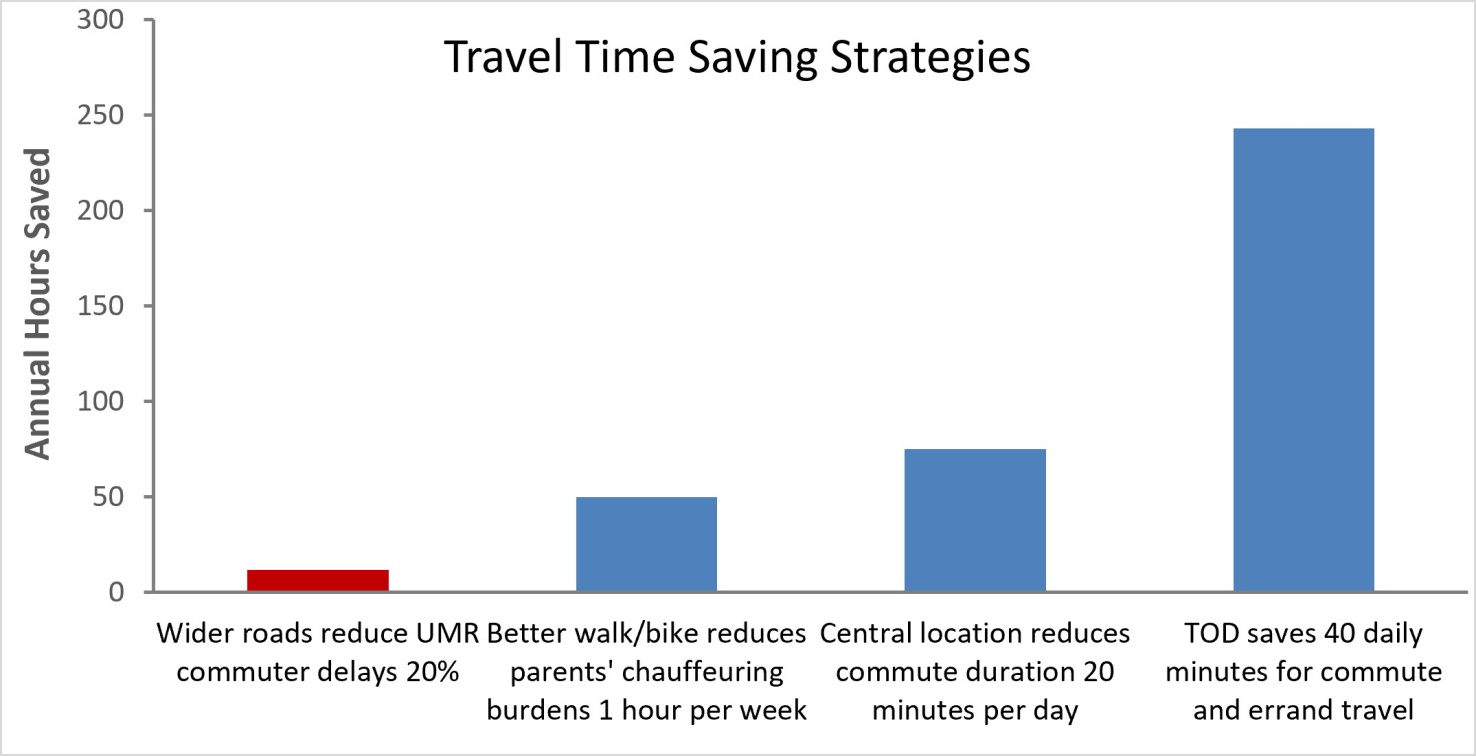
The table below compares the effects of various travel time saving strategies. An aggressive urban roadway expansion program could optimistically reduce congestion delays by 20%, saving about 12 annual hours. Improving walking and bicycling conditions so children and adolescents require one less hour of chauffeuring per week saves 52 annual hours. Living in a central neighborhood reduces commute durations by more than 20 daily minutes or 75 hours per year, and living in a transit-oriented neighborhood with abundant nearby services and frequent and fast public transit can reduce commute and local errand travel by 40 daily minutes compared with living in urban fringe locations. This illustrates the relatively small impact of congestion reductions compared with other travel time savings strategies.
The development industry recognizes these opportunities — many developers now embrace New Urbanism, and the National Association of Realtors’ community preference surveys highlight the benefits of compact, multimodal neighborhoods — but transportation agencies seldom encourage households to reduce congestion by choosing more accessible locations and reducing driving.
Conclusions: Individuals can significantly reduce the congestion costs they bear and impose by choosing accessible locations and minimizing the need for peak-period driving, which provides many co-benefits.
Summary
The table below compares these strategies’ impacts and how they are considered in conventional transportation planning.
Comparing congestion reduction strategies
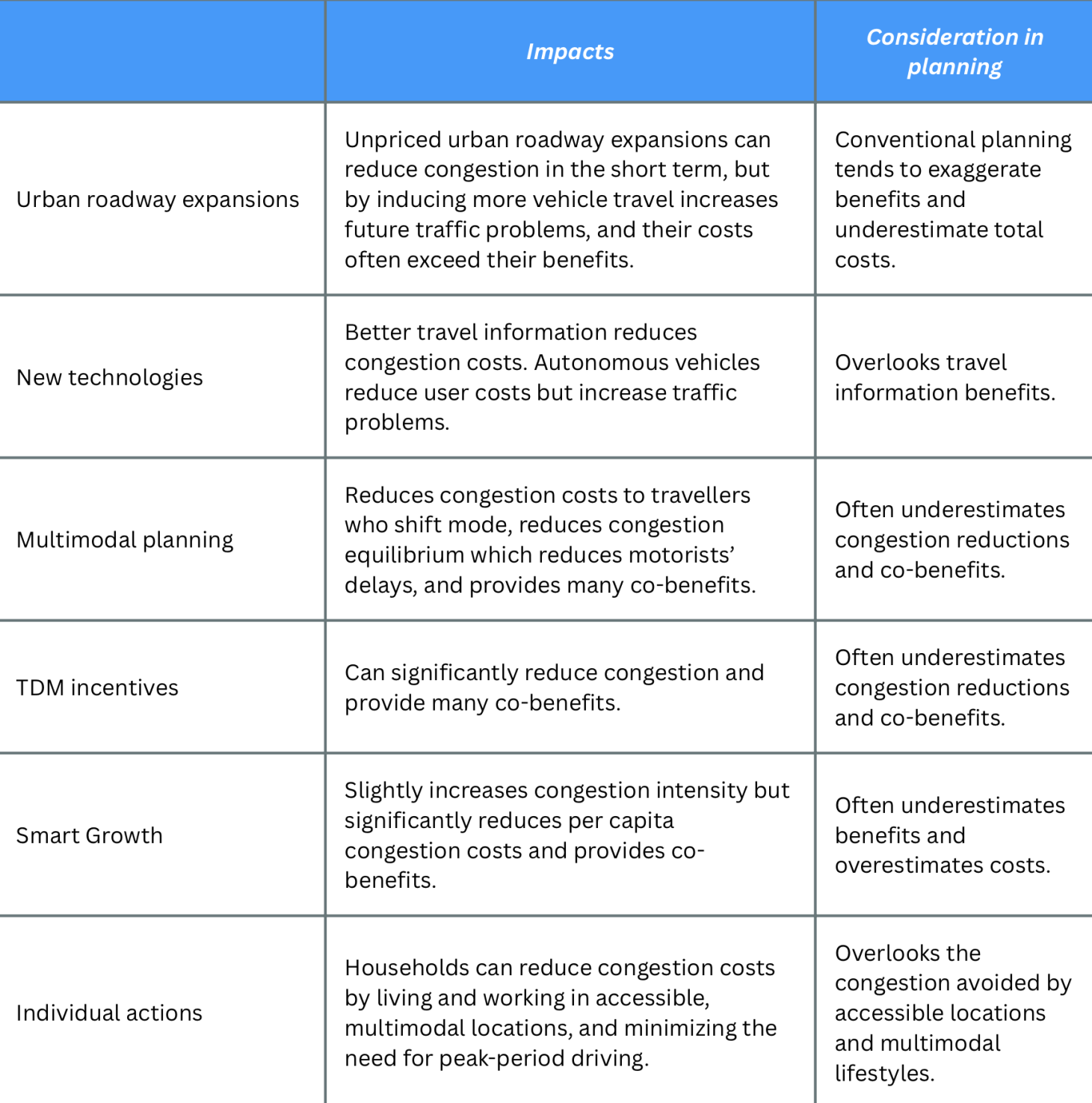
This indicates that conventional analysis overvalues roadway expansion by overlooking many roadway expansion costs, and undervalues multimodal planning, TDM incentives and Smart Growth by underestimating their effectiveness and co-benefits.
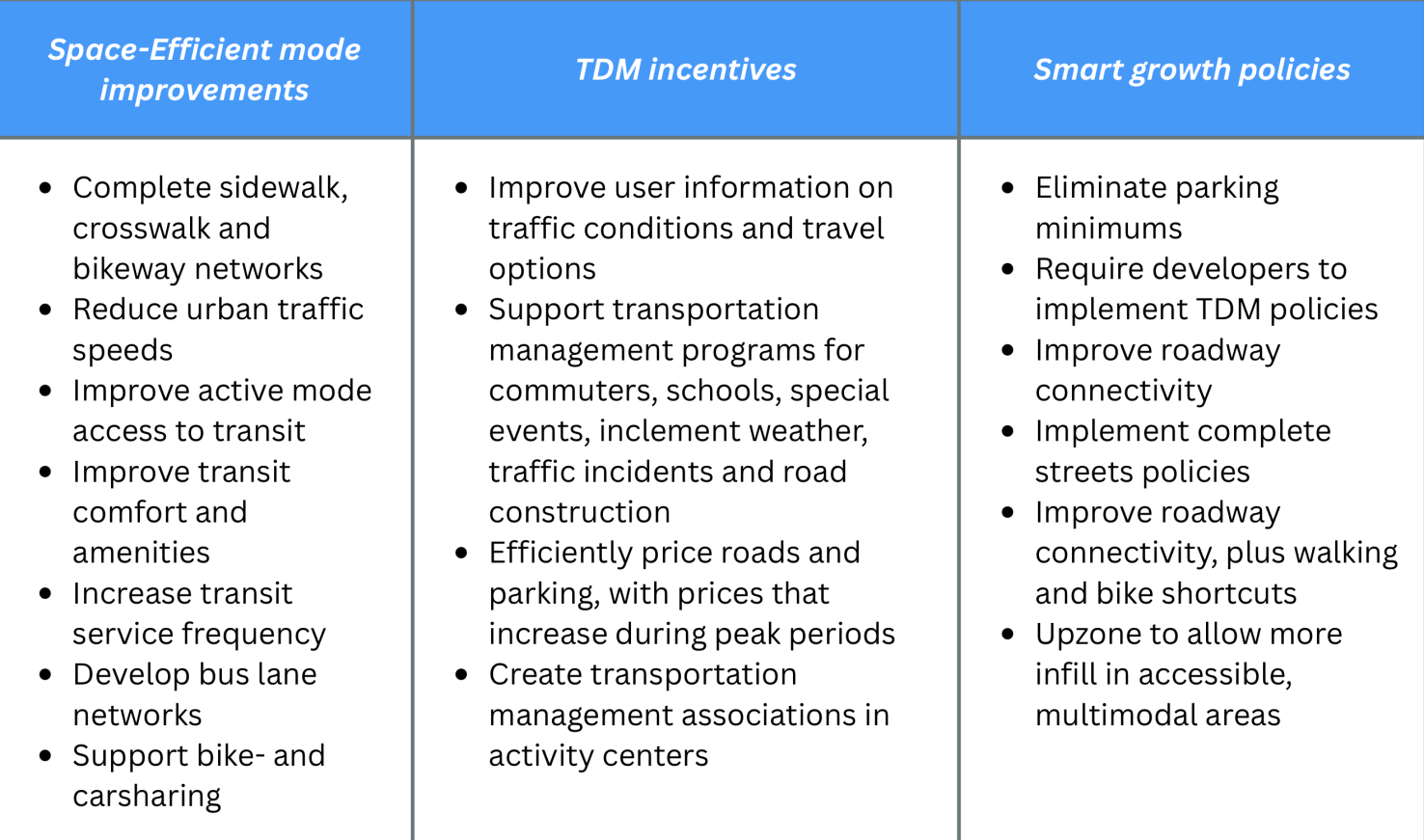
Where should a city start? The table below identifies several quick, cost effective and beneficial, win-win congestion reduction strategies. They are justified for co-benefits and so should be implemented regardless of their congestion reduction impacts. For example, before spending a billion dollars on a roadway expansion, a transportation agency should be willing to spend two billion dollars to implement these win-win strategies due to their large total benefits.
Win-win congestion reduction strategies
What can planners do?
Planners can help implement more rational and equitable congestion reduction strategies by challenging analysis biases and promoting win-win solutions. My reports, “Congestion Costing Best Practices,” “Congestion Costing Critique” and “Smart Congestion Relief” provide detailed guidance.
We can help redirect congestion concerns to support more holistic solutions. We can say, “This helps reduce congestion and achieve other goals such as …” describing appropriate benefits. For example, if parents complain about school area congestion, we can recommend active mode improvements, traffic calming and school transport management programs, highlighting benefits to children. If commuters complain about urban roadway congestion, we can recommend bicycling, public transit and ridesharing improvements, commute trip reduction programs and transit-oriented development to reduce auto commuting. If businesses are concerned about parking congestion, we can show how better parking management with improved pedestrian connections can expand the parking supply available to customers, and how commute trip reduction programs can reduce employee parking demands. We can paint a word picture that describes the benefits that resonate with each audience.
Conclusions
There are many possible ways to reduce traffic congestion, some of which are much better overall, considering all impacts. Current congestion evaluation practices are flawed in ways that favor roadway expansions and undervalue strategies that increase transportation system efficiency.
Motorists usually prefer roadway expansions provided somebody else bears the costs, but if required to pay directly through user fees, demand plummets, indicating that their costs exceed their benefits. Other congestion strategies can provide more time savings and greater total benefits.
A key insight of this research is that urban road supply affects congestion costs much less than travel information, non-auto mode quality, parking prices and neighborhood design and location. This can help planners identify truly effective congestion solutions.
Individuals can minimize the congestion costs they bear and impose by living and working in accessible neighborhoods, making lifestyle decisions that minimize urban-peak driving, and using traffic apps to optimize urban travel. Communities can minimize system-wide congestion costs by integrating multimodal planning, TDM incentives and Smart Growth policies that create compact, multimodal neighborhoods. These solutions benefit everybody, including motorists, who experience less congestion, less crash risk and reduced chauffeuring burdens.

Congestion Costing Reality Check, Part 2: A congestion costing critique
There are good reasons to be skeptical of highway industry claims that traffic congestion is a growing problem. Their analysis is often incomplete and biased. Let’s pull back the curtain on some major congestion cost studies.
What's the Right Price for Congestion Pricing in New York City?
On this episode of the price is right, a city of more than 8 million people tries to determine the most effective cost for driving in a dense part of its downtown.
Congestion Costing Reality Check, Part 1: Congestion evaluation best practices
Widely cited studies claim that traffic congestion is a huge and growing problem. They exaggerate. Let’s examine how to correctly calculate congestion costs and roadway expansion benefits.

Planetizen Federal Action Tracker
A weekly monitor of how Trump’s orders and actions are impacting planners and planning in America.

Amtrak, CN end decades-long dispute with eight-year agreement
The new operating agreement establishes an updated framework for the companies to work together, including processes to resolve disputes.

Northwest rail fans eager for Sept. 30 debut of Amtrak’s Airo fleet
Get ready for that new train smell and more seats. But they won’t go faster or run more frequently on the Cascades route in Washington and Oregon.

A 'dangerous' precedent: North Carolina successfully pressures communities into voting for toll roads
Two mayors resigned from the Charlotte Regional Transportation Planning Organization after it voted in favor of the toll roads.

Austin landlords only need to address mold when it covers 25 sqft. A resolution looks to change that
The city manager will propose updates to the city code regarding regulations around mold in May.

NYCHA’s green future? Officials open ‘showroom’ apartment with sustainable features
Heat pumps, inductions stoves and infrared heating panels: these are a few of the climate-friendly upgrades being installed at some public housing developments, with more to come, officials said Tuesday.

FREE Course: Walkable City 1: Why Walkability?
After describing his path towards focusing on walkability as the essence of good planning, Jeff Speck marches through his five principal reasons for making more walkable places.
Reinventing Malls: Planning Alchemy—Turning Gray Fields Into Gold
The course focuses on the opportunities and imperatives that shape reinvention of mall sites.

City of Thousand Oaks
City of Wisconsin Rapids
Harvard University Graduate School of Design
The Architects Foundation
University of Cincinnati Online
The Pocatello Development Authority
The Urban Renewal Agency of the City of Pocatello

