The study also examined air quality around freeways which experts worried would see increased traffic from people avoiding the tolls.


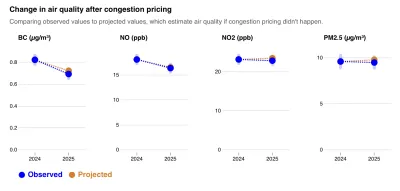
On Aug. 14, the New York City Health Department released its first study of the Congestion Relief Zone Tolling Program’s impact on air quality. After a year of congestion pricing, the evaluation found that the air quality of the neighborhoods within the Congestion Relief Zone either improved slightly or stayed the same, Noah Kolenda writes for Mass Transit. The report also revealed that congestion pricing led to more people choosing to walk, take transit or bike into congestion zones.
The report also studied the air quality of communities near major highways, including the Brooklyn-Queens Expressway and Trans-Manhattan Expressway. The Congestion Relief Zone Tolling Environmental Assessment had warned that these neighborhoods may see increased air pollution if New Yorkers used the expressways to avoid tolls, but the report found no increase in air pollution attributable to congestion pricing.
The analysis used data from one year before congestion pricing and one year after, and tracked concentrations of fine particulate matter, nitrogen dioxide, nitric oxide and black carbon. The report’s findings mark the continuation of a 20-year trend of improving air quality in New York City.
Read the full story, below.
Read the full story: NYC Health Department releases Congestion Relief Zone air quality study results

Report: 75% of NYC warehouses are in 'disadvantaged communities'
Low-income New Yorkers are 1.2 times more likely to live within half a mile of a warehouse.
NYC Congestion Pricing Revenue Will Fund up to 1,000 Hybrid Refrigerated Trucks
Traffic to the Hunts Point Produce Market causes increased rates of asthma in surrounding neighborhoods.
NYC Congestion Pricing Cut Air Pollution by 22% in 6 Months
The program reduced vehicle entries into the toll zone by 11 percent.

Planetizen Federal Action Tracker
A weekly monitor of how Trump’s orders and actions are impacting planners and planning in America.

‘Going backwards:’ Baltimore mayor, students rally against state's transit funding plan
Maryland's proposed six-year plan provides no funding for Baltimore’s BMORE bus program and reduces its road maintenance funding.

Detroit to transform waterfront with $2.2 billion investment
Developers will convert about 18 acres of unused parking lot space into civic spaces.

25 states, cities sue the EPA over erased power plant emissions limits
The coalition also intends to sue the EPA for not regulating emissions from gas-fired power plants.

Newsom vetoes giving CA tribes greater voice in water projects
In his veto letter, Newsom said the bill would add ‘uncertainty’ to the state’s fight to secure Californians’ water supplies.

Michigan Senate votes to revise 'lax' dam safety laws
A Bridge Michigan investigation found more than 100,000 Michigan residents live in the floodpath of a high or significant-hazard dam.

FREE Course: Walkable City 1: Why Walkability?
After describing his path towards focusing on walkability as the essence of good planning, Jeff Speck marches through his five principal reasons for making more walkable places.
Reinventing Malls: Planning Alchemy—Turning Gray Fields Into Gold
The course focuses on the opportunities and imperatives that shape reinvention of mall sites.

City of Thousand Oaks
City of Wisconsin Rapids
Harvard University Graduate School of Design
The Architects Foundation
University of Cincinnati Online
Northern Illinois Transit Authority (NITA)
The Pocatello Development Authority
The Urban Renewal Agency of the City of Pocatello