Low-income New Yorkers are 1.2 times more likely to live within half a mile of a warehouse.


A report from the Environmental Defense Fund reveals that the proliferation of warehouses and delivery services in New York City are having the most significant air pollution impacts on the lowest-income neighborhoods.
As Casey Wetherbee explains in City Limits, "In New York City, low-income populations are 1.2 times more likely to live within half a mile of a warehouse, and 75 percent of warehouses are located within “disadvantaged communities“—census tracts that are already disproportionately burdened by climate change, as defined in state law."
While two proposed state laws that would regulate delivery companies and mitigate pollution did not advance during the last legislative session, New York City's Department of Transportation launched a Microhubs pilot program that encourages last-mile deliveries using cargo bikes or other small, sustainable mobility devices. "DOT estimates that the pilot program replaced more than 3,000 truck trips in a year, reducing approximately nine grams of pollutants from the air."
FULL STORY: Delivery Warehouse Boom is Impacting NYC’s Low-Income Neighborhoods Most, Reports Finds

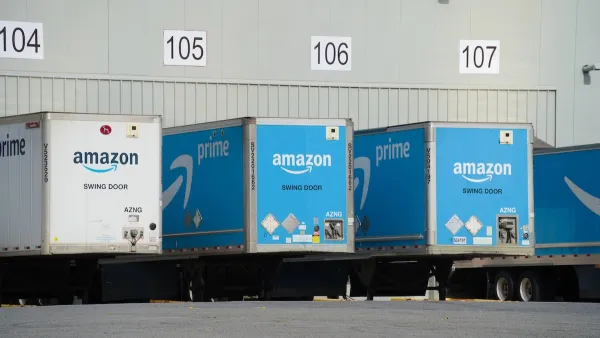
Poorest NYC Neighborhoods Pay Price for Delivery Boom
The rise of ‘last-mile’ e-commerce warehouses — and their attendant truck traffic and air pollution — is disproportionately impacting the most historically disadvantaged parts of the city.
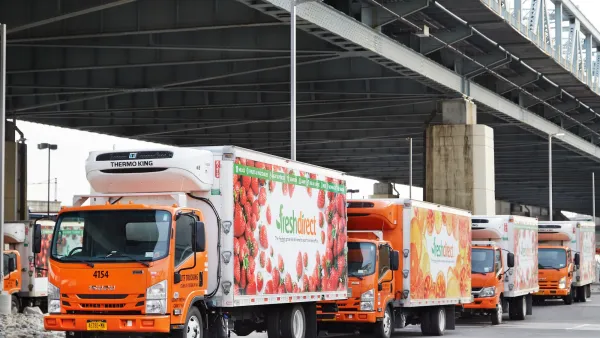
NYC Congestion Pricing Revenue Will Fund up to 1,000 Hybrid Refrigerated Trucks
Traffic to the Hunts Point Produce Market causes increased rates of asthma in surrounding neighborhoods.

Study: Building Pollution Contributing to Poor Air Quality in NYC
Pollutants from methane, propane, and fuel oil are on the rise, leading to a growing public health crisis.

Planetizen Federal Action Tracker
A weekly monitor of how Trump’s orders and actions are impacting planners and planning in America.

The state-sanctioned urbicide of Austin
People don’t kill cities. Freeways do.

US to reduce Colorado River water deliveries to Mexico
A new Colorado Treaty amendment reduces Mexico’s Colorado River water allocation by 250,000 acre feet.

5 New England states march closer to 800 megawatt wind energy project
Securing federal approval for the project may be complicated under the Trump administration, which has historically been hostile towards domestic wind power.

Baltimore to break ground on $50 million Transit Priority Project
The project will bring faster bus trips, safer streets and better bike connections to Baltimore.

Airbnb launches $250 million 'last-dollar financing' housing accelerator, makes first investment in Austin
The company will put $6.4 million towards affordable housing development in Texas’ capital.

FREE Course: Walkable City 1: Why Walkability?
After describing his path towards focusing on walkability as the essence of good planning, Jeff Speck marches through his five principal reasons for making more walkable places.
Reinventing Malls: Planning Alchemy—Turning Gray Fields Into Gold
The course focuses on the opportunities and imperatives that shape reinvention of mall sites.

Eagle County Government
Harvard University Graduate School of Design
Nashville Planning Department
The Architects Foundation
University of Cincinnati Online
The Pocatello Development Authority
The Urban Renewal Agency of the City of Pocatello
Journal of the American Planning Association