The hubs are designed to provide parking for large delivery trucks, which can pass on their cargo to bikes or other zero-emission vehicles.


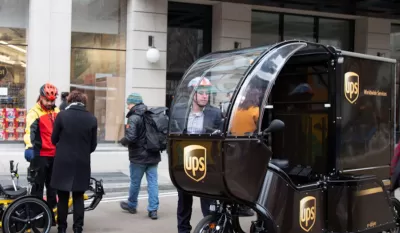
New York City is launching a network of “microhubs” in an effort to reduce traffic and pollution from large delivery trucks and replace last-mile trips with smaller, zero-emission vehicles.
As Danielle McLean explains in Smart Cities Dive, “The city said in an April 22 press release the microhubs will create designated spaces for Amazon, Net Zero Logistics and UPS on the Upper West Side, allowing those companies’ delivery trucks to transfer packages to cargo bikes, pushcarts and zero-emission vehicles to complete the last leg of deliveries.”
Almost 90 percent of goods in New York City are delivered by truck, so consolidating truck parking and distribution could significantly reduce traffic and impacts on neighborhood streets. “The first three locations are within city Smart Curbs’ zones — part of a program launched last year that dedicates curb space for trucks and passenger vehicle loading, bike corrals, electric vehicle charging and pedestrians.”
The city says it plans to expand the program to 36 on- and off-street hubs in the next three years.
FULL STORY: NYC launches ‘microhub’ pilot to reduce truck delivery congestion, pollution

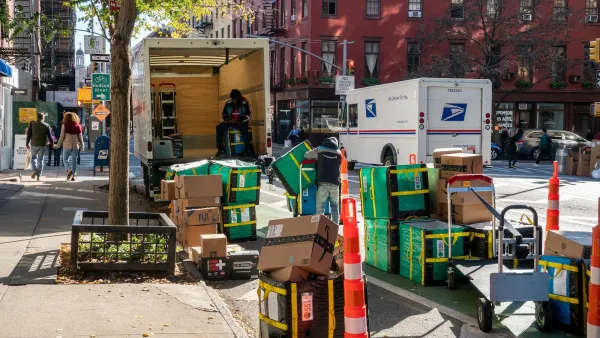
Report: 75% of NYC warehouses are in 'disadvantaged communities'
Low-income New Yorkers are 1.2 times more likely to live within half a mile of a warehouse.
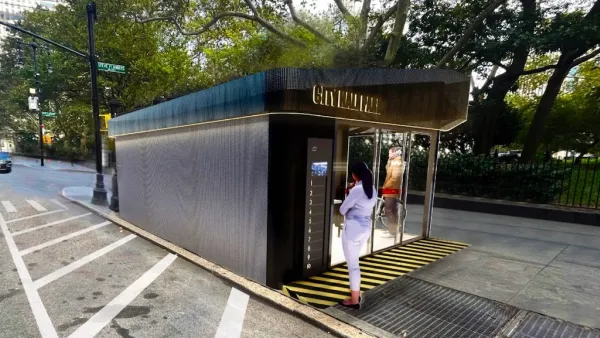
Why NYC Needs More ‘Deliverista Hubs’
The city began construction on a facility that will provide seating, shade, and e-bike charging for delivery workers. Its 80,000 ‘deliveristas’ could use many more.
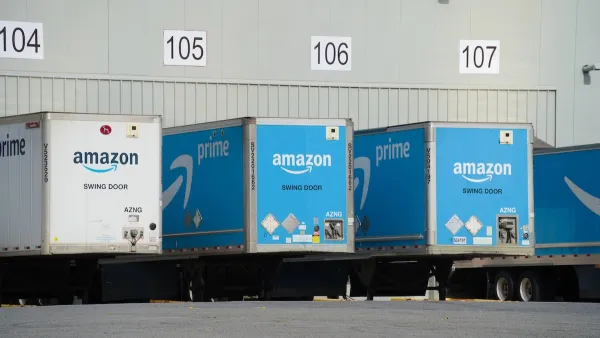
Poorest NYC Neighborhoods Pay Price for Delivery Boom
The rise of ‘last-mile’ e-commerce warehouses — and their attendant truck traffic and air pollution — is disproportionately impacting the most historically disadvantaged parts of the city.

Planetizen Federal Action Tracker
A weekly monitor of how Trump’s orders and actions are impacting planners and planning in America.

The state-sanctioned urbicide of Austin
People don’t kill cities. Freeways do.

US to reduce Colorado River water deliveries to Mexico
A new Colorado Treaty amendment reduces Mexico’s Colorado River water allocation by 250,000 acre feet.

5 New England states march closer to 800 megawatt wind energy project
Securing federal approval for the project may be complicated under the Trump administration, which has historically been hostile towards domestic wind power.

Baltimore to break ground on $50 million Transit Priority Project
The project will bring faster bus trips, safer streets and better bike connections to Baltimore.

Airbnb launches $250 million 'last-dollar financing' housing accelerator, makes first investment in Austin
The company will put $6.4 million towards affordable housing development in Texas’ capital.

FREE Course: Walkable City 1: Why Walkability?
After describing his path towards focusing on walkability as the essence of good planning, Jeff Speck marches through his five principal reasons for making more walkable places.
Reinventing Malls: Planning Alchemy—Turning Gray Fields Into Gold
The course focuses on the opportunities and imperatives that shape reinvention of mall sites.

Eagle County Government
Harvard University Graduate School of Design
Nashville Planning Department
The Architects Foundation
University of Cincinnati Online
The Pocatello Development Authority
The Urban Renewal Agency of the City of Pocatello
Journal of the American Planning Association