The light rail project is moving ahead with plans to finalize its environmental impact review by late 2025.



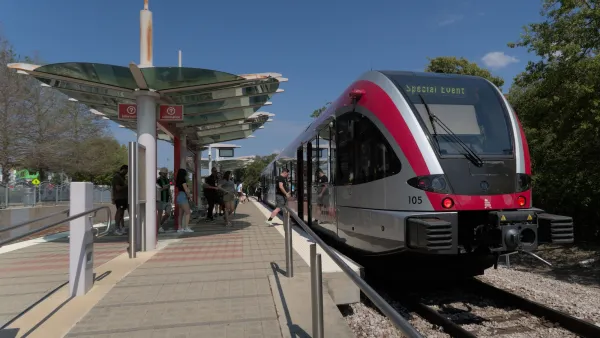
Despite uncertainty about federal funding and state support, the light rail portion of Austin’s Project Connect is moving ahead, with the Austin Transit Partnership releasing its latest plan for the 9.8-mile transit line. However, as Benton Graham reports in Smart Cities Dive, “The project, which city voters approved in a referendum, faces potential funding and other challenges at the state and federal levels.” Last April, the Texas Attorney General filed a lawsuit against the project, claiming that voters did not approve a revised design.
The latest updates to the plan include an additional station near the state capitol downtown and a bridge over Lady Bird Lake with an elevated station. “The light rail line would have 15 stations that cut north-south through the city’s downtown and turn east after crossing Lady Bird Lake. It also lists priority extension stations further north, south and east, including to Austin Bergstrom International Airport, that it would pursue if funding were to become available.”
If it remains on track, the project could be completed by 2033. Although half of the project was to be financed by federal funding, ATP officials say federal funding freezes will not affect Project Connect’s 2025 timeline, which is funded through a $193 million budget approved in September consisting primarily of taxpayer dollars.
Read the full story: Austin, Texas, light rail project advances amid political uncertainty

Austin's Project Connect has shrunk to less than half its proposed length — at a higher cost
A highly anticipated light rail project is quickly diminishing in scope as costs soar.

Texas Attorney General Calls Project Connect Funding Scheme Illegal
The massive transit project’s unique funding scheme could run afoul of state law.

Austin’s Project Connect Faces More Hurdles
Two proposed bills in the Texas state legislature call for more voter oversight of the mass transit project, which could imperil the transit expansion approved by voters in 2020.

Planetizen Federal Action Tracker
A weekly monitor of how Trump’s orders and actions are impacting planners and planning in America.

California plans to bury El Niño’s downpour
If the state plays its cards right, it may be able to store a billion acre-feet of El Niño’s water in aquifers.

Chicago breaks ground on $3 billion megadevelopment
The new neighborhood, titled Foundry Park, will one day host 3,700 residences.

Satanic Place Names
From streams and lakes to valleys and canyons, I mapped more than 1,000 places named after the Devil.

California High-Speed Rail Authority CEO resigns after $600,000 scandal
Under Ian Choudri, the authority used taxpayer dollars to fund first class flights and trips to nightclubs.

Want to study the Missouri River? Soon, you may need unanimous approval from 10 states
Legislation would require 10 governors’ permission to study or build projects moving water outside the basin.

FREE Course: Walkable City 1: Why Walkability?
After describing his path towards focusing on walkability as the essence of good planning, Jeff Speck marches through his five principal reasons for making more walkable places.
Reinventing Malls: Planning Alchemy—Turning Gray Fields Into Gold
The course focuses on the opportunities and imperatives that shape reinvention of mall sites.

City of Rosemead
Rutgers University, Edward J. Bloustein School of Planning and Public Policy
One Hundred Miles
Hunter College, City University of New York (CUNY)
The Architects Foundation
University of Cincinnati Online
City of Cambridge
Montrose County
The Pocatello Development Authority