A new lawsuit could delay the massive transit proposal into the next legislative session, where anti-Austin lawmakers could kill it altogether.


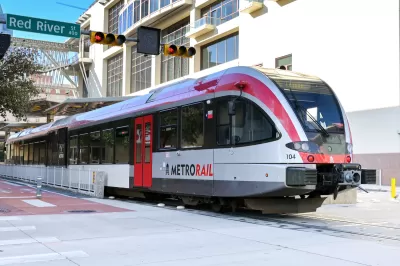
Austin’s Project Connect may never get built, in part thanks to a new legal challenge supported by Texas Attorney General Ken Paxton.
As Lina Fisher reports in the Austin Chronicle, “In 2022, ATP had to halve their planned 20.2 miles of light rail, subway, and new rapid bus routes to a now 9.8-mile line, with no subway and no lines to the airport, all thanks to climbing costs from design changes and inflation.” Now, the lawsuit argues that voters did not approve the revised design, thus making the city unable to issue debt or spend property taxes on the project.
“The A.G. must approve any entity that wants to issue debt in the state, but ATP has asked for a bond validation election in Travis County district court that can override the A.G.’s disapproval and expedite the legal process, which could have otherwise taken two years.” A trial is set for the end of May, but there are multiple ways for the plaintiffs and Paxton to delay the process into the next legislative session, “which may prove the biggest threat to Project Connect.”
FULL STORY: Project Connect’s Paxton Problem

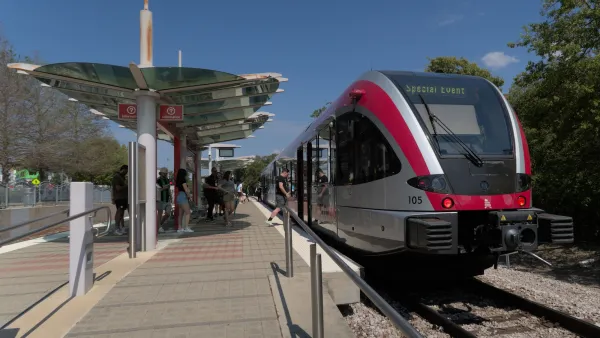
Austin's Project Connect has shrunk to less than half its proposed length — at a higher cost
A highly anticipated light rail project is quickly diminishing in scope as costs soar.
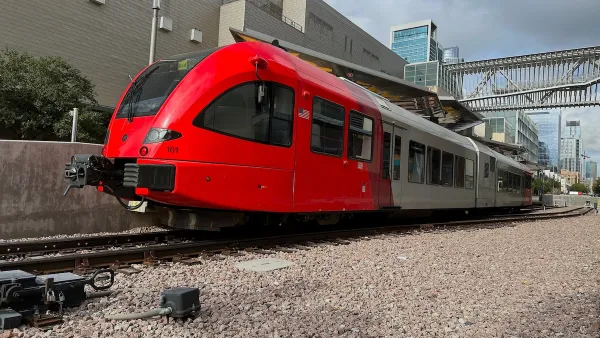
Texas State Bills Could Kill Transit Funding in Dallas, Austin
State lawmakers could pull funding from the state’s largest transit agency and the ambitious Project Connect, a voter-approved transit project in Austin.

Austin’s Project Connect Funding Safe for 2025
The light rail project is moving ahead with plans to finalize its environmental impact review by late 2025.

The state-sanctioned urbicide of Austin
People don’t kill cities. Freeways do.

US to reduce Colorado River water deliveries to Mexico
A new Colorado Treaty amendment reduces Mexico’s Colorado River water allocation by 250,000 acre feet.

New Jersey’s second-largest city bans standalone data centers
Jersey City will continue to allow co-location facilities, such as those meant for research institutions that store their own data.

Amtrak not solely to blame for New Jersey commuter rail's unreliability, report finds
A new study from the Garden State Initiative found that NJ Transit’s budget grew 20% across a 4 year period, but reliability declined significantly over the same period.

EPA erases limits on planet-warming pollution from power plants
Under Monday’s plan, power plants would still have some limits on how much mercury, arsenic and other contaminants they can emit.

Phoenix announces new on-demand transit service, more frequent RAPID buses
Both new services will launch in October, and are part of Phoenix's Project Effective Access Solutions for Easing Congestion.

FREE Course: Walkable City 1: Why Walkability?
After describing his path towards focusing on walkability as the essence of good planning, Jeff Speck marches through his five principal reasons for making more walkable places.
Reinventing Malls: Planning Alchemy—Turning Gray Fields Into Gold
The course focuses on the opportunities and imperatives that shape reinvention of mall sites.

Eagle County Government
Harvard University Graduate School of Design
Nashville Planning Department
The Architects Foundation
University of Cincinnati Online
The Pocatello Development Authority
The Urban Renewal Agency of the City of Pocatello
Journal of the American Planning Association