Sanitation workers must manually collect bags from containers blocked by parked cars, slowing a process that is meant to be safer and more efficient.


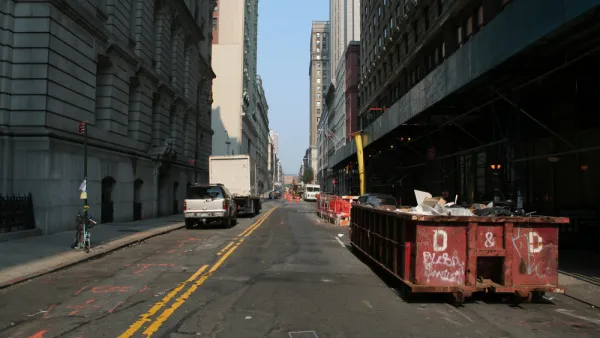
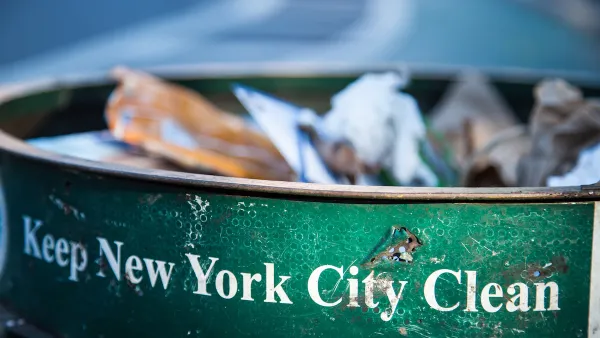
Despite a recent program to containerize garbage, New York City sanitation workers still have to contend with parked cars blocking trash containers, forcing them to continue manually collecting garbage bags from the city’s sidewalks.
As Kevin Duggan explains in Streetsblog NYC, “The agency is equipping some of its roughly 2,000 rear-loaders with tippers to mechanically hoist the newly mandated wheelie bins, but because they're on the sidewalk, these upgrades will run up against the steel wall of the roughly 3 million parking spaces the city provides to motorists largely at no cost.”
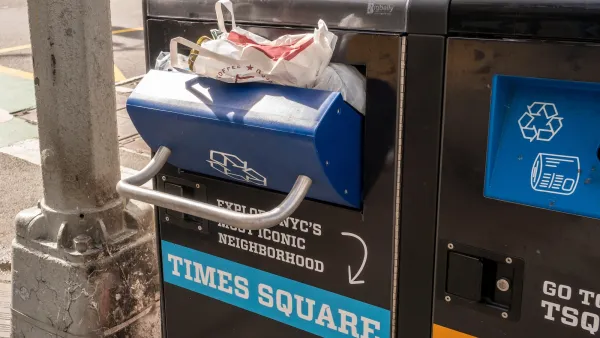
The city’s new containerization program is part of the effort to reduce the rampant rat population. Next year, the Sanitation Department will begin installing street-side stationary containers for buildings with 31 or more units, while smaller buildings can choose stationary containers or mobile bins.
In addition to keeping the city’s streets cleaner, containerization can also reduce the physical impact on sanitation workers, who haul “as much as 20 tons per shift in some neighborhoods.” According to Duggan, “The answer to this issue is clawing back space from cars for better uses, advocates said, urging Sanitation officials to work with the Department of Transportation to mark sections of the streetscape to wheel out trash.”
FULL STORY: Cars Still Get in the Way of Containerized Trash Pickup

N.Y.C. Law Will Establish Waste Collection Zones
A new law will reorganize the city’s trash collection network and reduce the number of sanitation trucks crisscrossing the city.
Why is Public Sanitation so Hard?
U.S. cities struggle to keep streets and sidewalks clean. Some are turning to high-tech trash cans to help.
New York to Cut Sidewalk Trash Service by 40 Percent
Budget cuts will force the Department of Sanitation to cut sidewalk trash collection by nearly half.

The state-sanctioned urbicide of Austin
People don’t kill cities. Freeways do.

US to reduce Colorado River water deliveries to Mexico
A new Colorado Treaty amendment reduces Mexico’s Colorado River water allocation by 250,000 acre feet.

New Jersey’s second-largest city bans standalone data centers
Jersey City will continue to allow co-location facilities, such as those meant for research institutions that store their own data.

Amtrak not solely to blame for New Jersey commuter rail's unreliability, report finds
A new study from the Garden State Initiative found that NJ Transit’s budget grew 20% across a 4 year period, but reliability declined significantly over the same period.

EPA erases limits on planet-warming pollution from power plants
Under Monday’s plan, power plants would still have some limits on how much mercury, arsenic and other contaminants they can emit.

Phoenix announces new on-demand transit service, more frequent RAPID buses
Both new services will launch in October, and are part of Phoenix's Project Effective Access Solutions for Easing Congestion.

FREE Course: Walkable City 1: Why Walkability?
After describing his path towards focusing on walkability as the essence of good planning, Jeff Speck marches through his five principal reasons for making more walkable places.
Reinventing Malls: Planning Alchemy—Turning Gray Fields Into Gold
The course focuses on the opportunities and imperatives that shape reinvention of mall sites.

_May_2023_(2).jpg)
Eagle County Government
Harvard University Graduate School of Design
Nashville Planning Department
The Architects Foundation
University of Cincinnati Online
The Pocatello Development Authority
The Urban Renewal Agency of the City of Pocatello
Journal of the American Planning Association