A new law will reorganize the city’s trash collection network and reduce the number of sanitation trucks crisscrossing the city.


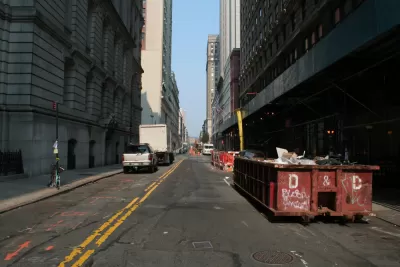
The New York City Council recently passed a bill to create waste collection zones throughout the city. "The bill, which represents years of activism, study and wrangling, aims to create a safer, more labor-friendly and environmentally sustainable industry, in which trucks travel shorter routes and recycling rates improve under a franchised system overseen by the Department of Sanitation," writes Matthew Flamm.
The new law will create 20 zones across the city’s five boroughs with each zone serviced by three carters. Advocates say that the new system will cut down on greenhouse gas emissions and also make streets safer for pedestrians, cyclists, and workers. Labor unions were split in their support, and other opponents argued that the bill would increase service costs for small businesses and put smaller waste operators out of business.
"[Department of Sanitation Commissioner Kathryn Garcia] led the development of the plan over the past three years, following a de Blasio administration report in 2016 that determined the introduction of waste collection zones could reduce truck traffic by 49% to 68%," notes Flamm.
FULL STORY: City Council passes historic waste zone bill

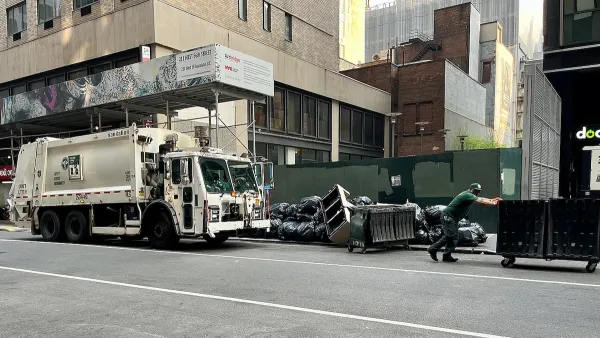
Parked Cars Hamper NYC Trash Containerization Effort
Sanitation workers must manually collect bags from containers blocked by parked cars, slowing a process that is meant to be safer and more efficient.
New York to Cut Sidewalk Trash Service by 40 Percent
Budget cuts will force the Department of Sanitation to cut sidewalk trash collection by nearly half.
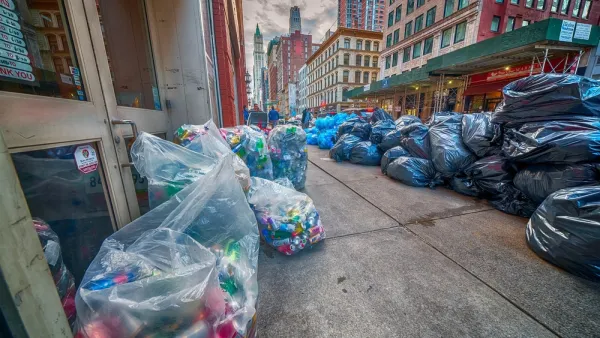
New York Garbage ‘Containerization’ Pilot Not Replicable at Scale
The city’s sanitation department says the program, while successful on one block, would be too difficult and expensive to implement citywide.

Planetizen Federal Action Tracker
A weekly monitor of how Trump’s orders and actions are impacting planners and planning in America.

The state-sanctioned urbicide of Austin
People don’t kill cities. Freeways do.

US to reduce Colorado River water deliveries to Mexico
A new Colorado Treaty amendment reduces Mexico’s Colorado River water allocation by 250,000 acre feet.

Baltimore to break ground on $50 million Transit Priority Project
The project will bring faster bus trips, safer streets and better bike connections to Baltimore.

Airbnb launches $250 million 'last-dollar financing' housing accelerator, makes first investment in Austin
The company will put $6.4 million towards affordable housing development in Texas’ capital.

Guerilla urbanists are building DIY bus stop benches in Chicago
A before-and-after of one of the bus stops with a new bench. The new benches are not officially sanctioned or permitted, but the residents who placed them hope they will be the start of a network of DIY benches across the city.

FREE Course: Walkable City 1: Why Walkability?
After describing his path towards focusing on walkability as the essence of good planning, Jeff Speck marches through his five principal reasons for making more walkable places.
Reinventing Malls: Planning Alchemy—Turning Gray Fields Into Gold
The course focuses on the opportunities and imperatives that shape reinvention of mall sites.

Eagle County Government
Harvard University Graduate School of Design
Nashville Planning Department
The Architects Foundation
University of Cincinnati Online
The Pocatello Development Authority
The Urban Renewal Agency of the City of Pocatello
Journal of the American Planning Association