Previously unreleased plans reveal a ‘greenwashed’ plan to expand the roadway with minimal commitment to connectivity and multimodal infrastructure.


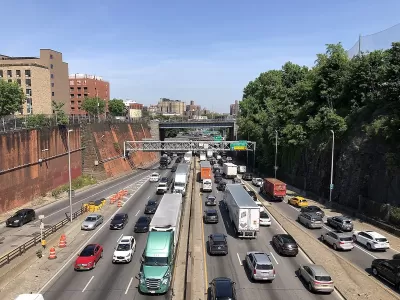
The New York State Department of Transportation is planning another expansion to the Cross Bronx Expressway, according to an article by Dave Colon in Streetsblog NYC. The information came from a Freedom of Information law request filed by Streetsblog.
“As part of a project to replace an elevated section of the Cross Bronx Expressway between Webster and Third avenues beginning in 2027, the state DOT is also moving ahead with a second piece of its so-called ‘community connector’ beyond what it is already planning between Boston Road and Rosedale Avenue.” While the agency claims the project will “tentatively include” a bus priority lane and shared use path, Colon calls this ‘greenwashing.’
Colon adds, “The project is being pitched as stitching the Bronx back together after it was torn apart by highways, but it is, as a practical matter, a five-mile long service road for the Cross Bronx itself.”
The vast majority of the proposed road would be new construction, and Colon points out that “The project itself also works directly against the goals of the project to cap below grade sections of the Cross Bronx Expressway, which the federal, state and city DOT are currently working on. If the connector road project was completed as envisioned, the parks created on the capped sections of the highway would be bound in by the 45-mile-per-hour connector road.”
Read the full story: Highway Boondoggle: State DOT Already Planning Another Piece of Cross Bronx Expansion Project

Mamdani to Revive Multiple Complete Streets Projects Killed by Adams
NYCDOT will restore several proposed bike and bus lanes.
UPS trucks blocked NYC bus lanes 25,000 times last year
The city recorded 843,000 bus lane violations in 2025.
NYC Will Extend Madison Ave Bus Lane by 19 Blocks
The project support Mayor Mamdani’s promise of making New York buses ‘fast and free.’

Planetizen Federal Action Tracker
A weekly monitor of how Trump’s orders and actions are impacting planners and planning in America.

Amtrak, CN end decades-long dispute with eight-year agreement
The new operating agreement establishes an updated framework for the companies to work together, including processes to resolve disputes.

Judges permit Denver to divert 77,000 acre feet from the Colorado River for reservoir expansion
Overuse and climate change have caused the Colorado River’s water levels to plummet.

NYC DOT wants faster, more permanent street upgrades
The city is examining ways to build more concrete infrastructure without getting entangled in 'decades-long' projects.

'Something we’ve never seen before:' rising utility rates could strain city finances nationwide
Data centers, climate change and other factors have caused utility rates in the United States to increase by 38% since 2020.

Trump to overrule local leaders, lease millions of acres of America’s Pacific Island territories’ seafloors to mining companies
International law says that the Indigenous people of America’s territories have a right to prior and informed consent regarding projects that impact their countries.

FREE Course: Walkable City 1: Why Walkability?
After describing his path towards focusing on walkability as the essence of good planning, Jeff Speck marches through his five principal reasons for making more walkable places.
Reinventing Malls: Planning Alchemy—Turning Gray Fields Into Gold
The course focuses on the opportunities and imperatives that shape reinvention of mall sites.


Harvard University Graduate School of Design
KFH Group Inc.
Greater Baltimore Committee
The Architects Foundation
University of Cincinnati Online
The Pocatello Development Authority
The Urban Renewal Agency of the City of Pocatello