Planners call them “express lanes,” but make no mistake, they are congestion pricing in action, and they're successful. The Bay Area network of what the Federal Highway Administration calls “high-occupancy toll (HOT) lanes” is growing.


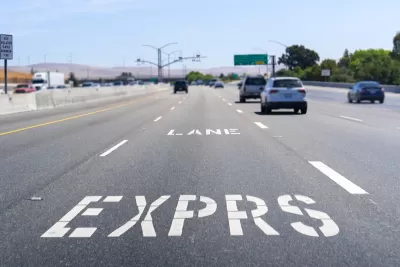
As the nation's first application of cordon pricing prepares to launch at the end of June, it's important to note that congestion pricing is alive and well on many of the nation's busiest highways.
The San Francisco Chronicle published a full page article on April 29 on what it's former transportation reporter, Michael Cabanatuan, call's “a primer on what you need to know about express lanes” in the nine-county San Francisco Bay Area.
“Express lanes are carpool lanes that drivers with fewer than the requisite number of carpool passengers can buy their way into," writes Cabanatuan in the first of 14 sections to define this particular form of road pricing. Interestingly, the term, “congestion pricing,” is never used, but is defined in the fifth section, “How much does it cost to use an express lane?"
The toll varies depending on the amount of traffic in the regular traffic lanes as well as the traffic speed in the express lanes. As traffic meters indicate congestion is worsening on a stretch of freeway, the toll rises; as congestion eases, the toll drops.
The minimum toll on Bay Area express lanes is 50 cents for a trip that may range from less than a mile to a couple of miles. There is, at least in theory, no maximum toll.
Not 'just' a toll lane
Rather than using the Federal Highway Administration term, High-Occupancy Toll (HOT) Lanes, Cabanatuan opted for ‘hybrid toll-carpool lanes.’
Carpoolers get in for free or at a discounted rate — though if they use the express lanes, they need to have a FasTrak Flex transponder. This second-generation electronic toll tag includes a switch for drivers to indicate the number of occupants in their vehicle: one, two, or three or more.
Why have express lanes?
Express lanes are an offshoot of carpool lanes, which limit access to those who carpool. “The idea behind express lanes is to improve the performance of a freeway by making carpool lanes perform more efficiently by carrying more vehicles, according to John Goodwin, spokesperson for the Metropolitan Transportation Commission,” explains Cabanatuan. “This is done by selling 'extra' room in the lanes to people willing to pay a toll.”
Multiple agencies
Similar to public transit in the 9-county Bay Area, there is no one single authority in charge.
Four different agencies — the Metropolitan Transportation Commission, the Santa Clara Valley Transportation Authority, the Alameda County Transportation Commission and the San Mateo County Express Lanes Joint Powers Authority — control and operate different express lanes, but all have agreed to the common hours.
The equity issue
Cabanatuan saves for last what arguably is the most-voiced objection to what were once called ‘Lexus lanes.’ Melanie Curry, editor of Streetsblog California, explains the origin of that term in an October 2020 article, “Historical Perspective on Los Angeles’ Traffic Congestion Fight.”
One of the first applications of congestion pricing was on the 91 Express Lanes. Arguments for and against these lanes spanned the political spectrum, with the notion of private companies building and operating toll lanes appealing to conservatives. Meanwhile, they were denounced as "Lexus Lanes" by Senator Tom Hayden, whose politics were decidedly on the progressive/radical end of the spectrum. He claimed that they were unfair to people who couldn't afford them.
Extent of express lane network in the Bay Area
“About 215 lane-miles of freeways are collecting tolls in the Bay Area Express Lane network,” notes Cabanatuan. “Another roughly 45 lane-miles are either under construction or set for conversion from traditional carpool to express lanes.”
Read the full story: Express lanes are expanding across Bay Area highways. Here’s how they work

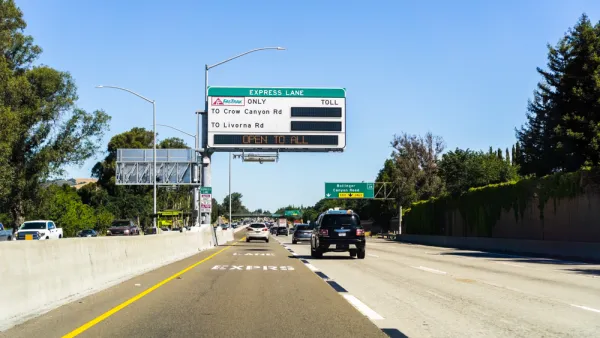
Tolling All Freeway Lanes in the Bay Area?
What's more surprising is seeing who is making the proposal and why. The first step would be to have the concept included in Plan Bay Area 2050.
The Bay Area's Coming 'Freeway Revolution'
This will not be a revolution against freeways, as some may have hoped, but a revolution marked by new express lanes totaling 550 miles, beginning with a new stretch of 14 miles on I-580 through Dublin, Pleasanton, and Livermore in the East Bay.
Tolling All Lanes
Bay Area transportation planners are studying a radical idea to reduce traffic congestion and fund driving alternatives: tolling all lanes on a freeway. Even more radical, the plan considers tolling parallel roads.

Planetizen Federal Action Tracker
A weekly monitor of how Trump’s orders and actions are impacting planners and planning in America.

California plans to bury El Niño’s downpour
If the state plays its cards right, it may be able to store a billion acre-feet of El Niño’s water in aquifers.

Chicago breaks ground on $3 billion megadevelopment
The new neighborhood, titled Foundry Park, will one day host 3,700 residences.

Move over, LA: St. Louis gears up for Olympics, invests millions in downtown redevelopment
The Missouri city will host the 2028 Olympic soccer group stage and knockout matches.

Satanic place names
From streams and lakes to valleys and canyons, I mapped more than 1,000 places named after the Devil.

California High-Speed Rail Authority CEO resigns after $600,000 scandal
Under Ian Choudri, the authority used taxpayer dollars to fund first class flights and trips to nightclubs.

FREE Course: Walkable City 1: Why Walkability?
After describing his path towards focusing on walkability as the essence of good planning, Jeff Speck marches through his five principal reasons for making more walkable places.
Reinventing Malls: Planning Alchemy—Turning Gray Fields Into Gold
The course focuses on the opportunities and imperatives that shape reinvention of mall sites.

City of Rosemead
Rutgers University, Edward J. Bloustein School of Planning and Public Policy
One Hundred Miles
Hunter College, City University of New York (CUNY)
The Architects Foundation
University of Cincinnati Online
City of Cambridge
Montrose County
The Pocatello Development Authority