Design standards that call for minimal road space allocated to bikes are limiting the growth of cycling in the city.


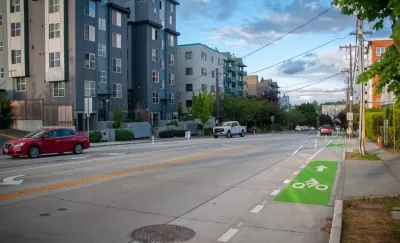
Seattle’s bike infrastructure isn’t keeping up with the city’s ambitious plan to double bicycling as part of its climate goals, writes Ryan Packer in The Urbanist. Packer provides examples of bike lane designs that limit the capacity of lanes, such as bike boxes at intersections that can only accommodate two to three bikes.
“But while the design of bike boxes will absolutely play a small role, there seems to be other, larger considerations looming that look to limit the true potential of the city’s bike network as it continues to grow.” Packer points out that the growing popularity of cargo bikes also signals a need for increased road capacity.
Yet city designs recommend minimum lane widths, putting cyclists in conflict with cars and pedestrians on some of Seattle’s busiest bikeways. “A bike route between Capitol Hill and Pike Place Market is one that clearly needs to accommodate a lot of riders. And yet the protected bike lane being installed right now on Pine Street varies quite a bit in terms of its width on different blocks downtown. Between 7th Avenue and 6th Avenue it narrows to about four-feet wide, raising questions about the city’s ability to maintain it with the electric bike lane sweeper.”
Packer suggests that updated design standards should “leave the idea of ‘minimum’ standard widths behind and push the city to be more forward-thinking about its bikeway (and sidewalk) width standards, with the goal of full alignment with lofty goals laid out in places like the Climate Change Response Framework.”
FULL STORY: Seattle Is Building a Citywide Bike Network That Cannot Handle Its Own Popularity


Seattle Introduces Electric Bike Lane Sweeper
The city will test the efficacy and durability of an electric bike lane sweeper during a six-month pilot program.
Seattle Redesigns Long-Delayed Ballard Bike Trail
Seattle officials hope a simplified design that avoids relocating railroad tracks will let the decades-old Ballard bike trail project move forward.
Salt Lake City opens protected bike path on viaduct trail
The 400 South Viaduct Trail features the state's longest continuous piece of public art.

The state-sanctioned urbicide of Austin
People don’t kill cities. Freeways do.

US to reduce Colorado River water deliveries to Mexico
A new Colorado Treaty amendment reduces Mexico’s Colorado River water allocation by 250,000 acre feet.

New Jersey’s second-largest city bans standalone data centers
Jersey City will continue to allow co-location facilities, such as those meant for research institutions that store their own data.

Amtrak not solely to blame for New Jersey commuter rail's unreliability, report finds
A new study from the Garden State Initiative found that NJ Transit’s budget grew 20% across a 4 year period, but reliability declined significantly over the same period.

EPA erases limits on planet-warming pollution from power plants
Under Monday’s plan, power plants would still have some limits on how much mercury, arsenic and other contaminants they can emit.

Phoenix announces new on-demand transit service, more frequent RAPID buses
Both new services will launch in October, and are part of Phoenix's Project Effective Access Solutions for Easing Congestion.

FREE Course: Walkable City 1: Why Walkability?
After describing his path towards focusing on walkability as the essence of good planning, Jeff Speck marches through his five principal reasons for making more walkable places.
Reinventing Malls: Planning Alchemy—Turning Gray Fields Into Gold
The course focuses on the opportunities and imperatives that shape reinvention of mall sites.

Eagle County Government
Harvard University Graduate School of Design
Nashville Planning Department
The Architects Foundation
University of Cincinnati Online
The Pocatello Development Authority
The Urban Renewal Agency of the City of Pocatello
Journal of the American Planning Association