The program, aimed at supporting highway removals and other projects that work to reverse the impacts of freeway construction, is light on accountability and performance measures, according to a new report.



A report from the U.S. Government Accountability Office found that the Department of Transportation’s Reconnecting Communities Pilot Program does not have clear, measurable objectives or performance benchmarks, writes Dan Zukowski in Smart Cities Dive.
Reconnecting Communities targets projects that mitigate the damage of freeways by removing them, building accommodations for pedestrians and cyclists, or otherwise improve walkability and connectivity in the areas surrounding them. But without clear goals and measures, it could end up contributing to road expansion projects and band-aid solutions that only superficially improve neighborhood connectivity.
The report recommended that the Department of Transportation take three key steps to improve the program:
-
Establish performance measures in line with the program’s objectives.
-
Develop a plan to collect and analyze data from the program aimed at evaluating results.
-
Find a way to share learnings from the program, such as whether the DOT is attracting enough high-quality projects and whether they can be completed in a reasonable timeframe.
Read the full story: DOT’s Reconnecting Communities highway removal program lacks performance measures: GAO report

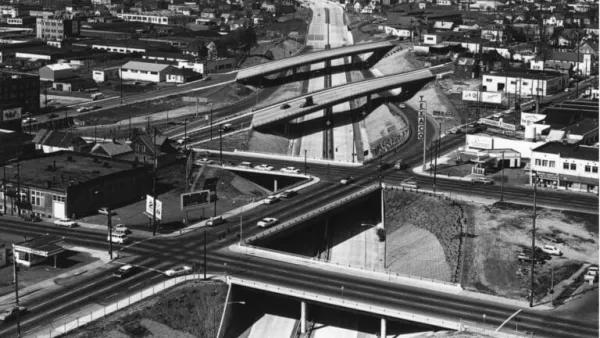
Will the Reconnecting Communities Program Survive Trump?
A freeway cap in Portland, Oregon is in jeopardy. But the visionary “restorative redevelopment” next door goes on.

Congress Moves to End Reconnecting Communities and Related Grants
The House Transportation and Infrastructure Committee moved to rescind funding for the Neighborhood Equity and Access program, which funds highway removals, freeway caps, transit projects, pedestrian infrastructure, and more.
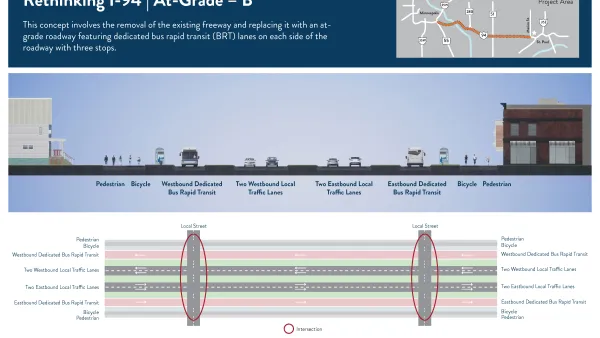
More Options Presented for Minneapolis I-94 Project
Two new proposals for replacing the freeway with at-grade segments offer new visions for the future of downtown Minneapolis.

Planetizen Federal Action Tracker
A weekly monitor of how Trump’s orders and actions are impacting planners and planning in America.

California plans to bury El Niño’s downpour
If the state plays its cards right, it may be able to store a billion acre-feet of El Niño’s water in aquifers.

Chicago breaks ground on $3 billion megadevelopment
The new neighborhood, titled Foundry Park, will one day host 3,700 residences.

Satanic place names
From streams and lakes to valleys and canyons, I mapped more than 1,000 places named after the Devil.

California High-Speed Rail Authority CEO resigns after $600,000 scandal
Under Ian Choudri, the authority used taxpayer dollars to fund first class flights and trips to nightclubs.

Want to study the Missouri River? Soon, you may need unanimous approval from 10 states
Legislation would require 10 governors’ permission to study or build projects moving water outside the basin.

FREE Course: Walkable City 1: Why Walkability?
After describing his path towards focusing on walkability as the essence of good planning, Jeff Speck marches through his five principal reasons for making more walkable places.
Reinventing Malls: Planning Alchemy—Turning Gray Fields Into Gold
The course focuses on the opportunities and imperatives that shape reinvention of mall sites.

City of Rosemead
Rutgers University, Edward J. Bloustein School of Planning and Public Policy
One Hundred Miles
Hunter College, City University of New York (CUNY)
The Architects Foundation
University of Cincinnati Online
City of Cambridge
Montrose County
The Pocatello Development Authority