A third party analysis predicts that the revenue brought in by development along the proposed streetcar line would bring in sufficient revenue to cover initial costs.



The Omaha streetcar project is one step closer to reality after an independent consulting firm, MuniCap, concluded that the financial plan presented by the city is viable and would stimulate more than enough revenue to cover the cost of the project. As Jessica Wade reports for the Omaha World-Herald, the revenue projections in the analysis surpass prior estimates.
“MuniCap’s analysis leans heavily on assumptions, including estimates of future property values, the rate of tax credits, the strength of Omaha’s economy and little change in zoning laws,” Wade explains. “If those assumptions hold, the firm predicts that a special district along the streetcar route will see more than $600 million in tax-increment financing revenues through 2057.”
The plan relies on $80 million in lease purchasing bonds and $360 million in redevelopment bonds to cover capital costs, which would be repaid by tax-increment financing (TIF). After the streetcar is built, “New developments on three blocks on either side of the streetcar would contribute 25% of their TIF proceeds. That element alone is projected to generate more than $421 million.”
FULL STORY: Analysis of Omaha streetcar financial plan predicts development will cover project cost


Omaha Mayor’s Proposal Would Build 1,900 New Housing Units Along Streetcar Line
Mayor Ewing introduced a new plan that would allow the city to begin distributing affordable housing financing as early as next year.

Omaha Streetcar Yielding $1.5 Billion in TIF Funds
The line, scheduled for completion in 2027, is bringing billions in new investment to the city’s urban core.
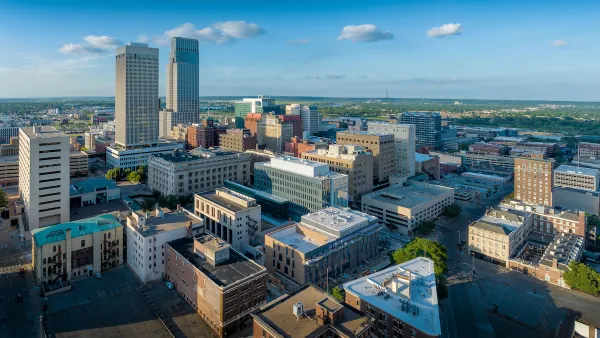
Omaha Streetcar Breaks Ground
The city aims to bring back its once-extensive streetcar network.

Planetizen Federal Action Tracker
A weekly monitor of how Trump’s orders and actions are impacting planners and planning in America.

The state-sanctioned urbicide of Austin
People don’t kill cities. Freeways do.

US to reduce Colorado River water deliveries to Mexico
A new Colorado Treaty amendment reduces Mexico’s Colorado River water allocation by 250,000 acre feet.

5 New England states march closer to 800 megawatt wind energy project
Securing federal approval for the project may be complicated under the Trump administration, which has historically been hostile towards domestic wind power.

Baltimore to break ground on $50 million Transit Priority Project
The project will bring faster bus trips, safer streets and better bike connections to Baltimore.

Airbnb launches $250 million 'last-dollar financing' housing accelerator, makes first investment in Austin
The company will put $6.4 million towards affordable housing development in Texas’ capital.

FREE Course: Walkable City 1: Why Walkability?
After describing his path towards focusing on walkability as the essence of good planning, Jeff Speck marches through his five principal reasons for making more walkable places.
Reinventing Malls: Planning Alchemy—Turning Gray Fields Into Gold
The course focuses on the opportunities and imperatives that shape reinvention of mall sites.

Eagle County Government
Harvard University Graduate School of Design
Nashville Planning Department
The Architects Foundation
University of Cincinnati Online
The Pocatello Development Authority
The Urban Renewal Agency of the City of Pocatello
Journal of the American Planning Association