Car commuting rates are returning to pre-pandemic levels, while public transit and active transportation rates are slower to recover.


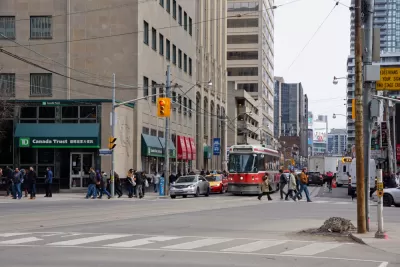
Canada’s car commuters are returning to the country’s roads while transit ridership continues to lag, reports Oliver Moore in the Globe and Mail.
“Overall, the 2021 census showed that the number of car commuters – which the agency defines as drivers or passengers who go to work in a car, truck or van – was 12.8 million a day, about the same as in 2016, Statistics Canada said.” Meanwhile, “About two million Canadians a day commuted routinely by transit before COVID-19 hit, a figure that sagged to 1.2 million during the pandemic.”
According to Moore, Statistics Canada points out that “In many Canadian cities, the result has been a split between those who can choose to avoid transit and those who have no other viable options,” with women, immigrants, and people of color continuing to use transit at higher rates.
Modes like biking and walking also remained at lower levels than before the pandemic, despite efforts to improve pedestrian and bike infrastructure. "Statistics Canada found that the number of people who commuted by active transportation – walking or cycling – fell by 26.2 per cent from 2016 to 2021. The agency attributes that to job losses in sectors whose employees rely disproportionately on these methods of commuting."
Read the full story: After pandemic dip, commuters are back on the road

Transit Ridership Continues its Slow Recovery
Ridership grew by 16 percent between 2022 and 2023.
Opinion: How to Save D.C. Transit
Ridership data shows that many D.C. transit users depend on the service, despite a drop in ridership. The system needs changes—and funding—to have a future.

Post-Pandemic Travel Patterns Call for Different Transit Schedules
As remote work and changed commuting patterns endure, transit agencies are shifting their focus to serve a wider variety of riders.

Planetizen Federal Action Tracker
A weekly monitor of how Trump’s orders and actions are impacting planners and planning in America.

The state-sanctioned urbicide of Austin
People don’t kill cities. Freeways do.

Colorado’s Largest Data Center Could Rise Next to Homes — Without a Public Hearing
The proposed campus would consume 11 times the power of Denver International Airport; as it has across the country, opposition mounts.

Judges permit Denver to divert 77,000 acre feet from the Colorado River for reservoir expansion
Overuse and climate change have caused the Colorado River’s water levels to plummet.
Amtrak, CN end decades-long dispute with eight-year agreement
The new operating agreement establishes an updated framework for the companies to work together, including processes to resolve disputes.

Raised interest rates may kill financially vulnerable construction projects
The chief economist at ConstructConnect warns that if construction project owners are negatively impacted by the raised rates, it could result in delayed payments to contractors.

FREE Course: Walkable City 1: Why Walkability?
After describing his path towards focusing on walkability as the essence of good planning, Jeff Speck marches through his five principal reasons for making more walkable places.
Reinventing Malls: Planning Alchemy—Turning Gray Fields Into Gold
The course focuses on the opportunities and imperatives that shape reinvention of mall sites.

KFH Group Inc.
Greater Baltimore Committee
Eagle County Government
The Architects Foundation
University of Cincinnati Online
The Pocatello Development Authority
The Urban Renewal Agency of the City of Pocatello