After facing a series of setbacks, the plan to rehabilitate and expand train tunnels under the Hudson River is moving forward thanks to new federal support.


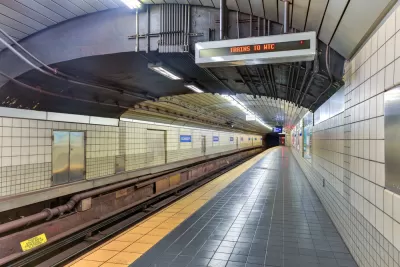
The tunnel linking New Jersey and New York by train under the Hudson River, first built more than a century ago, will undergo a $16 billion repair and expansion project starting in 2024 after the Gateway Development Commission took control of the project in September. As Dan Zukowski explains in Smart Cities Dive, “Legislation enacted separately by New York and New Jersey created the GDC in 2019. The commissioners include representatives of both states and Amtrak, which owns the tunnel and the rail line.”
Zukowski describes the project’s decade-plus history, noting that, despite a series of past delays, “With a more Amtrak-friendly Biden White House and money from the bipartisan infrastructure law, the tunnel project looks to be moving ahead.”
“Plans to add capacity with an additional tunnel go back to at least 2009, when work began on a project killed a year later by then-New Jersey Gov. Chris Christie. But Superstorm Sandy in 2012 flooded the tunnels with saltwater, damaging electrical and mechanical equipment and creating cracks in the concrete walls.”
The project could be completed in 2035. “After completing the new tunnel, the GDC will spend three years rehabilitating the existing tunnels, ultimately doubling track capacity to reduce delays and increase service.”
FULL STORY: $16B Hudson tunnel project for Amtrak set to begin construction in late 2024

New Penn Station design won't move Madison Square Garden
Amtrak and federal officials agreed on a new plan for the station's redesign that may be largely funded by the federal government.
Amtrak to Resume NYC-to-Albany Service After Pressure From Gov. Hochul
Amtrak suspended most service between New York City and the state capital last May as part of work on a project to repair damage from Hurricane Sandy.
NYC-to-Scranton Train Advocates Confident About Project’s Future
State transportation officials say the effort to restore passenger rail service between Scranton and New York City is moving full steam ahead despite remaining challenges.

Planetizen Federal Action Tracker
A weekly monitor of how Trump’s orders and actions are impacting planners and planning in America.

The state-sanctioned urbicide of Austin
People don’t kill cities. Freeways do.

US to reduce Colorado River water deliveries to Mexico
A new Colorado Treaty amendment reduces Mexico’s Colorado River water allocation by 250,000 acre feet.

Mamdani overhauls NYC's Vision Zero plan with 100 new policy goals
The overhaul aims to reduce traffic deaths and make streets safer for pedestrians, cyclists and drivers through lower speed limits, new safety infrastructure and more.

Amtrak not solely to blame for New Jersey commuter rail's unreliability, report finds
A new study from the Garden State Initiative found that NJ Transit’s budget grew 20% across a 4 year period, but reliability declined significantly over the same period.

EPA erases limits on planet-warming pollution from power plants
Under Monday’s plan, power plants would still have some limits on how much mercury, arsenic and other contaminants they can emit.

FREE Course: Walkable City 1: Why Walkability?
After describing his path towards focusing on walkability as the essence of good planning, Jeff Speck marches through his five principal reasons for making more walkable places.
Reinventing Malls: Planning Alchemy—Turning Gray Fields Into Gold
The course focuses on the opportunities and imperatives that shape reinvention of mall sites.

Eagle County Government
Harvard University Graduate School of Design
Nashville Planning Department
The Architects Foundation
University of Cincinnati Online
The Pocatello Development Authority
The Urban Renewal Agency of the City of Pocatello
Journal of the American Planning Association