Three cities on the periphery of the fast-growing Treasure Valley showcase different approaches to a sudden influx of newcomers.


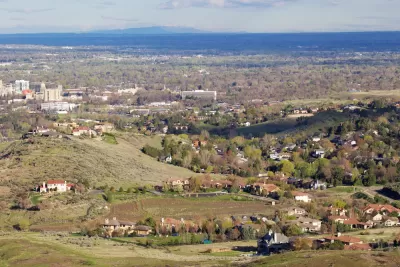
Peripheral cities are gaining prominence as the Treasure Valley around Boise continues to grow, according to a recent article by Carolyn Komatsoulis for the Idaho Press.
“For surrounding counties in the Treasure Valley, the prospect of growth means many things: It can be an added pressure on development, the potential to change the character of a community, or provide an opportunity to do things right.”
The article examines growth management case studies from three cities in counties surrounding Boise—Mountain Home, Marsing, and Emmett. Each of these cities "are feeling the impacts of local growth and development in their own backyard,” according to the article, but choosing mush different responses—distinct from each other and from the precedent set by the communities already enveloped by the region's sprawling growth.
Mountain Home, previously known mostly as the home to the Mountain Home Air Force Base, has recently been crowned as the “Mural Capital of Idaho.” Brock Cherry, community development director for Mountain Home, is quoted extensively in the article, including describing growth plans that call for “higher-density residences, commercial and industry, and a lower percentage of single-family homes compared to some cities in the Treasure Valley.”
Marsing is attempting to accommodate new growth while also preserving farmland by sticking to its comprehensive plan. Higher density development is not included in that plan—or any plans in surrounding Owyhee County.
Finally, Emmett is cited as an example of a city developing quickly while focusing resources, often financed by developers, on the infrastructure necessary to accommodate a larger population. While some cities in the region never planned for their current population, Emmett city leader say they starting planning for the current influx of new residents severn years ago.
FULL STORY: Three cities, three counties, three growth hot spots in the Treasure Valley

Cascadia Expects Millions of New Residents. Should it Build New Cities or New Density?
A recent report calls for the region stretching from Oregon to British Columbia to think big about accommodating expected population growth. The report's recommendation to build four new, large cities isn't universally accepted, however.
The Forgotten Treasure in Western Land
Will the arid West’s farms and settlements thrive for another century? Better conservation policy should take a longer view.
Planning for 1.8 Million New Residents Around Puget Sound
The state of Washington's 1990 Growth Management Act requires regions to create long-range growth plans. The Puget Sound Region Council is currently working on its latest iteration of the plan.

The state-sanctioned urbicide of Austin
People don’t kill cities. Freeways do.

US to reduce Colorado River water deliveries to Mexico
A new Colorado Treaty amendment reduces Mexico’s Colorado River water allocation by 250,000 acre feet.

New Jersey’s second-largest city bans standalone data centers
Jersey City will continue to allow co-location facilities, such as those meant for research institutions that store their own data.

Amtrak not solely to blame for New Jersey commuter rail's unreliability, report finds
A new study from the Garden State Initiative found that NJ Transit’s budget grew 20% across a 4 year period, but reliability declined significantly over the same period.

EPA erases limits on planet-warming pollution from power plants
Under Monday’s plan, power plants would still have some limits on how much mercury, arsenic and other contaminants they can emit.

Phoenix announces new on-demand transit service, more frequent RAPID buses
Both new services will launch in October, and are part of Phoenix's Project Effective Access Solutions for Easing Congestion.

FREE Course: Walkable City 1: Why Walkability?
After describing his path towards focusing on walkability as the essence of good planning, Jeff Speck marches through his five principal reasons for making more walkable places.
Reinventing Malls: Planning Alchemy—Turning Gray Fields Into Gold
The course focuses on the opportunities and imperatives that shape reinvention of mall sites.

Eagle County Government
Harvard University Graduate School of Design
Nashville Planning Department
The Architects Foundation
University of Cincinnati Online
The Pocatello Development Authority
The Urban Renewal Agency of the City of Pocatello
Journal of the American Planning Association