Councilmember Krekorian's proposal to criminalize bike repairs and sales on public right-of-way has been sharply criticized as a cynical move that will unfairly target the unhoused.



A proposal from a Los Angeles city councilmember to criminalize people who repair or sell bicycles in the public right-of-way has drawn criticism from advocates from the unhoused, reports Sahra Sulaiman for Streetsblog Los Angeles.
"The motion, part of what might best be described as Buscaino’s 'broken sidewalks' platform – the effort to position himself as The Reclaimer of Streets from Utter Lawlessness as he runs for mayor – was said to be necessary in order for law enforcement to be able to address the larger problem of bicycle theft." As Sulaiman points out, Councilmember Paul Krekorian's statement that "one hundred percent" of Metro bike share bikes had been stolen from North Hollywood is false, as the area's stations have been out of service while Metro switches out the fleet.
"The scrutiny people of color, and lower-income and unhoused people of color, in particular, face with regard to bikes more generally is already intense, disruptive, and sometimes fatal." As an example, Sulaiman describes the 2013 killing of Ricardo Díaz Zeferino by Gardena police officers. Several councilmembers raised objections to the proposed ordinance. "It’s very different when you have to think about the problems that will be created by – and the jeopardy that you’ll be put in by – a policy if you’re someone who might be targeted," said Councilmember Marqueece Harris-Dawson, who called the proposal "absolutely outrageous and beyond the pale."
Read the full story: Broad Motion by Homelessness Hardliner Takes Aim at Streetside Bike Sales and Repairs; Council Critics Call Out Political Theater
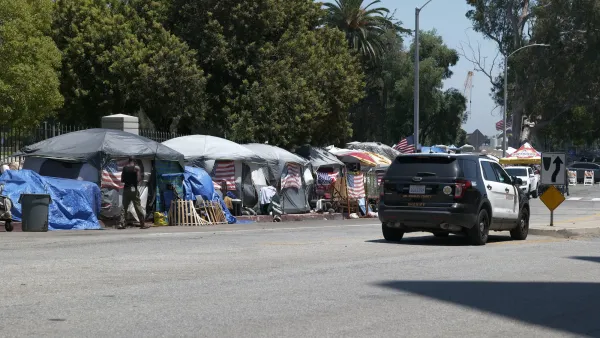
Study: LA’s Homelessness Program Displaced 5 People for Every One it Helped
Researchers say a city program designed to help people access housing and services “does not live up to its name” and has caused more harm than good.
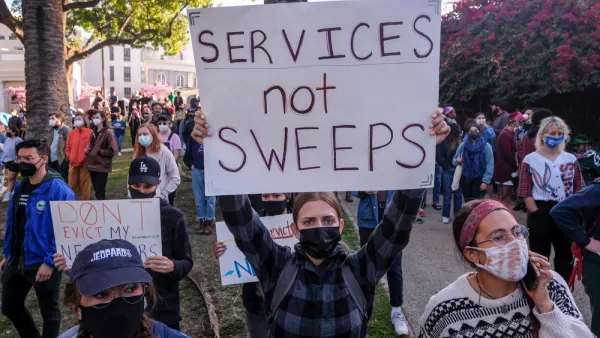
L.A. Shifts Homeless Policy to Clear Street Encampments
Advocates say L.A.'s new focus on clearing 'unsightly' homeless encampments is a political band-aid that won't help people find permanent housing.

LA has no plan — or funding — to help unhoused people displaced by Olympics security efforts
City and county officials say they don't have the funds to offer housing to the up to 1,600 people that will be displaced by perimeters around event venues.

Planetizen Federal Action Tracker
A weekly monitor of how Trump’s orders and actions are impacting planners and planning in America.

California plans to bury El Niño’s downpour
If the state plays its cards right, it may be able to store a billion acre-feet of El Niño’s water in aquifers.

Desperate measures: Advocates weigh draining Lake Powell to fill Colorado River
Draining the reservoir could reduce evaporation losses by a couple hundred thousand acre-feet.

Mamdani’s pied-à-terre tax survives legal challenge
A panel of judges found that the plaintiffs failed to demonstrate injury as a result of New York City's implementation of the tax.

Eastern Nebraska is running out of electricity
Data centers and electrification are straining eastern Nebraska’s grid, throttling economic development.

Seattle passes record-breaking transit services expansion
Proposition 1 will double the city’s transit tax to add 95,000 more bus trips and preserve 180,000 bus trips annually.

FREE Course: Walkable City 1: Why Walkability?
After describing his path towards focusing on walkability as the essence of good planning, Jeff Speck marches through his five principal reasons for making more walkable places.
Reinventing Malls: Planning Alchemy—Turning Gray Fields Into Gold
The course focuses on the opportunities and imperatives that shape reinvention of mall sites.

City of Rosemead
Rutgers University, Edward J. Bloustein School of Planning and Public Policy
One Hundred Miles
University of Michigan School for Environment and Sustainability (SEAS)
Hunter College, City University of New York (CUNY)
The Architects Foundation
City of Cambridge
Montrose County
The Pocatello Development Authority