A roundup of news on the planning-related consequences of the reported demise of the Build Back Better Act—a $2 trillion social spending bill intended to accompany the Infrastructure Investment and Jobs Act approved earlier this year.



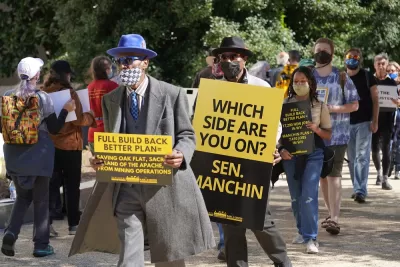
By now you have probably seen the news that the $2 trillion social spending bill known as the Build Back Better Act (BBB) has been dealt what appears to be a final defeat by U.S. Senator Joe Manchin (D-West Virginia). The bill, once included as a portion of a larger budget reconciliation bill, was split off from the Infrastructure Investment and Jobs Act (IIJA) to ensure the latter's approval in November, but with the promise of a consensus on BBB by the end of the year.
The demise of BBB means hundreds of billions in potential projects and programs directly related to the field of planning have suddenly vanished. Planetizen will continue to monitor the news for more insight into the consequences of BBB's failure for planners around the country, but a roundup of what we have found so far follows. So far, articles can be organized into two categories: climate change and political intrigue. As of this writing, there is not yet post-Manchin news and commentary on the placed-based initiatives, affordable housing programs, and zoning reform programs proposed in BBB.
Climate Change
- Joe Manchin may have doomed American climate policy (Vox, December 19)
- Manchin Rejects Landmark Legislation, Putting Biden’s Climate Goals at Risk (The New York Times, December 19)
- Manchin says Build Back Better's climate measures are risky. That's not true (NPR, December 19)
- Manchin’s opposition to Build Back Better bill undercuts Biden’s climate agenda (The Washington Post, December 19)
- Manchin killing Build Back Better is ‘devastating’ to climate change action, experts say (Yahoo News, December 20
- 'I'm kind of speechless': Democrats scramble to salvage climate provisions after Manchin sinks Build Back Better (CNN, December 20)
Politics
- Joe Manchin Kills the Build Back Better Bill (The New Yorker, December 19)
- Joe Manchin Just Tore Out the Heart of Biden’s Agenda (Rolling Stone, December 19)
- Schumer vows vote on Build Back Better legislation despite Manchin’s opposition (The Washington Post, December 20)


'Inflation Reduction Act' a Mixed Bag for Climate Action, Planning Innovation
A roundup of all the emerging news and commentary regarding the Inflation Reduction Act, which last week broke through a Congressional roadblock to resuscitate some, but not nearly all, of the Build Back Better legislation that failed in 2021.
Bipartisan 'Infrastructure Investment and Jobs Act' Passes the Senate
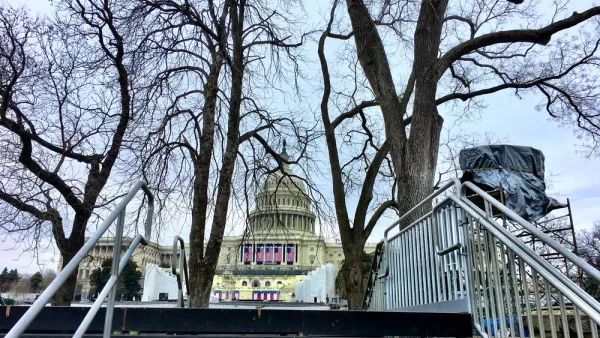
A final vote of 69-30, with 19 Republicans joining their Democratic colleagues in the Senate, will send the Infrastructure Investment and Jobs Act to the House.

The Surprising Oil Tax in the Inflation Reduction Act
President Biden has made reducing gas prices paramount in his administration, so it was likely a surprise to hear a Republican senator last Sunday warn TV viewers that a revived and increased oil fee in the climate bill will increase their gas costs.

The state-sanctioned urbicide of Austin
People don’t kill cities. Freeways do.

US to reduce Colorado River water deliveries to Mexico
A new Colorado Treaty amendment reduces Mexico’s Colorado River water allocation by 250,000 acre feet.

New Jersey’s second-largest city bans standalone data centers
Jersey City will continue to allow co-location facilities, such as those meant for research institutions that store their own data.

Amtrak not solely to blame for New Jersey commuter rail's unreliability, report finds
A new study from the Garden State Initiative found that NJ Transit’s budget grew 20% across a 4 year period, but reliability declined significantly over the same period.

EPA erases limits on planet-warming pollution from power plants
Under Monday’s plan, power plants would still have some limits on how much mercury, arsenic and other contaminants they can emit.

Phoenix announces new on-demand transit service, more frequent RAPID buses
Both new services will launch in October, and are part of Phoenix's Project Effective Access Solutions for Easing Congestion.

FREE Course: Walkable City 1: Why Walkability?
After describing his path towards focusing on walkability as the essence of good planning, Jeff Speck marches through his five principal reasons for making more walkable places.
Reinventing Malls: Planning Alchemy—Turning Gray Fields Into Gold
The course focuses on the opportunities and imperatives that shape reinvention of mall sites.

Eagle County Government
Harvard University Graduate School of Design
Nashville Planning Department
The Architects Foundation
University of Cincinnati Online
The Pocatello Development Authority
The Urban Renewal Agency of the City of Pocatello
Journal of the American Planning Association

