A roundup of all the emerging news and commentary regarding the Inflation Reduction Act, which last week broke through a Congressional roadblock to resuscitate some, but not nearly all, of the Build Back Better legislation that failed in 2021.



The Inflation Reduction Act of 2022 (IRA), has risen from the ashes of Build Back Better. Let there be no mistake, however: the $700 billion IRA is a far cry from the original ambition of Build Back Better, which fell one vote short of approval in the Senate at the end of 2021.
Fast forward to July 2022 and Congress is poised to deliver another massive piece of legislation, following the Infrastructure Investment and Jobs Act, capable of moving country in a new direction in several critical facts of contemporary life—from energy production and consumption to the engines in the nation's automobiles. The question of whether it will be enough to respond to the threats of climate change and worsening social and economic equality, or whether too much has been sacrificed to the politics of energy and transportation, is very much up for debate.
The IRA is both a climate bill and a health bill, with a promise for fiscal and economic consequences embedded in its title. To be clear, only a portion of the $700 billion in spending proposed by the bill—which has yet to clear both the House and the Senate and head to the president's signature—is directly relevant to the work of planners. The total includes $358 billion in energy and climate spending, comprising the following categories as laid out in an article by Jeff Stein, Maxine Joselow, and Rachel Roubein for the Washington Post:
- $40 billion for clean manufacturing tax credits
- $30 billion for clean energy technology
- $30 billion for clean electricity grants and loans
- $30 billion for clean agriculture funding
- $20 billion for clean vehicle manufacturing
- $235 billion for other energy and climate tax credits and spending
The Washington Post calls the IRA "the nation’s biggest-ever climate bill." Vox agrees, calling the bill, "the biggest effort to tackle climate change—ever." But some advocates and urbanists are finding fault with the IRA's approach to climate action. For example, Aex Daugherty writes for Politico that critics are pointing out that the vast majority of its approximately $50 billion in transportation-related spending to make cars greener"—with nothing for public transit. Also, as noted in the Washington Post, securing the vote of Senator Joe Manchin (D-West Virginia) required including in the bill a mandate for new oil and gas leasing in the Gulf of Mexico and off the coast of Alaska.
The political deal to clear that one-vote obstacle comes with additional conditions as well. "Manchin also said in a statement that Biden, Schumer and House Speaker Nancy Pelosi (D-Calif.) had 'committed to advancing' a permitting reform bill that would make it easier for developers to override environmental objections when building pipelines, natural gas export facilities and other energy infrastructure," according to Stein, Joselow, and Roubein in the Washington Post.
The losses from Build Back Better are also notable for planners. An article by Christian Britschgi for Reason notes that the final version of the IRA cut $900 million proposed for Build Back Better to fund energy efficiency improvements at affordable housing complexes.
The IRA also cut the Unlocking Possibilities program included in the version of Build Back Better passed by the House of Representatives in November. Unlocking Possibilities would have provided $1.6 billion in planning grants to reform local zoning codes. "The exclusion of even that tepid measure from the Inflation Reduction Act is more evidence that zoning reform is less and less of a priority for this Congress," writes Britschgi.
Still, the IRA is expected to make an incremental step toward the emissions required to prevent the worst effects of climate change. Stein, Joselow, and Roubein also report that Schumer and Manchin are claiming that the bill would reduce help the U.S. reduce its carbon emissions by roughly 40 percent by 2030—a figure in the neighborhood of President Biden’s goal to cut U.S. greenhouse gas emissions by 50 to 52 percent below 2005 levels by 2030. For an estimate from an outside observer, the Rhodium Group estimates the IRA will reduce greenhouse gas emissions 31% to 44% below 2005 levels in 2030—compared to 24% to 35% under current policy.
And in a move with huge significance—both literal and symbolic—for the political and social realities of the country, the IRA will raise $313 billion in revenue by implementing a 15 percent corporate minimum tax on all corporations that earn more than $1 billion per year in profits.
For more reading on what to expect from the IRA as it moves to the Senate for a vote this week, peruse the following roundup of planning-related news on the bill in its current state.
Details, Details
Articles that offer a breakdown of the spending programs outlined in the IRA.
- Seven Key Provisions in the Climate Deal (The New York Times, July 28)
- How the Schumer-Manchin climate bill might impact you and change the U.S. (The Washington Post, July 28)
- A Congressional Climate Breakthrough (Rhodium Group, July 28)
- What Democrats’ big new bill would actually do (Vox, July 28)
- Inflation and climate change tackled in new Senate deal that Biden calls 'historic' (National Public Radio, July 28)
- The Inflation Reduction Act is also an enormous climate bill. What’s in it? (Fast Company, July 28)
- What's in the Democrats' climate and energy legislation (Politico, July 28)
- Biden’s climate plan is back, and it’s all about building things (The Verge, July 28)
- Here are the biggest technology wins in the breakthrough climate bill (MIT Technology Review, July 28)
- 'Inflation Reduction Act': What you need to know about major effort to fight climate change (Phys.org, July 29)
- Manchin Sets High Bar for Tesla and GM Electric-Car Tax Credits (Bloomberg, July 29)
- What’s in the New ‘Climate’ Deal for Sustainable Transport — And What’s Not (Streetsblog USA, July 29)
Debate, Criticism, Commentary
Some critics say the bill won't achieve its promised outcomes for the reduction of greenhouse gas emissions or the improvement of social equity. Another key debate playing out in the media is whether the IRA will worsen inflation rather than reduce it, as promised.
- ‘It’s so blatant’: Transit groups bemoan Dems’ car-centric climate deal (Politico, July 28)
- Democrats’ Plan to Fight Inflation May Lower Costs Over Time (The New York Times, July 28)
- New Budget Deal Would Be a Big Win for Congress — and the Country (Bloomberg, July 28)
- Democrats’ high-spending ‘Inflation Reduction Act’ will do just the opposite (The New York Post, July 28)
- The Schumer-Manchin Bill Will Ease Inflation and Climate Change (Wall Street Journal, July 28)
- Maxine Waters Says She May Not Vote For 'Shameful' Inflation Reduction Act, Citing Lack of Housing Spending (Reason, July 28)
Public Relations
Communications from no-media organizations and individuals with interest in the success of the IRA.
- Statement from President Biden on Inflation Reduction Act of 2022 (The White House, July 27)
- Manchin Supports Inflation Reduction Act of 2022 (Sen. Joe Manchin, July 27)
- Joint Statement From Leader Schumer And Senator Manchin Announcing Agreement To Add The Inflation Reduction Act Of 2022 To The FY2022 Budget Reconciliation Bill And Vote In Senate Next Week (Senate Democrats, July 27)
- New reconciliation package includes funds for safety, access (Transportation for America, July 29)
Chatter
A few notable quips from Twitter.
https://twitter.com/publiccarbon/status/1552744037622247429?s=20&t=kOhX…
https://twitter.com/yfreemark/status/1552457108343455744?s=20&t=PPhGF9c…

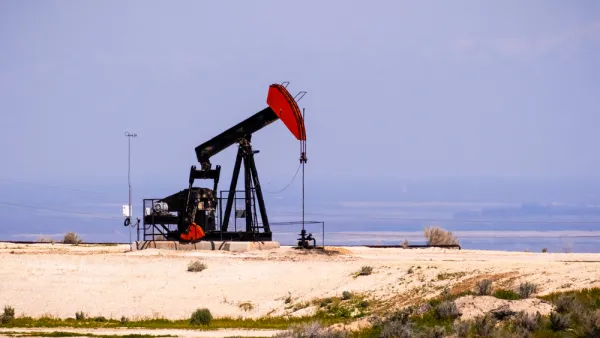
The Surprising Oil Tax in the Inflation Reduction Act
President Biden has made reducing gas prices paramount in his administration, so it was likely a surprise to hear a Republican senator last Sunday warn TV viewers that a revived and increased oil fee in the climate bill will increase their gas costs.
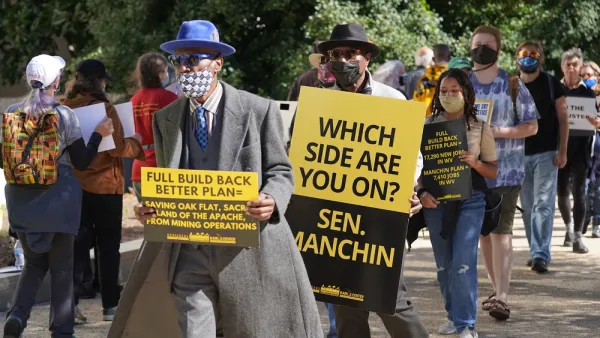
Build Back Almost: Historic Legislation Falls One Vote Short
A roundup of news on the planning-related consequences of the reported demise of the Build Back Better Act—a $2 trillion social spending bill intended to accompany the Infrastructure Investment and Jobs Act approved earlier this year.
Executive Order Pauses Infrastructure, Clean Energy Funds
Trump’s order puts a freeze on unspent funding from the Inflation Reduction Act and the Infrastructure Investment and Jobs Act.

Amtrak, CN end decades-long dispute with eight-year agreement
The new operating agreement establishes an updated framework for the companies to work together, including processes to resolve disputes.

Judges permit Denver to divert 77,000 acre feet from the Colorado River for reservoir expansion
Overuse and climate change have caused the Colorado River’s water levels to plummet.

Nation's most wind-powered state turns to coal as data centers increase energy demand
For the first time in decades, Iowa has increased its generation of coal power.

Boston has spent millions making the Green Line more accessible — and there’s no end in sight
While the city has invested millions into expanding and adding platforms to the Green Line to make it more accessible, new train cars set to arrive next year will be too tall for disabled passengers to board without raising the current platforms.

Idaho may see an 18% drop in federal surface transit funding — the largest estimated cut in the US
Transit systems in rural communities are much more reliant on federal funding to provide their services.

How ‘post-disaster gentrification’ alters neighborhoods after natural calamities
After hurricanes, fires or other calamities, the original residents of a community are often replaced by younger, wealthier residents.

FREE Course: Walkable City 1: Why Walkability?
After describing his path towards focusing on walkability as the essence of good planning, Jeff Speck marches through his five principal reasons for making more walkable places.
Reinventing Malls: Planning Alchemy—Turning Gray Fields Into Gold
The course focuses on the opportunities and imperatives that shape reinvention of mall sites.

City of Wisconsin Rapids
Harvard University Graduate School of Design
KFH Group Inc.
The Architects Foundation
University of Cincinnati Online
The Pocatello Development Authority
The Urban Renewal Agency of the City of Pocatello

