History repeats itself with the political controversies created by bike lanes.


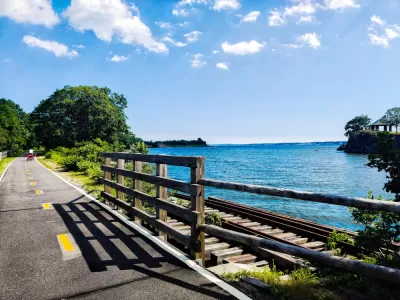
An article by Brian Amaral commences with a long list of complaints and predictions of doom lobbed against the East Bay Bike Path—linking providence to Bristol in Rhode Island—can when it was originally proposed 1983.
Despite the vehement protestations of opponents back in the early '80s, the bike path is now one of the state's most treasure infrastructure gems, "so wildly popular that one of the main concerns is how crowded it can get. Bristol now touts itself as the safest community in the state, and as crime has gone down overall, Barrington’s property values have only gone up."
Despite that track record, bike infrastructure remains controversial in Rhode Island, reports Amaral.
Today, business owners and institutions in Providence are raising concerns about a recently completed two-way protected bike lane on South Water Street. A bike lane on Eaton Street was torn up in 2019 after opposition from neighbors and the local councilwoman. A pilot program for a protected bike lane on First Street in East Providence was cut short after the City Council voted to do away with it over concerns about a confusing traffic pattern.
While acknowledging the differences between the bike lane projects of the 1980s and the present day's proposals, there are still comparisons to be made. Amaral focuses first on the First Street bike path project.
In an Oct. 1 letter to RIDOT published by the Providence Journal and signed by representatives of RISD, the food hall Plant City, Brown University, law firms, the Jewelry District Association, and others, opponents say they’re not opposed to a bike lane, just one that cuts out a lane of travel on South Water Street. (There’s enough room between the street and the Providence River for a bike lane, they argue.) They’ve said the city’s traffic studies are flawed and have asked the state Department of Transportation to intervene.
The article also compares the lessons of the East Bay Bike Path the controversies surrounding the South Water Street protected bike lane.
Read the full story: A battle over bike paths pits environmentalism and infrastructure against public safety and traffic problems


Bikelash Wins in Phoenix
Neighborhood opposition overwhelmed a plan to reduce the number of vehicles lanes on North Central Avenue to make space for a new bike lane, despite evidence of the benefits of the proposed street reconfiguration.
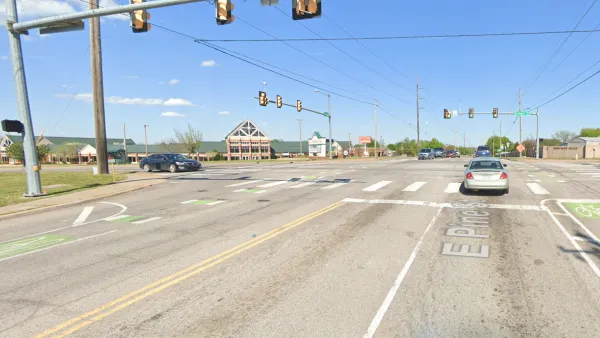
Business Owners Force Removal of New Tulsa Bike Lanes
Local politics is still an obstacle for street reconfigurations that make space for people on bikes.

Bikelash in Boise
Parents don’t want bike lanes to interfere with the pick up and drop off zone near two churches and schools in Boise.

Planetizen Federal Action Tracker
A weekly monitor of how Trump’s orders and actions are impacting planners and planning in America.

California plans to bury El Niño’s downpour
If the state plays its cards right, it may be able to store a billion acre-feet of El Niño’s water in aquifers.

Desperate measures: Advocates weigh draining Lake Powell to fill Colorado River
Draining the reservoir could reduce evaporation losses by a couple hundred thousand acre-feet.

California city breaks ground on transit connector
The project includes three mobility hubs and a pedestrian bridge.

After public outcry, Massachusetts city releases housing development tracker
Cambridge’s tracker currently shows 250 housing projects in various stages of development.

40 years after approval, Chicago breaks ground on new park
The park honors Jean Baptiste Point du Sable, the city’s first permanent non-native settler.

FREE Course: Walkable City 1: Why Walkability?
After describing his path towards focusing on walkability as the essence of good planning, Jeff Speck marches through his five principal reasons for making more walkable places.
Reinventing Malls: Planning Alchemy—Turning Gray Fields Into Gold
The course focuses on the opportunities and imperatives that shape reinvention of mall sites.

City of Rosemead
Rutgers University, Edward J. Bloustein School of Planning and Public Policy
One Hundred Miles
Hunter College, City University of New York (CUNY)
The Architects Foundation
University of Cincinnati Online
City of Cambridge
Montrose County
The Pocatello Development Authority