Transit advocates say that outdated road widening plans contradict the city's Climate Action Plan.



Despite the city's stated commitment "to cut back on car dependence by making streets safer and more oriented towards pedestrians, cyclists, and public transit" San Diego continues to widen roads based on outdated plans, reports Andrew Bowen.
One of the city's deadliest streets, El Cajon Boulevard, is slated to receive a new right-turn lane that would also shrink the footprint of the adjacent Fair@44 pedestrian plaza. Meanwhile, the permit for a trolley extension on Morena Boulevard required the re-widening of the street, creating dangerous conditions for pedestrians trying to reach the trolley station. Pedestrian and transit advocates say these and similar projects go against the city's 2015 Climate Action Plan, "which legally binds the city to cut back on driving by prioritizing less polluting modes of transportation."
"A lot of cities, including San Diego, haven't caught up to the value statements that their elected officials have signed onto," says Colin Parent, executive director of the nonprofit think tank Circulate San Diego. "Parent added that the city had to find a balance between redoing its old plans while not letting that work delay important projects like the trolley extension through Bay Park or the affordable housing project on El Cajon Boulevard."
Read the full story: San Diego Pledged To Shift Away From Cars. So Why Is It Still Widening Roads?

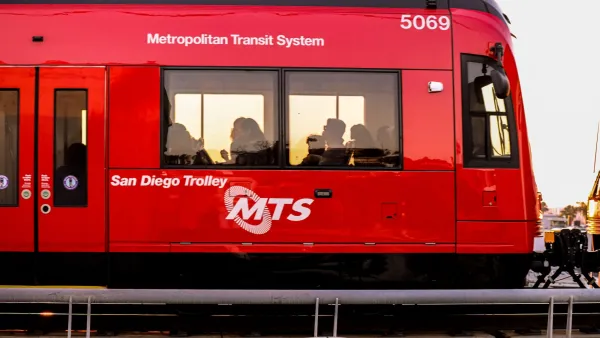
San Diego Regional Transportation Plan Shifts Away From Big Projects to Focus on Improving Existing Infrastructure
SANDAG’s 2025 Regional Plan scales down plans for new rail lines in favor of expanding rapid bus service.
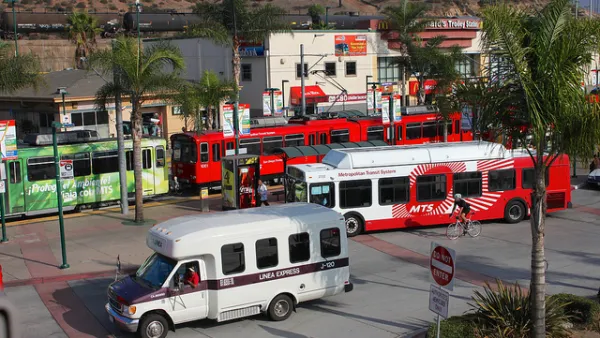
Report: San Diego Transportation Plan Won't Meet Climate Goals
A regional plan announced by the San Diego Association of Governments will fall short of the city's goals to increase alternate mode trips to 50 percent, report finds.
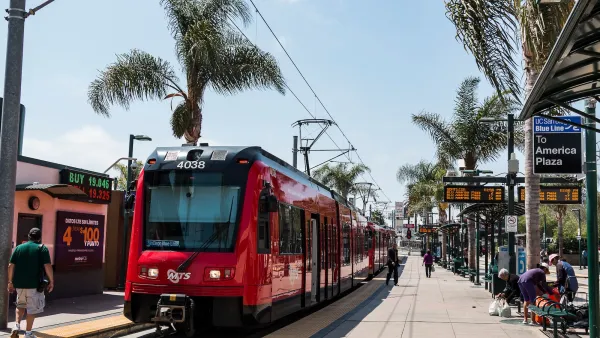
San Diego could raise fares for North County buses and trolleys
A SANDAG committee voted to raise single-ride fares from $2.50 to $3.

Planetizen Federal Action Tracker
A weekly monitor of how Trump’s orders and actions are impacting planners and planning in America.

California plans to bury El Niño’s downpour
If the state plays its cards right, it may be able to store a billion acre-feet of El Niño’s water in aquifers.

Chicago breaks ground on $3 billion megadevelopment
The new neighborhood, titled Foundry Park, will one day host 3,700 residences.

Satanic Place Names
From streams and lakes to valleys and canyons, I mapped more than 1,000 places named after the Devil.

California High-Speed Rail Authority CEO resigns after $600,000 scandal
Under Ian Choudri, the authority used taxpayer dollars to fund first class flights and trips to nightclubs.

Want to study the Missouri River? Soon, you may need unanimous approval from 10 states
Legislation would require 10 governors’ permission to study or build projects moving water outside the basin.

FREE Course: Walkable City 1: Why Walkability?
After describing his path towards focusing on walkability as the essence of good planning, Jeff Speck marches through his five principal reasons for making more walkable places.
Reinventing Malls: Planning Alchemy—Turning Gray Fields Into Gold
The course focuses on the opportunities and imperatives that shape reinvention of mall sites.

City of Rosemead
Rutgers University, Edward J. Bloustein School of Planning and Public Policy
One Hundred Miles
Hunter College, City University of New York (CUNY)
The Architects Foundation
University of Cincinnati Online
City of Cambridge
Montrose County
The Pocatello Development Authority