President Joe Biden might consider observing the actions of his French counterpart to learn of successful strategies to deal with the COVID-19 vaccine-hesitant and resistant population.



Vaccine hesitancy is not restricted to American shores, and the United States is certainly not the only country to encounter a coronavirus resurgence driven by the Delta variant first identified in India.
In France, 40% of the population is fully vaccinated against COVID-19, the same level as hard-hit Missouri, according to The New York Times' global and U.S. vaccination databases, respectively, on July 17. In the United States, 48.5% of the population is fully vaccinated, according to the Centers for Disease Control and Prevention.
[Contributor's note: The bottom of this post also includes a coronavirus update on Great Britain, which is more vaccinated than the United States.]
"Hoping to combat a possible new wave of coronavirus infections, President Emmanuel Macron of France on Monday announced [impending] new vaccination requirements, including mandatory inoculation for health care workers and proof of immunization or a recent negative test to enter restaurants and cultural venues," reported Constant Méheut from The New York Times' Paris bureau on July 12.
But it was highly uncertain whether the measures would be enough to avoid a fourth wave of the virus powered by the fast-spreading Delta variant, which already accounts for about half of new infections in France.
Compulsory vaccinations for health care workers
"The vaccine remains the only way to protect yourself and others," said Macron in his address to the French people on July 12.
We must move towards the vaccination of all French people because it is the only way to return to normal life.
Vaccination will thus be made compulsory for nursing and non-nursing staff in hospitals, clinics, retirement homes, establishments for people with disabilities, for all professionals or volunteers who work in contact with the elderly or frail, including at home.
Vaccine verification
However, the real impetus to be vaccinated, particularly among the demographic most resistant to vaccinations, came with the second strategy Macron outlined in his address, a vaccination requirement in order to gain access to many businesses.
➜ From July 21 , the health pass will be extended to places of leisure and culture.
➜ From August , the health pass will apply in cafes, restaurants, shopping centers, as well as in hospitals, retirement homes, medico-social establishments and in long-distance transport.
“If you want to be free and responsible, you vaccinate — your choice and your consequences,” said Jacques Rupnik, a political scientist, in an analysis written by Roger Cohen of the Times published July 14.
“That was the president’s message. The risk, however, is of a dual, or two-speed, society.”
That risk was put most bluntly by Michèle Rivasi, a Green member of the European Parliament with a history of vaccination skepticism, who declared, “This is apartheid in the land of human rights.”
How do you spell success?
The more than 2.2 million people who signed up to get vaccinated in the 48 hours since Mr. Macron spoke appeared not to agree with Ms. Rivasi. Their haste suggested that all the French needed to get the vaccine was a powerful prod of a kind not seen up to now.
Legislation would mandate vaccinations of health care workers
Unlike the United States, where the Centers for Disease Control and Prevention issues recommendations that states often follow, Macron would take a more forceful, centralized approach, working with Parliament to pass the vaccine policy. He stated "that the goal was now to 'put restrictions on the unvaccinated rather than on everyone'," wrote Méheut and Anna Schaverien of the Times' London bureau in the source article on July 13.
The law is likely to pass this summer as most political parties are in favor of mandatory vaccinations for health care workers.
The government aims to get two-thirds of people fully protected by the end of August, but public demand has dwindled in recent weeks because of vaccine hesitancy and a growing sense among many people that the virus is no longer a threat.
Great Britain update
"Doctors in Britain have warned that Prime Minister Boris Johnson’s plan to lift almost all of England’s coronavirus-related restrictions starting July 19 could have 'potentially devastating consequences' as the Delta variant spreads, add Méheut and Schaverien.
Britain is more vaccinated against COVID-19 than the United States, with 53% of the population fully vaccinated and 69% receiving at least one dose, compared to the U.S with 48% and 59%, respectively, according to the Times' U.K. and U.S. coronavirus databases on July 17.
Despite the superior vaccination levels, cases are surging in the U.K. After Indonesia, it has the most daily new cases in the world, averaging 42,350 on July 17 according to the Times' global tracker, which translates to 63 daily new cases per 100,000 people. The United States is averaging nine per 100k, with Arkansas seeing the most per capita infections at 34 per 100k.
Hat tip to Jonathan Wolfe who writes the coronavirus newsletter. The source article appeared as one of two reports under "vaccine rollout" in the July 13 briefing.
Related in Planetizen:
- Prolonging the Pandemic: A Public Health Expert Faults the Biden Administration, July 12, 2021
- Coronavirus Litigation: Can Employers Require Employee Vaccinations? ["Houston Methodist became the first major health care system in the US to mandate Covid-19 vaccinations on March 31..."] June 10, 2021
- Fourth Surge May Be a Second Wave, April 12, 2021
FULL STORY: A surge in appointments follows the issuing of new vaccination rules in France.

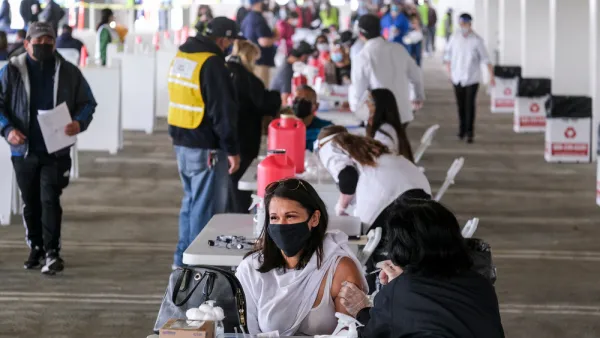
Coronavirus Litigation: Can Employers Require Employee Vaccinations?
The plaintiffs in one of the nation's first court cases over employer-required COVID vaccinations are among the heroes of the pandemic—nurses fighting to remain unvaccinated. Houston Methodist Hospital suspended unvaccinated employees on June 6.
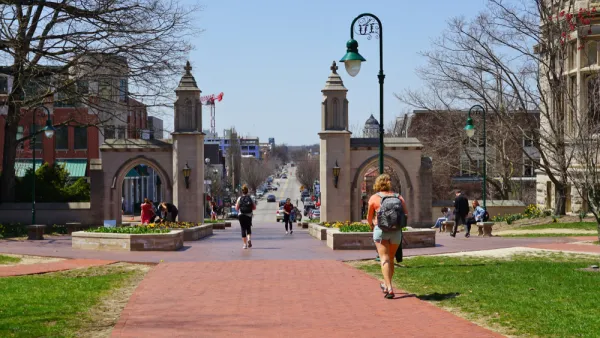
Coronavirus Litigation: Students Sue University's Mandatory Vaccination Policy
Eight college students have filed a lawsuit on June 21 against Indiana University's requirement that students, staff and faculty be vaccinated against COVID-19. The state attorney general supports the students.
COVID Vaccination Strategy: What the U.K. and U.S. Could Learn from Israel
Cases are surging in the U.K. despite 68% of its population being fully vaccinated. Experts say that U.K. officials should observe how Israel, with 63% of its population fully vaccinated, managed to reduce transmission after a similar surge.

Planetizen Federal Action Tracker
A weekly monitor of how Trump’s orders and actions are impacting planners and planning in America.

The state-sanctioned urbicide of Austin
People don’t kill cities. Freeways do.

US to reduce Colorado River water deliveries to Mexico
A new Colorado Treaty amendment reduces Mexico’s Colorado River water allocation by 250,000 acre feet.

Mamdani overhauls NYC's Vision Zero plan with 100 new policy goals
The overhaul aims to reduce traffic deaths and make streets safer for pedestrians, cyclists and drivers through lower speed limits, new safety infrastructure and more.

Amtrak not solely to blame for New Jersey commuter rail's unreliability, report finds
A new study from the Garden State Initiative found that NJ Transit’s budget grew 20% across a 4 year period, but reliability declined significantly over the same period.

EPA erases limits on planet-warming pollution from power plants
Under Monday’s plan, power plants would still have some limits on how much mercury, arsenic and other contaminants they can emit.

FREE Course: Walkable City 1: Why Walkability?
After describing his path towards focusing on walkability as the essence of good planning, Jeff Speck marches through his five principal reasons for making more walkable places.
Reinventing Malls: Planning Alchemy—Turning Gray Fields Into Gold
The course focuses on the opportunities and imperatives that shape reinvention of mall sites.

Eagle County Government
Harvard University Graduate School of Design
Nashville Planning Department
The Architects Foundation
University of Cincinnati Online
The Pocatello Development Authority
The Urban Renewal Agency of the City of Pocatello
Journal of the American Planning Association