Advocates are thrilled that the city of Cleveland is seeking federal funding for a pair of ambitious cycle track plans—but one of the plans has been significantly watered down.


Steven Litt reports that the city of Cleveland is seeking $32.5 million in federal funding for the Superior Avenue Midway in downtown, along with a similar cycle track project planned for Lorain Avenue on the West Side of the city.
The Cleveland Planning Commission approved the Lorain Avenue concept in 2015, but the project has changed in the ensuing years. Advocates expressed dismay, reports Litt, "that the city appears to be backpedaling on building the 2-mile Lorain Avenue project as a sidewalk-level, two-way cycle track from West 20th to West 65th Street," as approved in 2015.
Tom McNair, executive director of the nonprofit Ohio City Inc. community development corporation, "said the 2015 concept offered a chance to create a local equivalent of the highly-acclaimed Cultural Trail in downtown Indianapolis. That eight-mile, sidewalk-level cycle track separates cyclists from traffic and pedestrians along its entire length."
The Superior Avenue Midway is planned "as a two-mile, sidewalk-level cycle track in a 30-foot-wide central median that would extend from Public Square east to East 55th Street."
Read the full story: Cleveland’s request for $32.5 million from feds for bike projects shows it’s backpedaling on Lorain Avenue Cycle Track
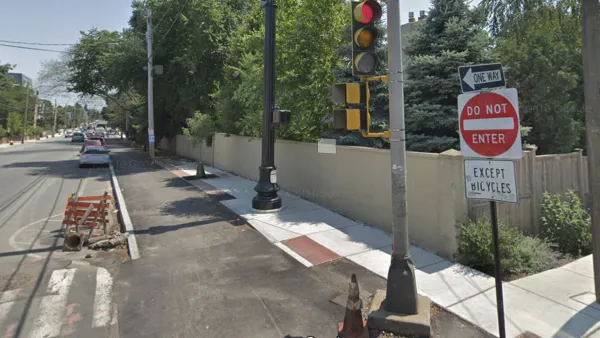
A Utility Pole in the Middle of a Raised, Painted Bike Lane: 'It's Utterly Ridiculous'
You've probably never seen anything like this before, but if you're a bike advocate, it probably still feels familiar.

Cleveland's First Protected Bike Lanes Get $14 Million Boost
[Updated] The Northeast Ohio Areawide Coordinating Agency will provide the funding for two ambitious protected bike lanes in Cleveland.
Cleveland Planning a New Bikeway on the Model of the Cultural Trail of Indianapolis
The city of Cleveland's first protected bike path has planning commission approval. The protected path is a component of the city's ambitious bike infrastructure plans.

Planetizen Federal Action Tracker
A weekly monitor of how Trump’s orders and actions are impacting planners and planning in America.

Eastern Nebraska is running out of electricity
Data centers and electrification are straining eastern Nebraska’s grid, throttling economic development.

Washington state to charge fee to drivers with fuel-efficient cars
Revenue from the fee will go towards supporting the state’s highways.

Instead of building new housing, LA developers are turning mansions into mega-mansions
In the richest areas, the number of houses valued at $30 million with demolition permits has skyrocketed since 2018.

Illinois considers spending $1 billion in taxpayer money on data center
A quantum computing campus and data center are currently under construction in Chicago.

As development costs rise, Boston moves to lessen affordable housing requirements
The Boston Zoning Commission and the City Council still need to approve Boston Mayor Michelle Wu’s proposed changes

FREE Course: Walkable City 1: Why Walkability?
After describing his path towards focusing on walkability as the essence of good planning, Jeff Speck marches through his five principal reasons for making more walkable places.
Reinventing Malls: Planning Alchemy—Turning Gray Fields Into Gold
The course focuses on the opportunities and imperatives that shape reinvention of mall sites.

City of Charlotte
City of Rosemead
Rutgers University, Edward J. Bloustein School of Planning and Public Policy
University of Michigan School for Environment and Sustainability (SEAS)
Hunter College, City University of New York (CUNY)
The Architects Foundation
City of Cambridge
The Pocatello Development Authority
The Urban Renewal Agency of the City of Pocatello