Officials from Brightline recently signed an agreement that dictates terms for the study of an extension of the private rail system between Orlando and Tampa.


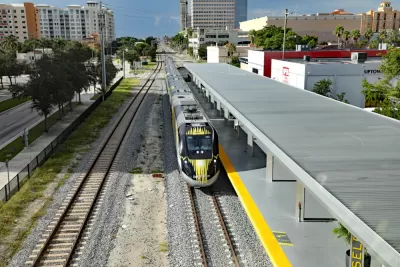
"Florida transportation authorities on Monday gave Brightline what appears to be a final deadline of mid-summer to iron out agreements with local and state governments for the extension of passenger rail service from Orlando’s airport to Tampa," reports Kevin Spear.
"Brightline’s proposal for rail service between Orlando and Tampa is to follow the company’s completion of an extension to Orlando’s airport, now under construction and more than half finished, from existing service between Miami, Fort Lauderdale and West Palm Beach," adds Spear for an explanation of the scope of the project.
Brightline has been negotiating leases along the route since empowered to the job by the Florida Department of Transportation in 2019, according to Spear, and the state is now pressing the company to wrap it up.
The agreement came with a bunch of other requirements in addition to the expiration date, including the delivery of a study that would quantify the loss of toll revenues for the state and the Central Florida Expressway Authority. (The Brightline extension will require the Central Florida Expressway Authority to vacate space currently devoted to the toll-road system.)
"Both the state and the Central Florida Expressway Authority would need to be compensated for the loss of revenue that may occur from cars being removed from the road if the train service is built," according to another article by Next Miami.
Read the full story: Florida authorities tell Brightline to lock down Orlando-Tampa passenger-train plan by mid-summer
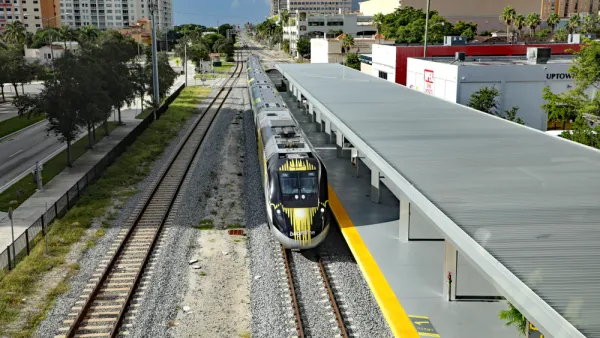
Brightline Opening to Central Florida Delayed
The high-speed rail connection between West Palm Beach and Orlando will not open on time for the holiday weekend as originally planned.
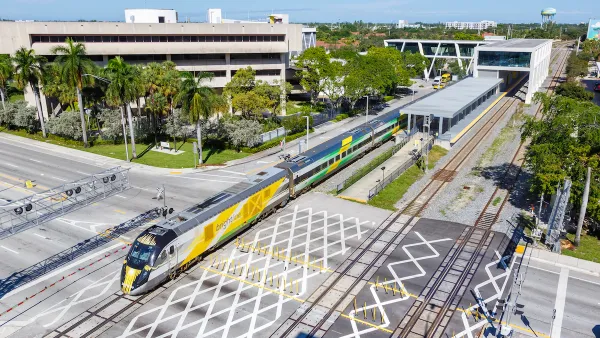
Brightline Completes Higher-Speed Rail Construction in Florida
Florida will soon be home to 170 miles of higher-speed, intercity rail service.

House Bill Would Provide $41 Billion for High-Speed Rail Grants
The "American High-Speed Rail Act" would provide $41 billion in grants and incentives for an additional $38 billion in funding for high-speed rail projects in the United States.

Planetizen Federal Action Tracker
A weekly monitor of how Trump’s orders and actions are impacting planners and planning in America.

Eastern Nebraska is running out of electricity
Data centers and electrification are straining eastern Nebraska’s grid, throttling economic development.

Washington state to charge fee to drivers with fuel-efficient cars
Revenue from the fee will go towards supporting the state’s highways.

Instead of building new housing, LA developers are turning mansions into mega-mansions
In the richest areas, the number of houses valued at $30 million with demolition permits has skyrocketed since 2018.

Illinois considers spending $1 billion in taxpayer money on data center
A quantum computing campus and data center are currently under construction in Chicago.

As development costs rise, Boston moves to lessen affordable housing requirements
The Boston Zoning Commission and the City Council still need to approve Boston Mayor Michelle Wu’s proposed changes

FREE Course: Walkable City 1: Why Walkability?
After describing his path towards focusing on walkability as the essence of good planning, Jeff Speck marches through his five principal reasons for making more walkable places.
Reinventing Malls: Planning Alchemy—Turning Gray Fields Into Gold
The course focuses on the opportunities and imperatives that shape reinvention of mall sites.

City of Charlotte
City of Rosemead
Rutgers University, Edward J. Bloustein School of Planning and Public Policy
University of Michigan School for Environment and Sustainability (SEAS)
Hunter College, City University of New York (CUNY)
The Architects Foundation
City of Cambridge
The Pocatello Development Authority
The Urban Renewal Agency of the City of Pocatello