Controversy erupts in Toronto after the TTC informed transit employees that it isn't safe to carpool to work…driving people around on transit.



A controversy at Toronto's transit agency, the Toronto Transit Commission (TTC), presents more evidence of the ethical challenges facing essential workers during the pandemic—especially the essential workers upon which so many other essential workers depend.
"The TTC is directing its employees not to carpool to work, even as it assures the public its transit vehicles are safe during the pandemic," reports Ben Spurr. "The transit workers’ union is accusing the transit agency of hypocrisy. But health experts say the directive for workers not to hitch a ride together is backed by evidence."
The TTC sent the notice advising all employees to stop carpooling to work on January 5. "Starting Jan. 18, employee vehicles arriving at TTC properties carrying more than two people will be stopped and occupants will be required to provide their employee information, including name and badge number," explains Spurr of the contents of the notice.
In response, the Amalgamated Transit Union Local 113, which represents nearly 12,000 TTC workers, accuses the TTC of not taking steps to mitigate overcrowding on transit vehicles operating in the system.
TTC spokesperson Stuart Green is quoted in the article saying that there's no contradiction in telling workers not to carpool while their jobs require contact with the public on public transit. "There remain no links between TTC use and infections," Green is quoted saying in the article. But carpooling "has led to increased self-isolations," in Green's words, again.
Read the full story: TTC tells employees not to carpool. Union accuses agency of hypocrisy over COVID-19 guidance
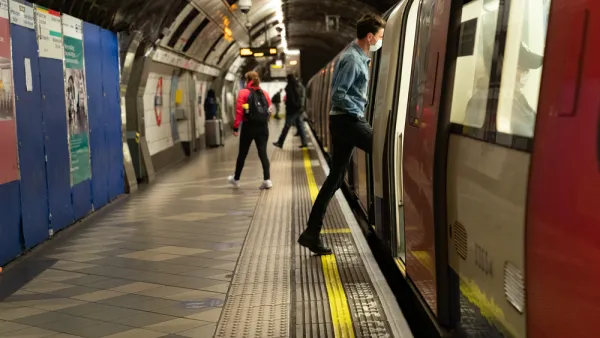
What Is the Future for Transit After COVID? - A Debate
Critic Randal O'Toole and advocate Todd Litman debate how communities should plan for public transit in the post pandemic future. Should it contract or expand?

Most Questions About the Long-Term Impact of the Pandemic Still Unanswered
Planetizen started gathering articles attempting to predict the post-pandemic future in March 2020. The work goes on, with many questions left still to be answered.
How COVID-19 Impacted Mobility in California
Analysis of cell phone location tracking data shows changes in how Californians have moved around since the pandemic.

Planetizen Federal Action Tracker
A weekly monitor of how Trump’s orders and actions are impacting planners and planning in America.

California plans to bury El Niño’s downpour
If the state plays its cards right, it may be able to store a billion acre-feet of El Niño’s water in aquifers.

Desperate measures: Advocates weigh draining Lake Powell to fill Colorado River
Draining the reservoir could reduce evaporation losses by a couple hundred thousand acre-feet.

Mamdani’s pied-à-terre tax survives legal challenge
A panel of judges found that the plaintiffs failed to demonstrate injury as a result of New York City's implementation of the tax.

Eastern Nebraska is running out of electricity
Data centers and electrification are straining eastern Nebraska’s grid, throttling economic development.

Seattle passes record-breaking transit services expansion
Proposition 1 will double the city’s transit tax to add 95,000 more bus trips and preserve 180,000 bus trips annually.

FREE Course: Walkable City 1: Why Walkability?
After describing his path towards focusing on walkability as the essence of good planning, Jeff Speck marches through his five principal reasons for making more walkable places.
Reinventing Malls: Planning Alchemy—Turning Gray Fields Into Gold
The course focuses on the opportunities and imperatives that shape reinvention of mall sites.

City of Rosemead
Rutgers University, Edward J. Bloustein School of Planning and Public Policy
One Hundred Miles
University of Michigan School for Environment and Sustainability (SEAS)
Hunter College, City University of New York (CUNY)
The Architects Foundation
City of Cambridge
Montrose County
The Pocatello Development Authority