New York City will now be measurably less car-centric for the indefinite future.


New York City Mayor Bill de Blasio announced late last week that the city of New York's Open Restaurants on Open Streets program, enacted as a lifeline for restaurants struggling to make ends meet during the COVID-19 pandemic, will be expanded and continued permanently.
Mayor de Blasio announced the city's new approach to restaurant regulations during an interview on Brian Lehrer's WNYC show, but the local urbanism news industry was quick to amplify the announcement.
Luke Fortney and Erika Adams report for Eater New York, explaining the details of the program as it will work in the future.
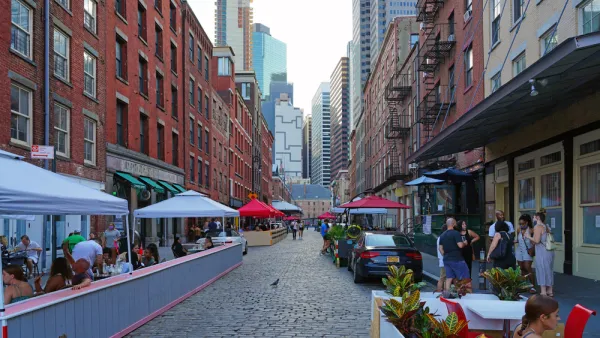
Under the new rules, restaurants will be allowed to keep sidewalk and curbside dining going indefinitely. The city’s Open Streets program, which designated dozens of city blocks to shut down to car traffic for dining in the street over the summer, will also be made a permanent fixture. "This will really help us as an important part of how we recover as a city," de Blasio said.
Restaurants will also be able to expand their frontage space to include seating in front of adjacent businesses if those landlords and tenants are open to it, the mayor said. He also stipulated that for restaurants that conduct outdoor dining in the winter, the space has to be kept “more open” to allow enough airflow. If the area is fully enclosed to better heat the space, those dining areas have to adhere to the same seating restrictions as indoor dining, which will start at 25 percent capacity next week.
According to Fortney and Adams, the permanent extension of the outdoor dining program comes as a result of protracted lobbying by restaurant owners. Despite the scheduled return of indoor dining in the city on September 30, many restaurant industry insiders consider outdoor dining essential for the survival of restaurant businesses through the winter.
The Open Streets component of this big reveal sparked the interest of Gersh Kuntzman at Streetsblog NYC, calling the mayor's announcement a long-overdue shift in priorities to people over cars. "It may turn out to be the single biggest conversion of public space since, well, since car drivers commandeered the curbside lane for free overnight vehicle storage in the 1950s," writes Kuntzman.
Kuntzman also notes that some of the program, as announced, can be achieved by executive action and other components will require legislative action by the City Council. Kuntzman also collects notable political reactions to the news, including that of advocates for mobile vending, who raise alarms about the city's track record of pushing out mobile street vendors to make room for the new outdoor dining arrangements.
FULL STORY: Outdoor Dining Is Now a Permanent NYC Fixture, Mayor Announces

Open Streets and Outdoor Dining Are Best for Business, Report Says
Most business owners believe that they'd be out of business without on-street parking near their front door. The experience of New York City during the pandemic proves otherwise.
New Car Owners, Fewer Parking Spaces—Chickens Come to Roost in New York City
Many cities like New York have reallocated space formerly reserved for moving and storing cars to help restaurants and stores weather the pandemic, but as more residents rely on cars for the same reason, the dynamic threatens to boil over.
Seattle Extends Outdoor Dining for a Year, Eases Rules on Heaters for the Winter
Outdoor dining is going to hang out for a bit.

Planetizen Federal Action Tracker
A weekly monitor of how Trump’s orders and actions are impacting planners and planning in America.

The state-sanctioned urbicide of Austin
People don’t kill cities. Freeways do.

US to reduce Colorado River water deliveries to Mexico
A new Colorado Treaty amendment reduces Mexico’s Colorado River water allocation by 250,000 acre feet.

Mamdani overhauls NYC's Vision Zero plan with 100 new policy goals
The overhaul aims to reduce traffic deaths and make streets safer for pedestrians, cyclists and drivers through lower speed limits, new safety infrastructure and more.

Amtrak not solely to blame for New Jersey commuter rail's unreliability, report finds
A new study from the Garden State Initiative found that NJ Transit’s budget grew 20% across a 4 year period, but reliability declined significantly over the same period.

EPA erases limits on planet-warming pollution from power plants
Under Monday’s plan, power plants would still have some limits on how much mercury, arsenic and other contaminants they can emit.

FREE Course: Walkable City 1: Why Walkability?
After describing his path towards focusing on walkability as the essence of good planning, Jeff Speck marches through his five principal reasons for making more walkable places.
Reinventing Malls: Planning Alchemy—Turning Gray Fields Into Gold
The course focuses on the opportunities and imperatives that shape reinvention of mall sites.

Eagle County Government
Harvard University Graduate School of Design
Nashville Planning Department
The Architects Foundation
University of Cincinnati Online
The Pocatello Development Authority
The Urban Renewal Agency of the City of Pocatello
Journal of the American Planning Association