The impact of the coronavirus on capital budgets has been feared for the duration of the pandemic, and the catastrophic reality of those fears is now apparent in a proposed capital budget for transportation in the state of Maryland.


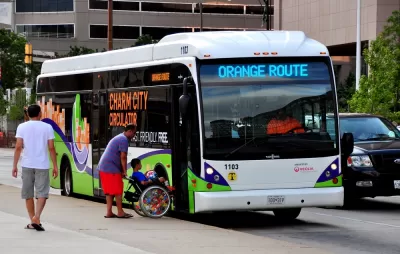
"The Maryland Department of Transportation on Tuesday released a draft of its capital budget for the next six years, and it includes major cuts across MDOT due to the coronavirus, including at the Maryland Transit Administration," reports David Collins.
"The fiscal year budgets from 2021 to 2026 includes a $2.9 billion reduction compared to the previous six years. About two-thirds of that -- $1.9 billion -- is directly related to the coronavirus pandemic," explains Collins.
Among the various agencies and programs impacted by the cuts, the budget cuts $150 million in funding for the Maryland Transit Administration, which has responded by proposing service cuts.
In a separate article following the new about the Maryland Department of Transportation's new budget, Alex Holt digs into the details of the expected service cuts, especially for the city of Baltimore, where the cuts are expected to impact for the vulnerable and transit-dependent riders.
All told, service cuts will eliminate, according to Holt's analysis, 44 “LocalLink” routes, all nine of the “Express BusLink” routes, and 2 “Commuter Bus” routes. An additional 11 LocalLink routes would see their frequency reduced and 13 CityLink or LocalLink routes would be modified. The Maryland Area Rail Commuter will also run fewer trains.
The cuts are not yet final, however, as reported by Holt:
Before implementing any of the cuts, the MTA and MDOT will hold a 30-day “public review and comment period” ending November 15 which will include 10 virtual public hearings on the Local Bus cuts between October 5 and October 16. How those hearings turn out could go a long way towards determining the future of Baltimore transit.
Read the full story: MTA proposes service changes due to decline in ridership amid coronavirus

Baltimore Bus Service Cuts Restored
Maryland Gov. Larry Hogan rescinded a plan that would have cut bus service in the city of Baltimore to the bone.
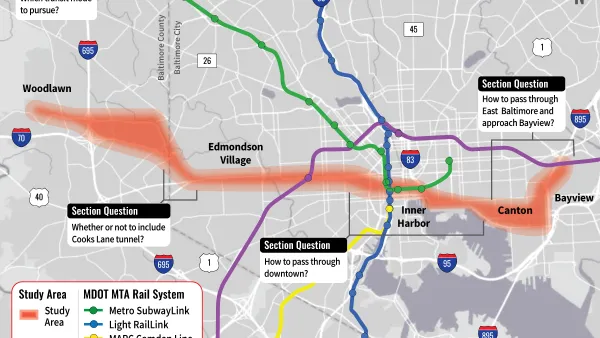
Maryland to Restart Planning for East-West Transit Line Through Baltimore
A plan for the Red Line, an east-west light rail line notoriously canceled by former-Governor Larry Hogan in 2015, is back on the table in Baltimore.
More Transit Agencies Propose Cuts; Congress Finally Takes Notice
The stakes in the economic stimulus package under consideration on Capitol Hill this week are incredibly high.

Planetizen Federal Action Tracker
A weekly monitor of how Trump’s orders and actions are impacting planners and planning in America.

Amtrak, CN end decades-long dispute with eight-year agreement
The new operating agreement establishes an updated framework for the companies to work together, including processes to resolve disputes.

Judges permit Denver to divert 77,000 acre feet from the Colorado River for reservoir expansion
Overuse and climate change have caused the Colorado River’s water levels to plummet.

NYC DOT wants faster, more permanent street upgrades
The city is examining ways to build more concrete infrastructure without getting entangled in 'decades-long' projects.

'Something we’ve never seen before:' rising utility rates could strain city finances nationwide
Data centers, climate change and other factors have caused utility rates in the United States to increase by 38% since 2020.

Trump to overrule local leaders, lease millions of acres of America’s Pacific Island territories’ seafloors to mining companies
International law says that the Indigenous people of America’s territories have a right to prior and informed consent regarding projects that impact their countries.

FREE Course: Walkable City 1: Why Walkability?
After describing his path towards focusing on walkability as the essence of good planning, Jeff Speck marches through his five principal reasons for making more walkable places.
Reinventing Malls: Planning Alchemy—Turning Gray Fields Into Gold
The course focuses on the opportunities and imperatives that shape reinvention of mall sites.

Harvard University Graduate School of Design
KFH Group Inc.
Greater Baltimore Committee
The Architects Foundation
University of Cincinnati Online
The Pocatello Development Authority
The Urban Renewal Agency of the City of Pocatello