The state of Maryland is moving forward with a highway widening plan that would spend $11 billion in a private-partnership to add toll lanes to two Capital Beltway highways.


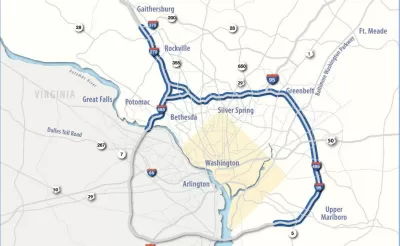
"The state of Maryland has released its long-awaited draft environmental impact assessment for the Hogan administration’s controversial Beltway expansion project," reports Margaret Barthel.
The environmental review for a plan that would widen parts of I-495 and I-270 in Montgomery and Prince George’s counties totals 18,000 pages. The project would add new highway capacity by adding express toll lanes or high-occupancy toll lanes, and the estimated $11 billion price tag would be covered in part by a public-private partnership.
According to Barthel, the study argues that the project would mitigate worsening traffic congestion and meet the demands of expected population growth.
The report reduced the number of alternatives on the table from 15 to seven, but all the remaining project alternatives are likely to have significant impact, according to Barthel's explanation of the report.
But all seven options would have significant environmental impact, the study determined. In all seven, more than 140 acres of public parks and historic sites could be affected, as could more than seventy acres of wetland. Close to 1,400 acres of forest canopy would be cleared, damaged, or disturbed.
Under all seven options, about 34 residential homes and four businesses would have to be relocated. More than 4,000 noise-sensitive land areas–like homes, schools, churches, and parks–could be impacted by the sound of the expanded highway.
More on the response of critics, who have voiced vocal opposition to the project before, is included in the source article.
FULL STORY: Maryland Publishes 18,000-page Environmental Impact Assessment Of Proposed I-270 And I-495 Expansion

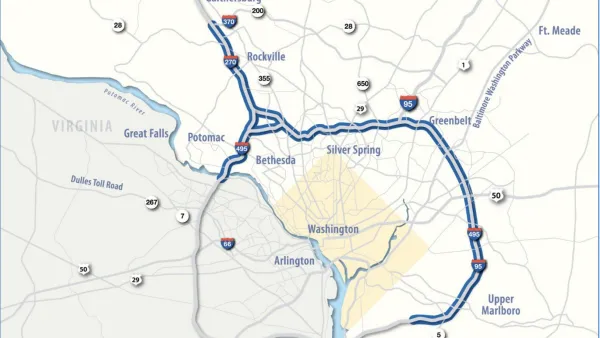
Maryland's Controversial Highway Widening Proposal Scaled Back
Interstate 270, the Capital Beltway, will no longer by widened as part of the I-495/I-270 Managed Lanes Project.
Maryland's Highway Expansion Project Out to Bid
Vocal opposition hasn't slowed the Maryland Department of Transportation's progress of the I-495/I-270 Managed Lanes Project.
Critics: Press Pause on Highway Widening in Maryland Until COVID Impacts Are Clear
Transportation plans justified with pre-coronavirus data are now obsolete, according to a line of argument recently presented to the Maryland Transportation Authority.

The state-sanctioned urbicide of Austin
People don’t kill cities. Freeways do.

US to reduce Colorado River water deliveries to Mexico
A new Colorado Treaty amendment reduces Mexico’s Colorado River water allocation by 250,000 acre feet.

New Jersey’s second-largest city bans standalone data centers
Jersey City will continue to allow co-location facilities, such as those meant for research institutions that store their own data.

Amtrak not solely to blame for New Jersey commuter rail's unreliability, report finds
A new study from the Garden State Initiative found that NJ Transit’s budget grew 20% across a 4 year period, but reliability declined significantly over the same period.

EPA erases limits on planet-warming pollution from power plants
Under Monday’s plan, power plants would still have some limits on how much mercury, arsenic and other contaminants they can emit.

Phoenix announces new on-demand transit service, more frequent RAPID buses
Both new services will launch in October, and are part of Phoenix's Project Effective Access Solutions for Easing Congestion.

FREE Course: Walkable City 1: Why Walkability?
After describing his path towards focusing on walkability as the essence of good planning, Jeff Speck marches through his five principal reasons for making more walkable places.
Reinventing Malls: Planning Alchemy—Turning Gray Fields Into Gold
The course focuses on the opportunities and imperatives that shape reinvention of mall sites.

Eagle County Government
Harvard University Graduate School of Design
Nashville Planning Department
The Architects Foundation
University of Cincinnati Online
The Pocatello Development Authority
The Urban Renewal Agency of the City of Pocatello
Journal of the American Planning Association