Super Tuesday wan't just for presidential primaries: numerous local elections decided the future of land use policy in the largest state in the nation, while Oklahoma City weighed in on planning-related issues as well.



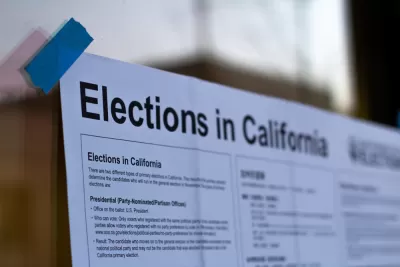
While the Democratic primary steals all the headlines, those concerned about the direction of land use, transportation, and housing policies has plenty to watch in California on Super Tuesday, both at the state and the local level.
A few key takeaways in California: it was a bad day for transportation sales taxes in the San Francisco Bay Area, and a mixed bag for progressive land use and housing policy reforms.
But California wasn't the only state with non-presidential election action, stick around to the end of the posts for the results on a sales tax intended to fund city parks in Oklahoma City.
California
Proposition 13: A controversial school facility bond appears headed for defeat in California. The campaign leading up to the vote was characterized by misinformation on social media, providing a sneak preview of the controversy likely to dog a future vote on "split roll" property tax reform in the state, which would change property tax rates for non-residential properties.
San Francisco
Measure E: A critical land use reform, capping the amount of office uses based on the delivery of affordable housing units, was approved by San Francisco voters. Measure E won handily despite the opposition of SPUR and other prominent figures in the Bay Area. Roland Li provides news coverage of Measure E's success.
Measure D: A vacancy tax for retail uses in San Francisco appears headed for victory, reports Adam Brinklow. "If Proposition D becomes law, starting in 2021 it would charge owners of chronically empty SF storefronts $250 per linear foot (not square foot) for the first year that a retail unit remains vacant, $500 in year two, and $1,000 per foot every year after," explains Brinklow.
Measure B: A bond for emergency services and facilities preparation was overwhelmingly approved by San Francisco voters.
Measure A: Voters approved a bond, which had the support of SPUR, that will fund $845 million in repairs at the City College of San Francisco. Nanatte Asimov provides news coverage of the bond's approval.
San José
Measure E: A proposed tax on the sale of San Jose properties worth $2 million or more was leading on Wednesday morning with 54 percent of the vote, according to Maggie Angst for The Mercury News. "The city estimates that the new tax, which leaders have vowed to use to build affordable housing and expand homeless services, would generate up to $73 million annually and at least $22 million during a recession year," writes Angst.
Contra Costa County
Measure J: Voters rejected a transportation sales tax in this Easy Bay Area county. "Measure J would have imposed a half-cent sales tax to raise $103 million annually for 35 years. It fell far short of the two-thirds percentage needed for passage," reports Rachel Swan [paywall].
Marin and Sonoma counties
Measure I: A sales tax to fund the SMART transit system failed to achieve the necessary votes for approval. "Measure I would have extended the Sonoma-Marin Area Rail Transit district’s existing quarter-cent sales tax for 30 years, pushing the sunset date to April 1, 2059," according to Will Houston.
Mountain View
Measure D: A measure to soften the rent control ordinance in this Silicon Valley city was defeated by voters, according to an article by Kevin Forestieri. Forestieri characterizes the failed modifications of the city's 2016 rent control ordinance as mostly benefitting property owners.
Redlands
Measure G: As of this writing, Measure G in Redlands, California appears headed for defeat, as reported by both Ballotpedia and Redlands Daily Facts. As detailed in an article by Planetizen correspondence Irvin Dawid, Measure G would have loosened density restrictions to allow for more transit oriented development around a forthcoming regional rail line.
San Diego
Measure C: "San Diego’s high-stakes measure to expand the city’s bayfront convention center — plus guarantee a steady stream of revenue to address the homeless crisis — was unable to score a win in Tuesday’s election, falling just short of the two-thirds majority it needed to prevail," report Lori Weisberg and Gary Warth.
Long Beach
Measure B: A proposed increase of Long Beach’s general transient occupancy (hotel bed) tax rate, from 6% to 7%, had the simple majority necessary for approval in early returns. Hayley Munguia provided news coverage of the proposed tax increase in an article published on the day of the election.
Oklahoma City
"A measure that would have added a permanent one-eighth cent sales tax in Oklahoma City was rejected by voters," according to KFOR, and confirmed by Ballotpedia. The sales tax increase would have raised an estimated $15 million a year for the Oklahoma City Parks Tax Fund.
Did we miss anything? Let us know in the comments. We'll be updating this article periodically as results are finalized and we identify more relevant local and statewide elections.

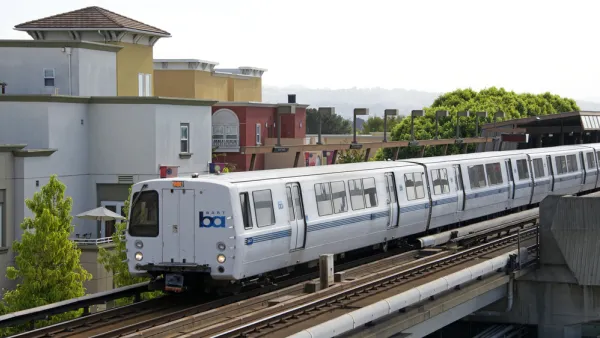
Competing Funding Strategies Promoted for Bay Area Transit Mega-Measure
Two Bay Area transportation sales tax measures affecting three Bay Area counties performed poorly on Super Tuesday, but it hasn't deterred the groups backing a nine-county mega-measure. Progressive groups are proposing non-sales tax alternatives.

The Blue Beltway
Ronald Brownstein, a senior editor at The Atlantic, coins a new political-geographic term in the wake of the Georgia U.S. Senate runoff elections to describe a shift in the political alignment of nearly all large metropolitan areas in the nation.
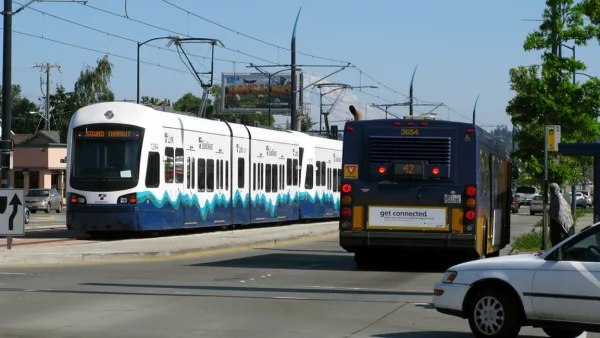
Transit's Big Day at the Ballot Box
Even with the fiscal uncertainty of the pandemic, voters around the country overwhelmingly supported new funding for public transit projects.

The state-sanctioned urbicide of Austin
People don’t kill cities. Freeways do.

US to reduce Colorado River water deliveries to Mexico
A new Colorado Treaty amendment reduces Mexico’s Colorado River water allocation by 250,000 acre feet.

New Jersey’s second-largest city bans standalone data centers
Jersey City will continue to allow co-location facilities, such as those meant for research institutions that store their own data.

Amtrak not solely to blame for New Jersey commuter rail's unreliability, report finds
A new study from the Garden State Initiative found that NJ Transit’s budget grew 20% across a 4 year period, but reliability declined significantly over the same period.

EPA erases limits on planet-warming pollution from power plants
Under Monday’s plan, power plants would still have some limits on how much mercury, arsenic and other contaminants they can emit.

Phoenix announces new on-demand transit service, more frequent RAPID buses
Both new services will launch in October, and are part of Phoenix's Project Effective Access Solutions for Easing Congestion.

FREE Course: Walkable City 1: Why Walkability?
After describing his path towards focusing on walkability as the essence of good planning, Jeff Speck marches through his five principal reasons for making more walkable places.
Reinventing Malls: Planning Alchemy—Turning Gray Fields Into Gold
The course focuses on the opportunities and imperatives that shape reinvention of mall sites.

Eagle County Government
Harvard University Graduate School of Design
Nashville Planning Department
The Architects Foundation
University of Cincinnati Online
The Pocatello Development Authority
The Urban Renewal Agency of the City of Pocatello
Journal of the American Planning Association

