Despite major opposition by residents, the Madison Common Council approved a $40 motor vehicle registration fee (aka 'wheel tax') on an 11-8 vote on Oct. 29 to help fund the city's new East-West Bus Rapid Transit system.


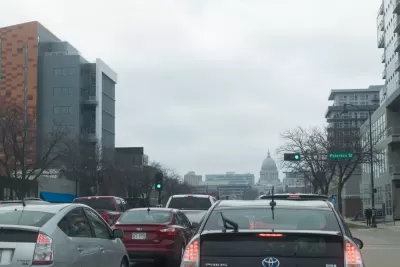
"[I]t was clear Tuesday night that the fee was unpopular, both with constituents and the alders, reported Sara Maslar-Donar for the local ABC news affiliate, WKOW, on Oct. 29 (see news video in article).
Mayor Satya Rhodes-Conway made a public plea to alders Tuesday night after several hours of discussion and three failed amendments to the fee, which included lowering it to $20.
“I need your support on this,” she said. “The city needs your support on this.”
Chris Rickert, who reports on Nov. 25 (in source article) on public correspondence received by the common council released under a public records request from the Wisconsin State Journal, shows "opposition to the highest-in-the-state wheel tax was running about 10-to-1." He called the legislation the mayor's "signature initiative."
Writers opposed to the wheel tax called it regressive, said it would hurt the poor and the elderly most, questioned the need for bus rapid transit — which the fee will help fund — and generally urged leaders to tighten the city’s belt.
Voicing support for the wheel tax was Local 6000 of the American Federation of State, County and Municipal Employees; the Wisconsin Public Interest Research Group, RENEW Wisconsin, 1000 Friends of Wisconsin, Clean Wisconsin and Wisconsin Environment; and Curt Witynski, deputy director of the League of Wisconsin Municipalities. [In an email, the Sierra Club's John Muir chapter confirmed their support as well.]
A widespread criticism in the emails was that any additional funds should be directed toward the police, but according to Wisconsin law, revenue from a wheel tax levied by a municipality or county must be directed to "transportation-related purposes." However, the police may see increased funds as a result of the approval, reported Maslar-Donar on Oct. 29:
The fee has been on the table for a few months, and was projected to bring in almost $8 million in 2020. It would fund a variety of transportation projects in the city, which in turn would free up more than $3.5 million from property taxes. The city expects to use that money to fund general items like police and fire.
The tax takes effect Feb. 1, 2020. "Madison will join 20 other municipalities and 12 counties with wheel taxes, but Madison's will be the highest, according to WKOW.
Why no local vote?
Many municipalities charge vehicle registration fees, which often have to be approved by a local vote. Witynski of the League of Wisconsin Municipalities told the State Journal that "the League lobbies the state Legislature about retaining the ability to impose a local vehicle registration without the need to go to a referendum."
Local car tabs repealed in Washington
Washington state municipalities saw their voter-approved "car tabs" annulled on Election Day after state-wide voters approved Initiative 976 on Nov. 5. Seattle, King County, and other entities filed suit on Nov. 13, claiming the initiative is constitutional. They also sought an injunction to prevent the initiative from taking effect on Dec. 8.
Update: sustainability fee
Another type of vehicle registration fee is being considered in Shelby County, Tenn. Mayor Lee Harris proposed a less regressive "sustainability fee" in September that would only apply to the "third and additional" vehicles in multi-car households. Funds would benefit the Memphis Area Transit Authority
Last month he changed the proposal after receiving much public feedback – "only a household's third vehicle would be taxed," reported Richard Brandon for WMC Action News 5 on Oct. 9. "But he may still face an uphill climb," states Brandon in the video. The vote should go before the Shelby County Board of Commissioners in February.
- Transit Dreams Follow 'Wheel Tax' Proposal in Madison, October 15, 2019
- See three posts tagged "East-West BRT."
FULL STORY: Emails to Madison leaders reveal strong opposition to $40 wheel tax


Judge Puts Washington's Transportation-Busting Initiative on Hold
Washington state voters expecting to see their vehicle registration fees drop to $30 on Thursday due to the passage of Initiative 976 on Nov. 5 might have to wait much longer after a King County Superior Court judge put the measure on hold.
Transit Dreams Follow 'Wheel Tax' Proposal in Madison
After Madison Mayor Satya Rhodes-Conway proposed a $40 "wheel tax," otherwise known as a vehicle registration fee, the debate heated up about what the revenue could fund, or whether it's necessary at all.

Election 2019: Devastating Transportation Funding Loss in Pacific Northwest
Washington voters' approval of Initiative 976, which put a limit on car tab increases as well as repealing many motor vehicle fees, will have far-reaching consequences for funding road maintenance, transit, and bike and pedestrian projects.

Planetizen Federal Action Tracker
A weekly monitor of how Trump’s orders and actions are impacting planners and planning in America.

The state-sanctioned urbicide of Austin
People don’t kill cities. Freeways do.

US to reduce Colorado River water deliveries to Mexico
A new Colorado Treaty amendment reduces Mexico’s Colorado River water allocation by 250,000 acre feet.

5 New England states march closer to 800 megawatt wind energy project
Securing federal approval for the project may be complicated under the Trump administration, which has historically been hostile towards domestic wind power.

Baltimore to break ground on $50 million Transit Priority Project
The project will bring faster bus trips, safer streets and better bike connections to Baltimore.

Airbnb launches $250 million 'last-dollar financing' housing accelerator, makes first investment in Austin
The company will put $6.4 million towards affordable housing development in Texas’ capital.

FREE Course: Walkable City 1: Why Walkability?
After describing his path towards focusing on walkability as the essence of good planning, Jeff Speck marches through his five principal reasons for making more walkable places.
Reinventing Malls: Planning Alchemy—Turning Gray Fields Into Gold
The course focuses on the opportunities and imperatives that shape reinvention of mall sites.

Eagle County Government
Harvard University Graduate School of Design
Nashville Planning Department
The Architects Foundation
University of Cincinnati Online
The Pocatello Development Authority
The Urban Renewal Agency of the City of Pocatello
Journal of the American Planning Association