An idea that is gaining support with the public as the state of California suffers through catastrophic fire season after catastrophic fire season is still a deeply difficult political proposition.


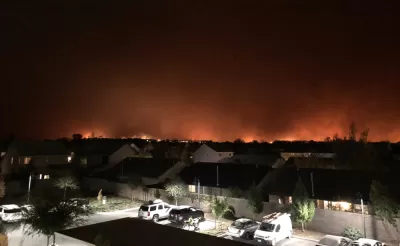
"The wildfires engulfing California this month have burned some of the same areas where other major fires have destroyed thousands of homes in recent years," writes Liam Dillon for the Los Angeles Times, but "no one has formally proposed robust limits on home building in areas at risk of wildfire."
There's been plenty of public hand wringing of the role of PG&E in what has been another disastrous fire season in California, as the utility responds to its role, and liability, in destructive fires of recent years by shutting down power to whole huge swaths of the state.
Despite the lack of conversation among political leaders about limiting home building in wildfire-prone areas, the idea seems to be catching on as fires repeatedly strike the same areas. Dillon reports:
In June, the UC Berkeley Institute of Governmental Studies released a poll that showed that three-quarters of California voters believe the state should restrain home building in areas at high risk of wildfires. The poll, prepared for The Times, revealed bipartisan support for such restrictions after deadly fires wiped out tens of thousands of homes across the state in the last two years.
The idea had strong support across party lines, geographic boundaries, generational divides, and disparate demographic groups. The state's political leaders, like Governor Gavin Newsom, are dismissive of the idea, however.
FULL STORY: The same areas of California keep catching on fire. What about limits on home building?


$50 Billion 'Wildfire Risk Strategy' Targets the Wildland-Urban Interface
The U.S. Department of Agriculture in January announced an ambitious, and only partially funded, new plan to reduce wildfire risks for communities around the United States.
California Governor's Budget Supports Infill Development
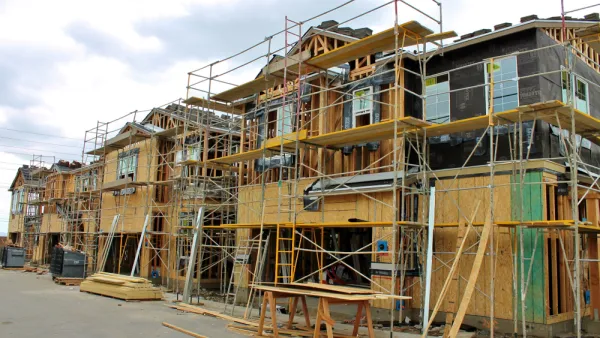
Governor Newsom's new budget proposes incentives for developers to build housing in existing urban areas away from fire-prone zones to reduce fire risk and add to the state's insufficient housing stock.
More Colorado Suburbs at Risk for Wildfires
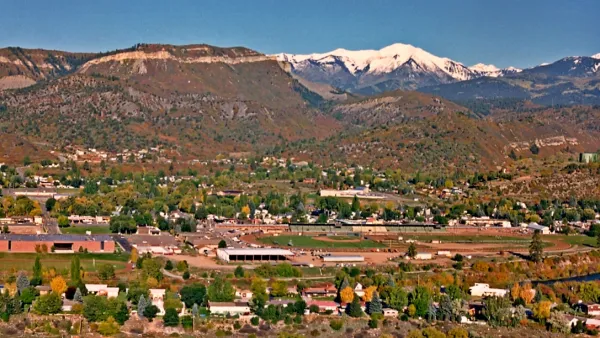
Experts warn that more intense fires fueled by a warming climate are threatening an increasing number of Colorado's suburban communities.

Planetizen Federal Action Tracker
A weekly monitor of how Trump’s orders and actions are impacting planners and planning in America.

The state-sanctioned urbicide of Austin
People don’t kill cities. Freeways do.

US to reduce Colorado River water deliveries to Mexico
A new Colorado Treaty amendment reduces Mexico’s Colorado River water allocation by 250,000 acre feet.

5 New England states march closer to 800 megawatt wind energy project
Securing federal approval for the project may be complicated under the Trump administration, which has historically been hostile towards domestic wind power.

Baltimore to break ground on $50 million Transit Priority Project
The project will bring faster bus trips, safer streets and better bike connections to Baltimore.

Airbnb launches $250 million 'last-dollar financing' housing accelerator, makes first investment in Austin
The company will put $6.4 million towards affordable housing development in Texas’ capital.

FREE Course: Walkable City 1: Why Walkability?
After describing his path towards focusing on walkability as the essence of good planning, Jeff Speck marches through his five principal reasons for making more walkable places.
Reinventing Malls: Planning Alchemy—Turning Gray Fields Into Gold
The course focuses on the opportunities and imperatives that shape reinvention of mall sites.

Eagle County Government
Harvard University Graduate School of Design
Nashville Planning Department
The Architects Foundation
University of Cincinnati Online
The Pocatello Development Authority
The Urban Renewal Agency of the City of Pocatello
Journal of the American Planning Association