The U.S. Department of Transportation is following through President Trump's promises to ease the federal government's permitting and approvals processes for infrastructure projects.


Sam Mintz reports that the U.S. Department of Transportation is publishing two new interim policies on environmental reviews for infrastructure projects.
"The first [pdf] says sub-agencies should limit the text of draft and final environmental impact statements to 150 pages, unless they're 'of an unusual scope or complexity.' It also recommends environmental assessments not be more than 75 pages," according to Mintz.
"The second [pdf] policy gives guidance on implementing President Donald Trump's One Federal Decision executive order, which mandates that major projects have one lead federal agency guiding the environmental review and authorization process," adds Mintz.
The interim policies follow up on a promise made by President Trump during his first State of the Union Address in January 2018. All of the Trump administration's cabinet secretaries signed a pledge in April 2018 to speed up permitting, including Secretary Elaine Chao at the U.S. Department of Transportation.
FULL STORY: DOT gives environmental reviews a page limit


New York City Congestion Pricing Confounded by Federal Delay
While New York City's congestion pricing scheme waits for needed federal approval, political support seems to waver.

A Win for ‘Keep it in the Ground’
Coal mining in Wyoming will take a major hit as a result of a U.S. Department of Interior plan to cease future leasing of coal mines in the nation's most productive coal mining basin. The decision casts a spotlight on the presidential election.
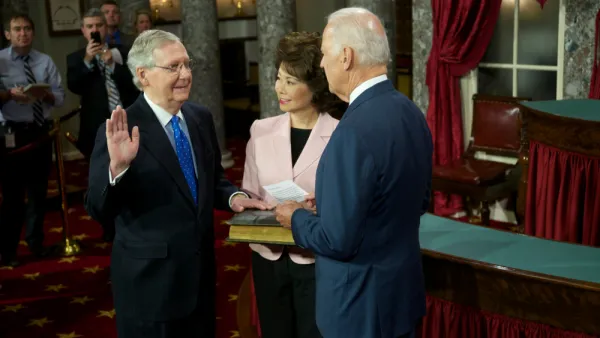
Report Finds Conflicts of Interest in Elaine Chao's Time as Transportation Secretary
The U.S. Department of Justice in the final weeks of the Trump administration rejected an attempt to broaden the investigation into former Secretary Elaine Chao's potential ethics violations.

The state-sanctioned urbicide of Austin
People don’t kill cities. Freeways do.

US to reduce Colorado River water deliveries to Mexico
A new Colorado Treaty amendment reduces Mexico’s Colorado River water allocation by 250,000 acre feet.

New Jersey’s second-largest city bans standalone data centers
Jersey City will continue to allow co-location facilities, such as those meant for research institutions that store their own data.

Amtrak not solely to blame for New Jersey commuter rail's unreliability, report finds
A new study from the Garden State Initiative found that NJ Transit’s budget grew 20% across a 4 year period, but reliability declined significantly over the same period.

EPA erases limits on planet-warming pollution from power plants
Under Monday’s plan, power plants would still have some limits on how much mercury, arsenic and other contaminants they can emit.

Phoenix announces new on-demand transit service, more frequent RAPID buses
Both new services will launch in October, and are part of Phoenix's Project Effective Access Solutions for Easing Congestion.

FREE Course: Walkable City 1: Why Walkability?
After describing his path towards focusing on walkability as the essence of good planning, Jeff Speck marches through his five principal reasons for making more walkable places.
Reinventing Malls: Planning Alchemy—Turning Gray Fields Into Gold
The course focuses on the opportunities and imperatives that shape reinvention of mall sites.

Eagle County Government
Harvard University Graduate School of Design
Nashville Planning Department
The Architects Foundation
University of Cincinnati Online
The Pocatello Development Authority
The Urban Renewal Agency of the City of Pocatello
Journal of the American Planning Association