The AV shuttles transporting passengers around the Brooklyn Navy Yard offer a chance to see the technology in action.


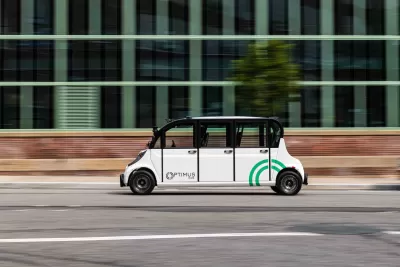
Self-driving shuttles are now operating in the Brooklyn Navy Yard in New York, reports Katie Pyzyk. "The free service, which includes six autonomous shuttles, will run seven days a week to transport passengers between the NYC Ferry stop at Dock 72 and the Cumberland Gate. The service is expected to accommodate 16,000 passengers a month."
Optimus Ride is the AV technology company behind the service. It launched a shuttle service in Reston, Virginia, earlier this year and has plans to start operations in Fairfield, California, and in Boston.
The vehicles will be operating on private roads in the Brooklyn Navy Yard. "Performing controlled AV testing close to or within urban areas is a lower safety risk than allowing them on public roads with a lot of obstacles," writes Pyzyk. It is also an opportunity, she notes, to highlight successful operations and gain much-needed public support for AV technology.
FULL STORY: Driverless shuttles hit the streets of Brooklyn, NY


Controversial N.Y.C. Housing Program Under Fire
The Third Party Transfer program lets the city transfer ownership of delinquent properties, but it unfairly targets communities of color, say critics.
New Master Plan Envisions Brooklyn Navy Yard as Next-Gen Manufacturing Hub
Brooklyn Navy Yard Development Corporation's master plan for the site is a $2.5 billion bet that high-tech manufacturers can be enticed back to New York, bringing with them the economic heft to transform the whole area.
Upping the Ante on the Brooklyn Navy Yard
A new $2.5 billion building plan could reshape the Brooklyn Navy Yard, again.

Planetizen Federal Action Tracker
A weekly monitor of how Trump’s orders and actions are impacting planners and planning in America.

The state-sanctioned urbicide of Austin
People don’t kill cities. Freeways do.

US to reduce Colorado River water deliveries to Mexico
A new Colorado Treaty amendment reduces Mexico’s Colorado River water allocation by 250,000 acre feet.

Mamdani overhauls NYC's Vision Zero plan with 100 new policy goals
The overhaul aims to reduce traffic deaths and make streets safer for pedestrians, cyclists and drivers through lower speed limits, new safety infrastructure and more.

Amtrak not solely to blame for New Jersey commuter rail's unreliability, report finds
A new study from the Garden State Initiative found that NJ Transit’s budget grew 20% across a 4 year period, but reliability declined significantly over the same period.

EPA erases limits on planet-warming pollution from power plants
Under Monday’s plan, power plants would still have some limits on how much mercury, arsenic and other contaminants they can emit.

FREE Course: Walkable City 1: Why Walkability?
After describing his path towards focusing on walkability as the essence of good planning, Jeff Speck marches through his five principal reasons for making more walkable places.
Reinventing Malls: Planning Alchemy—Turning Gray Fields Into Gold
The course focuses on the opportunities and imperatives that shape reinvention of mall sites.

Eagle County Government
Harvard University Graduate School of Design
Nashville Planning Department
The Architects Foundation
University of Cincinnati Online
The Pocatello Development Authority
The Urban Renewal Agency of the City of Pocatello
Journal of the American Planning Association