A new $2.5 billion building plan could reshape the Brooklyn Navy Yard, again.


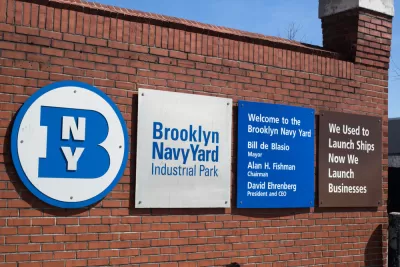
David M. Levitt breaks the news about the expanding footprint, and cost, of development plans at Brooklyn's Navy Yard.
Brooklyn Navy Yard Development Corp. is now planning on spending $2.5 billion to build 5.1 million square feet of tech industry-focused office and manufaturing space. "A little more than half of it will be in a single, vast complex with about the total square footage of the Empire State Building, bringing the yard’s total workforce to about 30,000," reports Levitt. The article provides additional details about the three total sites proposed under the new plan.
The article recounts the history of the Navy Yard, including its recent history, which has seen the rehabbing of all existing buildings and leasing rates of 99 percent for the past decade.
Read the full story: The $2.5 Billion Plan to Turn Brooklyn’s Navy Yard Into a Tech Hub

New Master Plan Envisions Brooklyn Navy Yard as Next-Gen Manufacturing Hub
Brooklyn Navy Yard Development Corporation's master plan for the site is a $2.5 billion bet that high-tech manufacturers can be enticed back to New York, bringing with them the economic heft to transform the whole area.

Autonomous Shuttle Service Up and Running in Brooklyn
The AV shuttles transporting passengers around the Brooklyn Navy Yard offer a chance to see the technology in action.
The de Blasio Administration Stays Firm on Waterfront Rezonings
Despite its ambitious housing targets, the de Blasio Administration isn't willing to sacrifice more of its prime industrial spaces, and the jobs they bring, in the name of residential development.

Planetizen Federal Action Tracker
A weekly monitor of how Trump’s orders and actions are impacting planners and planning in America.

California plans to bury El Niño’s downpour
If the state plays its cards right, it may be able to store a billion acre-feet of El Niño’s water in aquifers.

Desperate measures: Advocates weigh draining Lake Powell to fill Colorado River
Draining the reservoir could reduce evaporation losses by a couple hundred thousand acre-feet.

Chicago voters approve permanent festival grounds, penalty for vacant property owners
Currently, major summer and fall festivals take over public parks for weeks at a time, drawing criticism from nearby residents

NYC votes to cut outdoor dining red tape, speed up permitting
New York City also voted to allow the Department of Transportation to begin work on urgent projects before notifying elected officials.

California appears to reject Prop. 45
The proposition would have expanded the projects that qualify for a streamlined environmental review, effectively paring down the California Environmental Quality Act.

FREE Course: Walkable City 1: Why Walkability?
After describing his path towards focusing on walkability as the essence of good planning, Jeff Speck marches through his five principal reasons for making more walkable places.
Reinventing Malls: Planning Alchemy—Turning Gray Fields Into Gold
The course focuses on the opportunities and imperatives that shape reinvention of mall sites.

City of Rosemead
Rutgers University, Edward J. Bloustein School of Planning and Public Policy
One Hundred Miles
Hunter College, City University of New York (CUNY)
The Architects Foundation
University of Cincinnati Online
City of Cambridge
Montrose County
The Pocatello Development Authority