Advocates and researchers say new development regulations, with more stringent flood protections, aren't doing enough to control the stormwater impacts of sprawl.


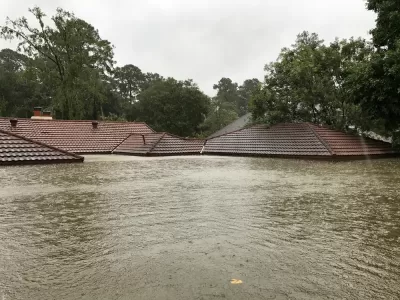
"As new development regulations in Houston attempt to offset the effects of more frequent heavy storms, some advocates and researchers say targeting the area’s urban sprawl will do more to reduce those at risk than limiting the amount of development in the city’s core," reports Emma Whalen.
The new regulations include "adjustments to flood plain boundaries, higher elevation requirements within flood plains and more significant detention requirements outside of flood plains," according to Whalen. The city has approved "25 drainage permits, many of which are subject to stricter city requirements," in and around the flood plains of Buffalo and White Oak Bayous since Hurricane Harvey, according to Whalen.
Meanwhile, development sprawl continues to sprawl beyond Houston's boundaries, raising concerns among advocates at the Bayou Preservation Association and academics at Rice University. Whalen summarizes the case for urban infill as an effective flood prevention tool:
Researchers, including Shelton, said approaching development regulations from a watershed level rather than a jurisdictional level would make it easier to manage stormwater runoff across Houston and its suburbs and would reduce the strain downstream on bayous and tributaries. This approach also calls for more dense development on existing property rather than converting open land into new subdivisions.
FULL STORY: In Houston, development must think outside the flood plains, advocates say

Developments Surrounding Houston's Distressed Dams
The Houston Chronicle continues a series of feature articles about the persistent flooding of the region. The latest installment examines the tenuous position of the Addicks and Barker dams.

Promoting Infill Development for a Denser Houston
An advocacy group is calling for ‘sustainable, vertical’ mixed-use urbanism in the famously sprawling city.
A Small Town Makes its First Zoning Update Since 1997
Mixed-use development and a floodplain overlay are the big-ticket items when the small community of Akron Borough in Pennsylvania recently updated its zoning code.

Planetizen Federal Action Tracker
A weekly monitor of how Trump’s orders and actions are impacting planners and planning in America.

The state-sanctioned urbicide of Austin
People don’t kill cities. Freeways do.

US to reduce Colorado River water deliveries to Mexico
A new Colorado Treaty amendment reduces Mexico’s Colorado River water allocation by 250,000 acre feet.

5 New England states march closer to 800 megawatt wind energy project
Securing federal approval for the project may be complicated under the Trump administration, which has historically been hostile towards domestic wind power.

Baltimore to break ground on $50 million Transit Priority Project
The project will bring faster bus trips, safer streets and better bike connections to Baltimore.

Airbnb launches $250 million 'last-dollar financing' housing accelerator, makes first investment in Austin
The company will put $6.4 million towards affordable housing development in Texas’ capital.

FREE Course: Walkable City 1: Why Walkability?
After describing his path towards focusing on walkability as the essence of good planning, Jeff Speck marches through his five principal reasons for making more walkable places.
Reinventing Malls: Planning Alchemy—Turning Gray Fields Into Gold
The course focuses on the opportunities and imperatives that shape reinvention of mall sites.

Eagle County Government
Harvard University Graduate School of Design
Nashville Planning Department
The Architects Foundation
University of Cincinnati Online
The Pocatello Development Authority
The Urban Renewal Agency of the City of Pocatello
Journal of the American Planning Association