The Southwest Corridor light rail project has a preferred alternative route, but there's still a lot of work to do before the ambitious project can begin construction, much less begin shuttling riders between Portland and Bridgeport Village.


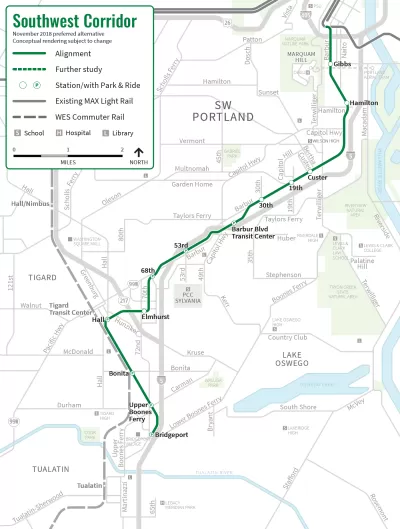
TriMet's proposed light rail extension through Southwest Portland to Bridgeport Village in Washington County presents a new kind of design and engineering challenge, according to a recent article by Andrew Theen.
"The estimated $2.7 billion light rail line would transform a swath of Southwest Portland and the Tigard/Tualatin area. The trip between Bridgeport Village and Portland State University's southernmost station is projected to take 30 minutes," according to Theen.
Leah Robbins, TriMet project director, is quoted in the article with these words to describe the challenge compared to earlier light rail projects in the region: "Everything is bigger."
The size of that project also means complexity, as 13 stations are positioned around undulating and occasionally meandering terrain and between neighborhoods ranging from suburban industrial, residential, and railroad oriented.
Theen took a tour of the potential route and surrounding areas to report in detail on how the project could look if and when it receives funding.
Read the full story: 7 things to know about TriMet’s proposed Southwest Portland MAX line

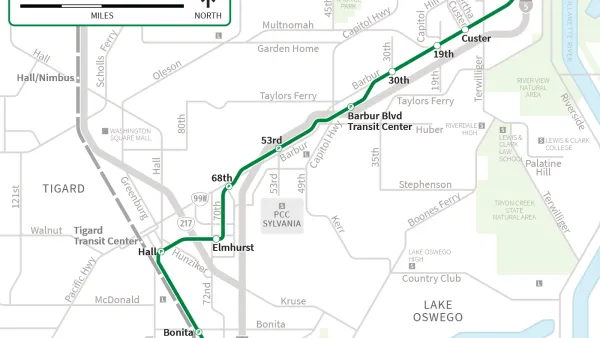
Portland Transit Vote Kills SW Transit Corridor Light Rail Project
In a pair of articles, Jonathan Maus reports on the final moments of the SW Corridor Light Rail Project, as project supporters deals with a loss at the ballot box.
State and Local Votes Reveal Widespread Support for Public Transit
There's a narrative to be built from the results of state and local elections on issues of public transit funding: voters continue to support more funding for public transit projects and programs.

New Details for Portland's Transit Plan as Voters Head to the Polls
Voters in Portland-area voters will decide on a transportation funding measure for the "Get Moving 2020" plan, with details of four bus rapid transit project targeted for funding announced within weeks of the election.

Planetizen Federal Action Tracker
A weekly monitor of how Trump’s orders and actions are impacting planners and planning in America.

California plans to bury El Niño’s downpour
If the state plays its cards right, it may be able to store a billion acre-feet of El Niño’s water in aquifers.

Chicago breaks ground on $3 billion megadevelopment
The new neighborhood, titled Foundry Park, will one day host 3,700 residences.

Satanic Place Names
From streams and lakes to valleys and canyons, I mapped more than 1,000 places named after the Devil.

California High-Speed Rail Authority CEO resigns after $600,000 scandal
Under Ian Choudri, the authority used taxpayer dollars to fund first class flights and trips to nightclubs.

Want to study the Missouri River? Soon, you may need unanimous approval from 10 states
Legislation would require 10 governors’ permission to study or build projects moving water outside the basin.

FREE Course: Walkable City 1: Why Walkability?
After describing his path towards focusing on walkability as the essence of good planning, Jeff Speck marches through his five principal reasons for making more walkable places.
Reinventing Malls: Planning Alchemy—Turning Gray Fields Into Gold
The course focuses on the opportunities and imperatives that shape reinvention of mall sites.

City of Rosemead
Rutgers University, Edward J. Bloustein School of Planning and Public Policy
One Hundred Miles
Hunter College, City University of New York (CUNY)
The Architects Foundation
University of Cincinnati Online
City of Cambridge
Montrose County
The Pocatello Development Authority