Washington, D.C., is not meeting its Vision Zero goals. Three proposed bills would put requirements in place to make traffic safety a priority.


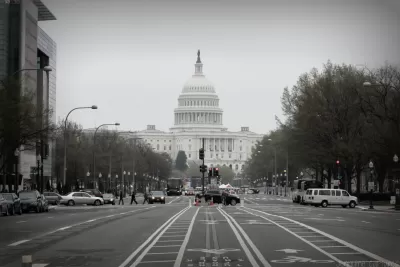
A bill introduced last week would bolster Vision Zero efforts in Washington, D.C., reports Caitlin Rogger. It focuses on better infrastructure, stronger enforcement of existing laws, and planning to reduce auto travel. Two additional proposed bills would improve traffic safety by requiring curb extensions to protect pedestrians and mandating that the district’s written driving test include questions about biking-related laws.
The Vision Zero bill also requires that the District Department of Transportation update the transportation plan every two years and work to improve street safety and shift commuters from driving to transit, biking, and walking. "The provision to plan for 50% of commutes by public transit and 25% by riding bicycles or walking by 2032 are particularly encouraging, as they reflect the kind of paradigm shift needed to meet equity, sustainability, and safety goals on a broader scale," notes Rogger.
Washington, D.C., is behind in reaching its Vision Zero goals. The plan was introduced in 2014, but the number of fatalities last year was the highest in a decade. "Advocates have been saying for years that DC’s leadership would have to make eliminating traffic-related deaths a much higher priority to make any progress," writes Rogger.
FULL STORY: Three new bills aim to make DC streets safer

Audit: Portland’s Vision Zero Needs More Data, Funding
A city audit found that the program has failed to reduce traffic deaths and could benefit from a more systematic approach. Meanwhile, PBOT says it needs more state funding to support road safety projects.
How “Proven Safety Countermeasures” Save Lives
A bill named in honor of a U.S. diplomat killed while on her bicycle would let state DOTs access full federal funding for road safety projects.
Jacksonville Takes Action on Vision Zero
The city is implementing its first-ever Vision Zero Action Plan in an effort to reduce pedestrian and cyclist deaths and serious injuries.

Planetizen Federal Action Tracker
A weekly monitor of how Trump’s orders and actions are impacting planners and planning in America.

The state-sanctioned urbicide of Austin
People don’t kill cities. Freeways do.

US to reduce Colorado River water deliveries to Mexico
A new Colorado Treaty amendment reduces Mexico’s Colorado River water allocation by 250,000 acre feet.

Colorado’s Largest Data Center Could Rise Next to Homes — Without a Public Hearing
The proposed campus would consume 11 times the power of Denver International Airport; as it has across the country, opposition mounts.

5 New England states march closer to 800 megawatt wind energy project
Securing federal approval for the project may be complicated under the Trump administration, which has historically been hostile towards domestic wind power.

Baltimore to break ground on $50 million Transit Priority Project
The project will bring faster bus trips, safer streets and better bike connections to Baltimore.

FREE Course: Walkable City 1: Why Walkability?
After describing his path towards focusing on walkability as the essence of good planning, Jeff Speck marches through his five principal reasons for making more walkable places.
Reinventing Malls: Planning Alchemy—Turning Gray Fields Into Gold
The course focuses on the opportunities and imperatives that shape reinvention of mall sites.

Eagle County Government
Harvard University Graduate School of Design
Nashville Planning Department
The Architects Foundation
University of Cincinnati Online
The Pocatello Development Authority
The Urban Renewal Agency of the City of Pocatello
Journal of the American Planning Association