Critics are pointing to a discrepancy between the plan and the reality in terms of how much private property must be acquired through eminent domain to make the state of Missouri's Hyperloop dreams come true.



"As much as 35 percent of the proposed route for Missouri’s ultra-fast Kansas City to St. Louis Hyperloop would require land acquisition through the government’s power of eminent domain, far more than boosters of the $10-billion venture have claimed," reports Edward McKinley
"The full feasibility report, completed last fall by the Kansas City-based firm Black & Veatch, is at odds with statements by supporters of the project, including Missouri House Speaker Elijah Haahr, who said last month that among the project’s selling points was that it could use 'a vast majority' of state-owned right-of-way along I-70," according to McKinley.
Eminent domain isn't popular in the state of Missouri. "On Tuesday, the House tentatively approved legislation blocking the use of eminent domain for the Grain Belt Express, a transmission line that would carry wind-generated electricity east across eight Missouri counties," according to McKinley.
Read the full story: Missouri Hyperloop would require taking more private land than supporters say
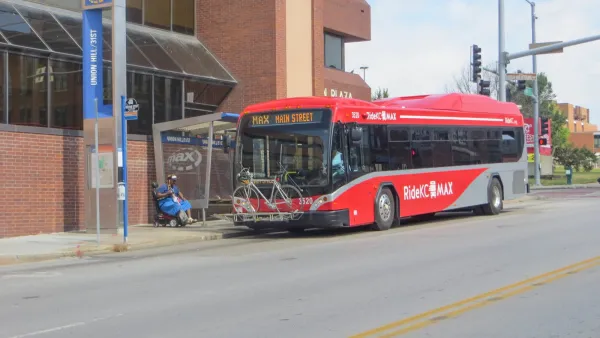
Draft RideKC Bus System Redesign Announced
The RideKC bus system is being redesigned on a high frequency grid.

Missouri Making Hyperloop Plans
Missouri state legislators have created a task force aimed at delivering a hyperloop route between Kansas City and St. Louis.
Planning in Earnest for a Hyperloop From Pittsburgh to Chicago
Funded studies of the hyperloop concept are underway in the Midwest.

Planetizen Federal Action Tracker
A weekly monitor of how Trump’s orders and actions are impacting planners and planning in America.

California plans to bury El Niño’s downpour
If the state plays its cards right, it may be able to store a billion acre-feet of El Niño’s water in aquifers.

Desperate measures: Advocates weigh draining Lake Powell to fill Colorado River
Draining the reservoir could reduce evaporation losses by a couple hundred thousand acre-feet.

Chicago voters approve permanent festival grounds, penalty for vacant property owners
Currently, major summer and fall festivals take over public parks for weeks at a time, drawing criticism from nearby residents

NYC votes to cut outdoor dining red tape, speed up permitting
New York City also voted to allow the Department of Transportation to begin work on urgent projects before notifying elected officials.

California appears to reject Prop. 45
The proposition would have expanded the projects that qualify for a streamlined environmental review, effectively paring down the California Environmental Quality Act.

FREE Course: Walkable City 1: Why Walkability?
After describing his path towards focusing on walkability as the essence of good planning, Jeff Speck marches through his five principal reasons for making more walkable places.
Reinventing Malls: Planning Alchemy—Turning Gray Fields Into Gold
The course focuses on the opportunities and imperatives that shape reinvention of mall sites.

City of Rosemead
Rutgers University, Edward J. Bloustein School of Planning and Public Policy
One Hundred Miles
Hunter College, City University of New York (CUNY)
The Architects Foundation
University of Cincinnati Online
City of Cambridge
Montrose County
The Pocatello Development Authority