Not one Democratic senator, including sponsor Ed Markey (Mass.), voted on Tuesday to support the resolution "recognizing the duty of the Federal Government to create a Green New Deal." Instead, most, but not all, Democrats voted "present."


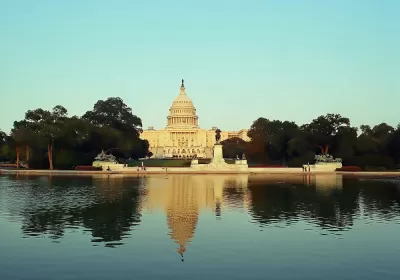
The sweeping Senate joint resolution, S.J. Res. 8, also addresses social goals such as ensuring high-quality health care and "guaranteeing a job with a family-sustaining wage" in addition to climate change goals such as achieving "net-zero greenhouse gas emissions through a fair and just transition for all communities and workers."
Voting "present" is considered to be a "rare step," enabling Democrats "to avoid an intraparty fight on the issue," write Washington Post reporters Dino Grandoni Felicia Sonmez in an analysis of the politically-driven vote orchestrated by Senate Majority Leader Mitch McConnell (R-Ky.), "who called the plan a 'far-left wish list.'”
Nonetheless, three Democrats, Sens. Doug Jones (Ala.), Joe Manchin III (W.Va.) and Kyrsten Sinema (Ariz.), as well as Sen. Angus King (Maine), an independent who caucuses with Democrats, joined with Republicans to oppose the resolution.
Taking a swipe at both the Green New Deal and the Majority Leader, King wrote:
"I am frustrated and dispirited that the Senate Majority Leader’s first vote on climate change mitigation isn’t a serious attempt to solve the problem facing our future generations, but rather a cynical act of political theater that did not include hearings or an amendment process to provide the opportunity to improve this flawed resolution."
Joining Senator Edward J. Markey (D-Mass) in co-sponsoring the actual Green New Deal resolution in the Senate, S.Res. 59, are the six declared Democratic presidential candidates who are U.S. Senators, all of whom voted "present:" Bernie Sanders (I-Vermont), Kirsten Gillibrand (N.Y), Kamala Harris, Elizabeth Warren (Mass.), Cory Booker (N.J.), and Amy Klobuchar (Minn.). [McConnell sponsored the joint resolution which was voted on Tuesday.]
The reporters discuss the candidates' positions on the Green New Deal delivered at a press event on Tuesday in front of the Capitol.
"One irony of the Green New Deal proposal is that it is forcing some Republicans to put forward their own climate proposals after being led for two years by Trump, who has repeatedly dismissed the overwhelming consensus among climate scientists that humans are warming the world," write Grandoni and Sonmez in the final paragraph.
Related in Planetizen:
-
Climate Action and the Green New Deal: Interview with Rep. Mike Levin, February 28, 2019
-
Updated: What the Green New Deal Means for Planning, February 11, 2019
-
Green New Deal Resolution Introduced in Congress, February 8, 2019
Hat tip to Kelsey Tamborrino, POLITICO Morning Energy.
Read the full story: Senate defeats Green New Deal, as Democrats call vote a ‘sham’
Democrats Take Steps to Address Climate Change in 116th Congress
Speaker-designate Nancy Pelosi has selected Rep. Nancy Castor (D-Fla.) to chair the new Select Committee on the Climate Crisis. Two bills that could advance in the House: the Green New Deal and a carbon tax-and-dividend bill, H.R. 7173.
The Surprising Oil Tax in the Inflation Reduction Act
President Biden has made reducing gas prices paramount in his administration, so it was likely a surprise to hear a Republican senator last Sunday warn TV viewers that a revived and increased oil fee in the climate bill will increase their gas costs.
Missing From the Climate-Energy Legislation: Bikes!
Missing from the Democrats' Inflation Reduction Act, the significant climate legislation which passed the Senate on a 51-50 party-line vote on Sunday with Vice President Harris casting the tie-breaking vote, is any mention of bikes.

Planetizen Federal Action Tracker
A weekly monitor of how Trump’s orders and actions are impacting planners and planning in America.

California plans to bury El Niño’s downpour
If the state plays its cards right, it may be able to store a billion acre-feet of El Niño’s water in aquifers.

Desperate measures: Advocates weigh draining Lake Powell to fill Colorado River
Draining the reservoir could reduce evaporation losses by a couple hundred thousand acre-feet.

US buildings threatened, destroyed by fires set to triple by 2060
Researchers found a high fire risk for socioeconomically vulnerable neighborhoods in the American West.

LA residents may be allowed to paint their own crosswalks
Councilwoman Katy Yaroslavsky put out a motion instructing the Los Angeles Department of Public Transportation to study the feasibility of allowing volunteers to paint crosswalks.

Dallas moves to overhaul its zoning code
The city's zoning reform will allow more multi-family and mixed-use developments.

FREE Course: Walkable City 1: Why Walkability?
After describing his path towards focusing on walkability as the essence of good planning, Jeff Speck marches through his five principal reasons for making more walkable places.
Reinventing Malls: Planning Alchemy—Turning Gray Fields Into Gold
The course focuses on the opportunities and imperatives that shape reinvention of mall sites.

City of Rosemead
Rutgers University, Edward J. Bloustein School of Planning and Public Policy
One Hundred Miles
Hunter College, City University of New York (CUNY)
The Architects Foundation
University of Cincinnati Online
City of Cambridge
Montrose County
The Pocatello Development Authority