The city of Alexandria, Virginia is asking the public to weigh in on a fundamental question of bus transit planning: ridership or coverage?


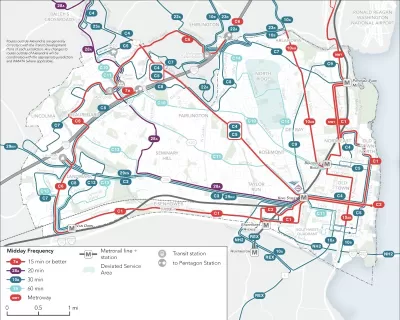
The city of Alexandria, Virginia is undertaking a Transit Vision planning process to lay the groundwork for the next ten to 20 years of bus service in the city. The city runs its won DASH bus service, but the WMATA’s Metrobus also operates in the city. Connections to the Virginia Railway Express (VRE), Metrorail, and external bus operators like the Fairfax Connector and Arlington Transit (ART) will also figure into the bus service equation in the city.
Greg Otten reports a few weeks after the city released a Transit Vision Concepts Report [pdf] on the findings of a community engagement process that included an online survey and several public meetings. The public input process is designed to determine "which of two scenarios the City and DASH should pursue: increased frequency of bus service trading off coverage, or, increased coverage of the city with less frequent bus service. The plan assumes a 20% increase in bus service."
The results [pdf] of the initial public input process showed "that a majority of Alexandria bus riders want fast and frequent bus service," according to Otten. A new survey is drilling down deeper into public preferences between two scenarios, referred to by planners as "Ridership" or "Coverage." Otten explains:
“Ridership” means increased and more frequent bus service in dense areas at the expense of fewer parts of the city being served by buses. The assumption is that more people will ride because there is faster and more frequent service in dense areas. “Coverage” means increased service in some areas at the expense of frequency. More of the city will be served, and thus more people potentially able to ride.
After gathering input on these two concepts, planners will proceed with a design for a new bus network in the city.
FULL STORY: Alexandria is updating its bus network, and riders want faster and more frequent service

Anchorage Buses Switch to a High Frequency Grid
Anchorage's People Mover bus system is the latest in a string of U.S. bus systems to reroute onto a high frequency grid.
New Orleans Weighs Regional Transit Plan
A new proposal would improve wait times for area buses and bring more households within walking distance to transit stops.
Draft RideKC Bus System Redesign Announced
The RideKC bus system is being redesigned on a high frequency grid.

Planetizen Federal Action Tracker
A weekly monitor of how Trump’s orders and actions are impacting planners and planning in America.

The state-sanctioned urbicide of Austin
People don’t kill cities. Freeways do.

US to reduce Colorado River water deliveries to Mexico
A new Colorado Treaty amendment reduces Mexico’s Colorado River water allocation by 250,000 acre feet.

Mamdani overhauls NYC's Vision Zero plan with 100 new policy goals
The overhaul aims to reduce traffic deaths and make streets safer for pedestrians, cyclists and drivers through lower speed limits, new safety infrastructure and more.

Amtrak not solely to blame for New Jersey commuter rail's unreliability, report finds
A new study from the Garden State Initiative found that NJ Transit’s budget grew 20% across a 4 year period, but reliability declined significantly over the same period.

EPA erases limits on planet-warming pollution from power plants
Under Monday’s plan, power plants would still have some limits on how much mercury, arsenic and other contaminants they can emit.

FREE Course: Walkable City 1: Why Walkability?
After describing his path towards focusing on walkability as the essence of good planning, Jeff Speck marches through his five principal reasons for making more walkable places.
Reinventing Malls: Planning Alchemy—Turning Gray Fields Into Gold
The course focuses on the opportunities and imperatives that shape reinvention of mall sites.

Eagle County Government
Harvard University Graduate School of Design
Nashville Planning Department
The Architects Foundation
University of Cincinnati Online
The Pocatello Development Authority
The Urban Renewal Agency of the City of Pocatello
Journal of the American Planning Association