The Los Angeles County metropolitan Transportation Authority announced the launch of a one-year pilot program for on demand ridesharing, otherwise known as microtransit.


Steve Scauzillo reports on the launch of Via, a "private ride-hailing service" touted by regional transit planners as a first-last mile solution that provides a cheaper alternative to Uber and Lyft.
"Riders with a LA Metro TAP card would pay $1.75, the same as the base fare for riding a bus or train," reports Scauzillo. "The driver would pick up other passengers, making it a shared ride that Metro officials said would cut down on additional congestion and air pollution caused by traditional single-passenger ride-hailing services that add cars to the roads."
The program is the result of a $2.5 million contract, funded in part by a $1.35 million grant from the Federal Transit Administration.
The pilot program will operate around select stations in the Metro system.
Despite the struggles of privately operated microtransit experiments, several cities have launched similar public microtransit programs over the past year. A report published a year ago provided guidance for successful microtransit programs.
Read the full story: LA Metro launches $2.5M ridesharing pilot program with private ride-hailing company Via

Poor Returns for L.A.'s Transit on Demand Pilot
Similar to microtransit on demand programs in other cities, Los Angeles' ongoing experiment is proving to be very expensive (for the public) for the benefit of very few riders.
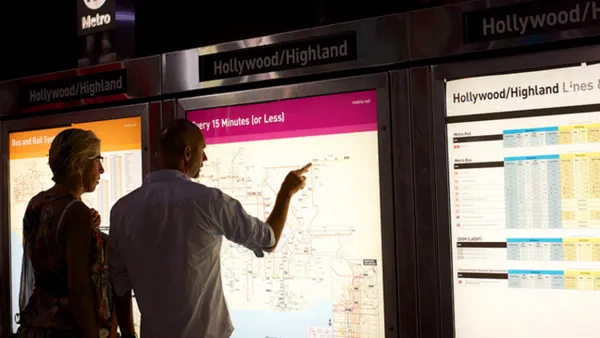
Los Angeles to Test New 'Mobility on Demand' Partnership
The Federal Transit Administration has offered the Los Angeles County Metropolitan Transportation Authority a $1.35 million grant to partner with ridesharing app Via on first-last mile solutions.
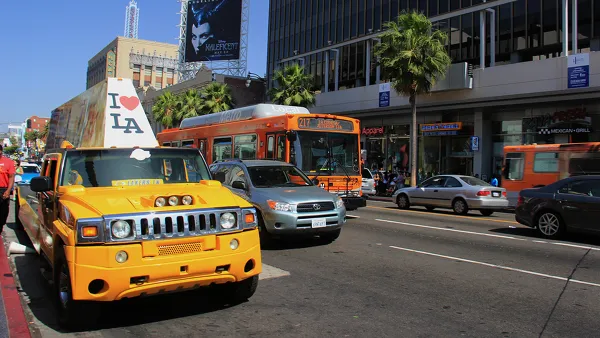
How Los Angeles Redefined Mobility as a Service
Los Angeles Department of Transportation General Manager Seleta Reynolds discusses her vision for urban mobility and the growing role of city leadership.

Planetizen Federal Action Tracker
A weekly monitor of how Trump’s orders and actions are impacting planners and planning in America.

California plans to bury El Niño’s downpour
If the state plays its cards right, it may be able to store a billion acre-feet of El Niño’s water in aquifers.

Chicago breaks ground on $3 billion megadevelopment
The new neighborhood, titled Foundry Park, will one day host 3,700 residences.

Satanic place names
From streams and lakes to valleys and canyons, I mapped more than 1,000 places named after the Devil.

California High-Speed Rail Authority CEO resigns after $600,000 scandal
Under Ian Choudri, the authority used taxpayer dollars to fund first class flights and trips to nightclubs.

Want to study the Missouri River? Soon, you may need unanimous approval from 10 states
Legislation would require 10 governors’ permission to study or build projects moving water outside the basin.

FREE Course: Walkable City 1: Why Walkability?
After describing his path towards focusing on walkability as the essence of good planning, Jeff Speck marches through his five principal reasons for making more walkable places.
Reinventing Malls: Planning Alchemy—Turning Gray Fields Into Gold
The course focuses on the opportunities and imperatives that shape reinvention of mall sites.

City of Rosemead
Rutgers University, Edward J. Bloustein School of Planning and Public Policy
One Hundred Miles
Hunter College, City University of New York (CUNY)
The Architects Foundation
University of Cincinnati Online
City of Cambridge
Montrose County
The Pocatello Development Authority