The Democratic governor proposed a ban on single-use plastic bags in his state-of-the-state address on Jan. 15. Nearly two years earlier, he signed a bill that prevented New York City from charging for bags as the District of Columbia and Boston do.


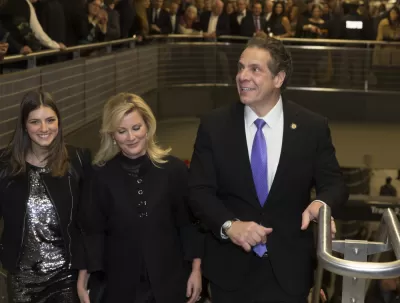
"Among Gov. Andrew M. Cuomo’s goals in the coming year is for the Democrats who now control the State Legislature to ban single-use plastic bags," reports Azi Paybarah on Jan. 22. Bans and/or fees on single-use plastic bags exist in hundreds of cities across the nation, such as Boston where it took effect last month, but statewide bans and/or fees exist in only two states and the District of Columbia.
- Hawaii after the County of Honolulu passed a ban in 2012, joining the state's three other counties that had already done so
- California passed legislation in 2014 that was signed by Gov. Jerry Brown, but the law was subjected to a referendum two years later due to opposition by the plastics industry. Fifty-two percent of voters supported the legislation by approving Proposition 67 and rejecting Proposition 65 on Nov. 8, 2016.
- The District of Columbia enacted a nickel plastic and paper bag fee in January 2010, and it appears to have worked well.
However, it must be noted that more states ban local governments from enacting plastic bag reduction ordinances than those that have adopted them.
Following in the footsteps of Arizona and Missouri in 2015 and Idaho in 2016, Michigan passed legislation in 2016, signed by Lt. Gov. Brian Calley, to preempt cities or counties from regulating single-use plastic bags or other disposable containers. The law was precipitated by an ordinance passed by Washtenaw County (county seat is Ann Arbor, home of the University of Michigan) to charge a 10-cent bag fee.
Similarly, Gov. Cuomo signed legislation on Feb. 14, 2017, "effectively killing a law that would have imposed a 5-cent fee on plastic bags in New York City, disappointing environmentalists as well as city leaders who characterized the move as a classic case of Albany’s overreach," reported Jesse McKinley for the Times. Cuomo objected to the fee being kept by the merchants, yet that's what's done with the nickel fee in D.C. and Boston, and the 10-cent fee in California.
The current proposal, described in the governor's Jan. 13 announcement, includes an expansion of the beverage container recycling known as the Bottle Bill. Times reporter Michael Gold of the Times reports more extensively on the proposal and background on the issue, including current state legislation to "establish guidelines for carryout bag waste reduction."
[Also see Gold's related article via Planetizen: New York City Polystyrene Ban Took Effect New Year's Day, January 4, 2019: Thanks to two recent New York State court rulings, disposable food and beverage containers will no longer be made from polystyrene in the nation's largest city.]
FULL STORY: N.Y. Today: Single-Use Plastic Bags May Soon Be Banned

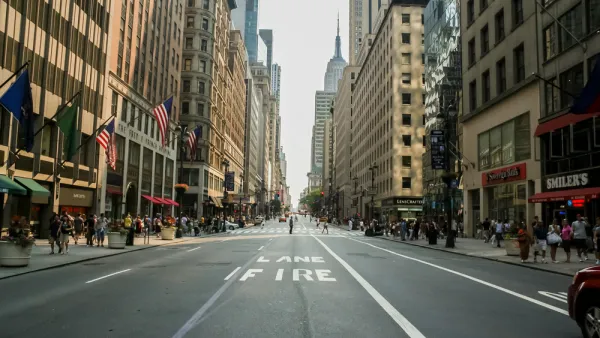
Done Deal: Manhattan Congestion Pricing
Finally, congestion pricing, as applied to city cordons, not highways, will be coming to the U.S., thanks to a budget deal approved by the New York State Legislature early Sunday morning. Tolls below 60th Street should begin by Jan. 1, 2021.
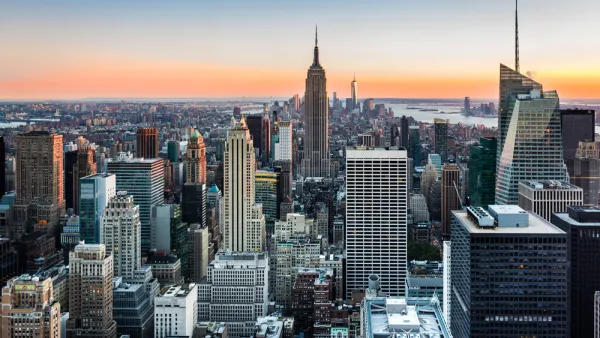
New York State, Not New York City, to Decide Whether to Toll Streets in Manhattan
While the city determines where to place parking meters and how much to charge, when it comes to charging tolls to drive in Manhattan, the city's elected leaders are excluded from the political process.
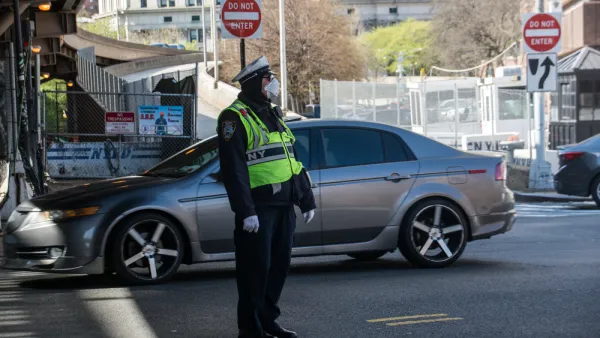
Reopening New York, New Jersey and Connecticut: Is May 19 Too Soon?
Coronavirus cases, hospitalizations and deaths are dropping in the U.S. Govs. Andrew Cuomo, Phil Murphy, and Ned Lamont jointly announced on May 3 that their states would lift most restrictions on May 19. Experts and residents have mixed reactions.

Planetizen Federal Action Tracker
A weekly monitor of how Trump’s orders and actions are impacting planners and planning in America.

The state-sanctioned urbicide of Austin
People don’t kill cities. Freeways do.

US to reduce Colorado River water deliveries to Mexico
A new Colorado Treaty amendment reduces Mexico’s Colorado River water allocation by 250,000 acre feet.

Mamdani overhauls NYC's Vision Zero plan with 100 new policy goals
The overhaul aims to reduce traffic deaths and make streets safer for pedestrians, cyclists and drivers through lower speed limits, new safety infrastructure and more.

Amtrak not solely to blame for New Jersey commuter rail's unreliability, report finds
A new study from the Garden State Initiative found that NJ Transit’s budget grew 20% across a 4 year period, but reliability declined significantly over the same period.

EPA erases limits on planet-warming pollution from power plants
Under Monday’s plan, power plants would still have some limits on how much mercury, arsenic and other contaminants they can emit.

FREE Course: Walkable City 1: Why Walkability?
After describing his path towards focusing on walkability as the essence of good planning, Jeff Speck marches through his five principal reasons for making more walkable places.
Reinventing Malls: Planning Alchemy—Turning Gray Fields Into Gold
The course focuses on the opportunities and imperatives that shape reinvention of mall sites.

Eagle County Government
Harvard University Graduate School of Design
Nashville Planning Department
The Architects Foundation
University of Cincinnati Online
The Pocatello Development Authority
The Urban Renewal Agency of the City of Pocatello
Journal of the American Planning Association