The Seattle Times Editorial Board argues that automated enforcement would remove scofflaws from blocking bus commuters.


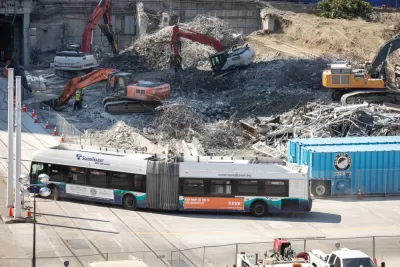
For efficiency and fairness, Seattle should experiment with automated enforcement of its bus lanes, the Seattle Times Editorial Board argues. "Given that buses carrying 90 people are routinely delayed or stopped by a single-occupant car, it’s a good idea that should be tried," the Times argues. The Seattle Department of Transportation has found that certain key points on bus routes are blocked more than a hundred times each day.
"Seattle Police could issue tickets every day, but the police have more important work and the act of stopping drivers to ticket them would further jam the bus lanes," they argue. Further, police stops can be problematic for other reasons, while the piece does not discuss it, automation could curb racial profiling and protect police and drivers from potentially violent interactions that sometimes happen during traffic stops.
Finally, the Seattle Times argues the tactic has been used successfully in other cities like London and San Francisco. "That city [San Francisco] has seen a 55 percent reduction in violations since 2014 and a 16 percent drop in collisions," they report.
FULL STORY: Cameras to nab bus-lane cheaters are a good idea

Vision Zero...Without the Enforcement
As a leading bicycle advocacy organization withdraws support for police enforcement of Vision Zero plans, the discretionary practices of traffic enforcement come under rejuvenated scrutiny.
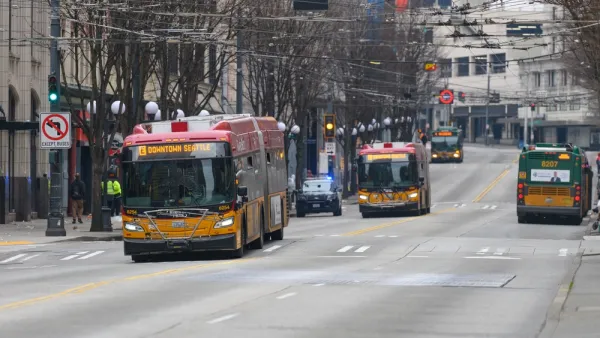
Seattle Bus Lane Cameras Capture Over 100,000 Violations
An automated traffic enforcement pilot program caught drivers illegally using transit lanes more than 110,000 times in less than a year.
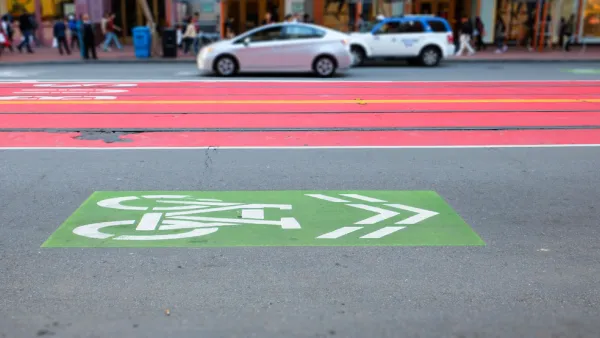
Lack of Traffic Safety Enforcement Blamed for Vision Zero Failures
Education, engineering, and enforcement are the three "e's" of Vision Zero in San Francisco. A lack of on of those "e's"—enforcement—might explain why more people are dying on the city's streets this year that any year since the city adopted Vision Z

The state-sanctioned urbicide of Austin
People don’t kill cities. Freeways do.

US to reduce Colorado River water deliveries to Mexico
A new Colorado Treaty amendment reduces Mexico’s Colorado River water allocation by 250,000 acre feet.

New Jersey’s second-largest city bans standalone data centers
Jersey City will continue to allow co-location facilities, such as those meant for research institutions that store their own data.

Amtrak not solely to blame for New Jersey commuter rail's unreliability, report finds
A new study from the Garden State Initiative found that NJ Transit’s budget grew 20% across a 4 year period, but reliability declined significantly over the same period.

EPA erases limits on planet-warming pollution from power plants
Under Monday’s plan, power plants would still have some limits on how much mercury, arsenic and other contaminants they can emit.

Phoenix announces new on-demand transit service, more frequent RAPID buses
Both new services will launch in October, and are part of Phoenix's Project Effective Access Solutions for Easing Congestion.

FREE Course: Walkable City 1: Why Walkability?
After describing his path towards focusing on walkability as the essence of good planning, Jeff Speck marches through his five principal reasons for making more walkable places.
Reinventing Malls: Planning Alchemy—Turning Gray Fields Into Gold
The course focuses on the opportunities and imperatives that shape reinvention of mall sites.

Eagle County Government
Harvard University Graduate School of Design
Nashville Planning Department
The Architects Foundation
University of Cincinnati Online
The Pocatello Development Authority
The Urban Renewal Agency of the City of Pocatello
Journal of the American Planning Association