Many streets and cities are designed for vehicles instead of for pedestrians. But policies and programs in cities around the world, and even in the United States, might be signaling a shift in priorities.


Richard Conniff takes a look at recent efforts to make cities better places for pedestrians. In Europe, car restrictions and bans are planned or have been instituted in Oslo, Madrid, and Paris, even in the face of public opposition, he says:
Yes, car owners are furious. That's because they have mistaken their century-long domination over pedestrians for a right rather than a privilege. The truth is that cities are not doing nearly enough to restore streets for pedestrian use, and it's the pedestrians who should be furious.
In the United States, the notion that streets are for cars is exemplified by level of service standards based on vehicle throughputs. The result is increased air pollution, more expensive cities, and streetscapes that are not conducive to more sustainable modes of travel. "Urban walking has thus deteriorated from a civilized pleasure to an overheated, unshaded, traffic-harried race to a destination," laments Conniff.
Still, he points to examples of change happening at the grassroots level, including the Walk [Your City] program, which promotes wayfinding and walkability, and the Better Block Foundation, an organization that helps communities with placemaking and neighborhood development projects.
"In many of the major cities of the world, it has begun to dawn even on public officials that walking is a highly efficient means of transit, as well as one of the great underrated pleasures in life," says Conniff.
FULL STORY: The Pedestrian Strikes Back

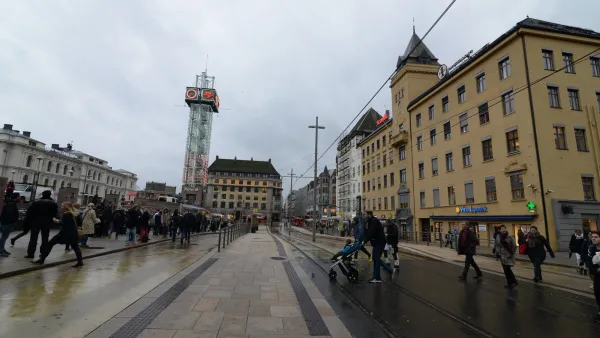
In Oslo, Streets for People, Not Cars
New measures will greatly reduce vehicle traffic in the city center as Oslo moves to put pedestrians, cyclists, and air quality before cars.
Car-Free Movement Gaining Steam in Europe and Elsewhere
Athlyn Cathcart-Keays of The Guardian-Cities chronicles the advancement of the international urban car-free movement as well as auto regulations that focus on air pollution. The most recent city to join the growing list is Oslo, Norway

U.S. Lagging in Making Streets Safer for Pedestrians
Pedestrian deaths are on the rise in the United States, but cities have been slow to implement effective policies and road design measures to change the trend.

Planetizen Federal Action Tracker
A weekly monitor of how Trump’s orders and actions are impacting planners and planning in America.

The state-sanctioned urbicide of Austin
People don’t kill cities. Freeways do.

US to reduce Colorado River water deliveries to Mexico
A new Colorado Treaty amendment reduces Mexico’s Colorado River water allocation by 250,000 acre feet.

Baltimore to break ground on $50 million Transit Priority Project
The project will bring faster bus trips, safer streets and better bike connections to Baltimore.

Airbnb launches $250 million 'last-dollar financing' housing accelerator, makes first investment in Austin
The company will put $6.4 million towards affordable housing development in Texas’ capital.

Guerilla urbanists are building DIY bus stop benches in Chicago
A before-and-after of one of the bus stops with a new bench. The new benches are not officially sanctioned or permitted, but the residents who placed them hope they will be the start of a network of DIY benches across the city.

FREE Course: Walkable City 1: Why Walkability?
After describing his path towards focusing on walkability as the essence of good planning, Jeff Speck marches through his five principal reasons for making more walkable places.
Reinventing Malls: Planning Alchemy—Turning Gray Fields Into Gold
The course focuses on the opportunities and imperatives that shape reinvention of mall sites.


Eagle County Government
Harvard University Graduate School of Design
Nashville Planning Department
The Architects Foundation
University of Cincinnati Online
The Pocatello Development Authority
The Urban Renewal Agency of the City of Pocatello
Journal of the American Planning Association