A bench is a basic bus stop amenity, but many stops on Los Angeles’ Eastside lack them. One resident took on the task of putting in benches himself.


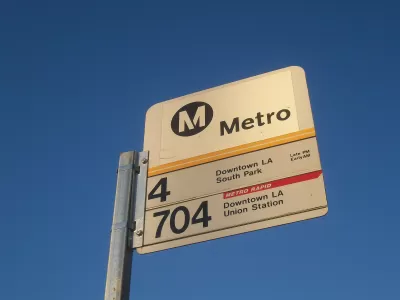
An anonymous artist is building and installing benches at bus stops throughout Los Angeles Eastside neighborhoods. These are stops where there is little else than a pole in the dirt with a sign at the stop, as is evident from Carolina A. Miranda’s description of one:
Then there is the complete lack of amenities: no shelter, no landscaping — and no place to sit. Unless you count the fragments of tarmac that someone has thoughtfully arranged into an improvised stool at the base of a commercial billboard nearby.
The artist experienced the challenges of traveling by bus a couple years ago when he had knee problems and had to wait at a stop with no bench. About a year ago, he started installing the wooden benches by attaching them to the solitary poles, and he has put in over a dozen so far.
Bus stop benches are part of a bureaucratic maze that involves the Los Angeles County Metropolitan Transportation Authority but also a host of other agencies and entities, including local governments, the Los Angeles City Council, the Department of Public Works, and private street-furniture contractors. The result is that getting something like a simple bench approved and installed is a slow-moving logistical nightmare.
Miranda says that the rogue benches are being used. “Some of his benches have become part of the fabric of the city — sat on and rained on, captured on Google Street View and even vandalized. Scrawled in tidy handwriting on one bench was, ‘i love it, thank you,’ punctuated by a small heart.”
Others, unfortunately, have disappeared or been destroyed, reports Miranda:
Not five days after I watched the artist install his bench at Valley and Soto — the second one he has installed there — it was gone. Was it the city? Was it a random dude with a crowbar? Is there someone with a deep-seated enmity toward public seating reporting them as garbage to 311?
Still, she reports that he plans to continue to leave benches in these otherwise overlooked voids of the Los Angeles transit network.
FULL STORY: Meet the anonymous artist installing bus benches at neglected stops on L.A.’s Eastside

L.A. Metro Report Examines How Women Travel
Findings from a new study about the mobility needs and concerns of women in Los Angeles will inform future initiatives and planning.
North Carolina removes bus benches installed by Democratic Socialists
NCDOT says the benches, installed without the department's permission, do not meet state standards for safety and accessibility.
UMich Students Install DIY Bus Benches in Ann Arbor
A student urbanism club built and distributed benches at some of the city’s most-used bus stops.

Planetizen Federal Action Tracker
A weekly monitor of how Trump’s orders and actions are impacting planners and planning in America.

The state-sanctioned urbicide of Austin
People don’t kill cities. Freeways do.

US to reduce Colorado River water deliveries to Mexico
A new Colorado Treaty amendment reduces Mexico’s Colorado River water allocation by 250,000 acre feet.

LA Metro’s ultimatum: no extra buses for LA28 if federal funding isn’t imminently secured
If Metro does not provide additional buses, LA28 organizers will have to find a new way to manage Olympic traffic. LA28’s budget does not include a line item for transit.

Colorado’s Largest Data Center Could Rise Next to Homes — Without a Public Hearing
The proposed campus would consume 11 times the power of Denver International Airport; as it has across the country, opposition mounts.

5 New England states march closer to 800 megawatt wind energy project
Securing federal approval for the project may be complicated under the Trump administration, which has historically been hostile towards domestic wind power.

FREE Course: Walkable City 1: Why Walkability?
After describing his path towards focusing on walkability as the essence of good planning, Jeff Speck marches through his five principal reasons for making more walkable places.
Reinventing Malls: Planning Alchemy—Turning Gray Fields Into Gold
The course focuses on the opportunities and imperatives that shape reinvention of mall sites.


Eagle County Government
Harvard University Graduate School of Design
Nashville Planning Department
The Architects Foundation
University of Cincinnati Online
The Pocatello Development Authority
The Urban Renewal Agency of the City of Pocatello
Journal of the American Planning Association