By restricting car traffic and eliminating parking along a portion of King Street in Toronto, streetcar ridership and service performance have been greatly improved.


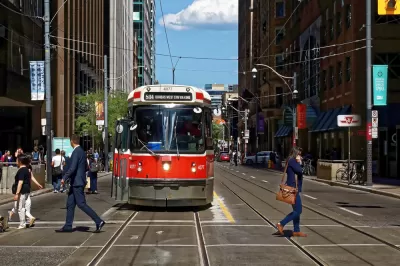
"A $1.5-million pilot project that gives priority to streetcar traffic on King St. between Bathurst and Jarvis Sts. marks its one-year anniversary Monday with [Toronto's] latest data showing a spike in transit ridership, cyclist and pedestrian travel and a slight improvement in customer spending in the busy downtown corridor," reports Michael Lewis.
"City of Toronto data for July and August shows double-digit increases in streetcar ridership during the morning and evening commutes on King St. during the period compared to ridership before the project began last Nov. 12, with average all-day ridership jumping by 11 per cent to roughly 80,000 boardings per day," adds Lewis.
Based on those data, and "key metrics" for September and October expected to be made public soon, the city will decide whether to make the pilot project permanent. The news about the King Street project has been positive for ridership and system performance since shortly after the project launched, as past coverage by Planetizen shows.
- An Ambitious Plan to Rethink Toronto's King Street (January 2016)
- In Praise of Toronto's Least Ambitious Transit Project (November 2017)
- Ridership Surges After Streetcars Gain Priority in Toronto (January 2018)
- With Transit Signal Priority Back On, Streetcars Moving Faster in Toronto (September 2018)
For more coverage of the anniversary of the pilot project, see also an article by Angie Schmitt.
Read the full story: One year in data deems King St. pilot project a success

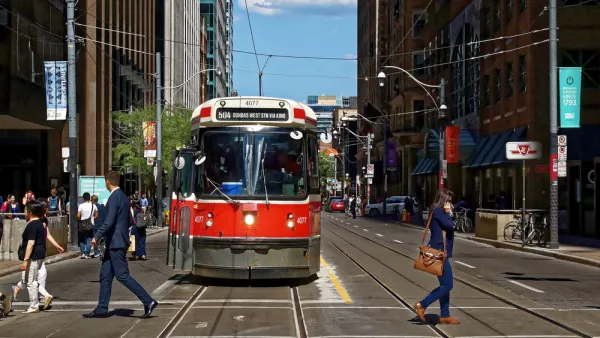
Toronto Streetcar Experiment Likely to Be Made Permanent
The city of Toronto did something radical and gave its streetcar its own lane on King Street as part of a pilot project launched in 2018. The results included improved service and increased ridership.
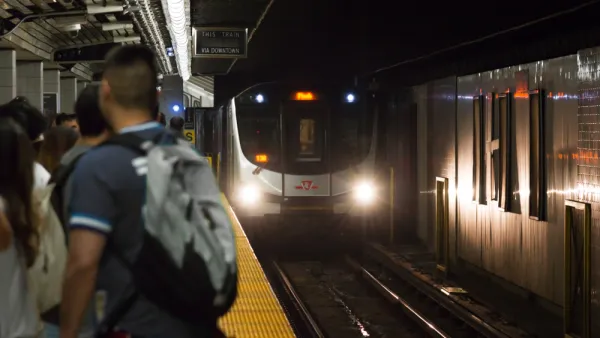
Plan to Speed Up Relief Line Construction Pitched in Toronto
Toronto Mayor John Tory is intervening in transit plans with a call to speed up spending and the construction timeline for the relief line, designed to relieve crowding on the city's subway system in the urban core.
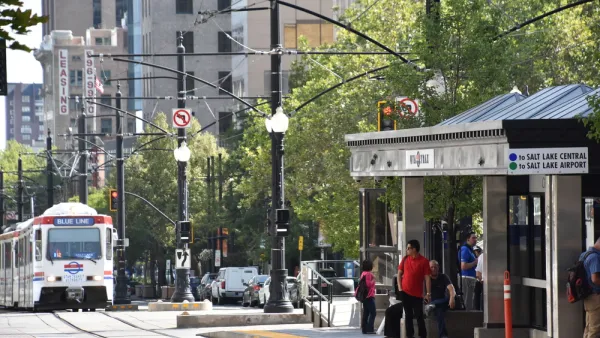
Buslash in Salt Lake City
New bus routes planned for Salt Lake City have provoked a vocal political opposition.

Planetizen Federal Action Tracker
A weekly monitor of how Trump’s orders and actions are impacting planners and planning in America.

California plans to bury El Niño’s downpour
If the state plays its cards right, it may be able to store a billion acre-feet of El Niño’s water in aquifers.

Chicago breaks ground on $3 billion megadevelopment
The new neighborhood, titled Foundry Park, will one day host 3,700 residences.

Satanic place names
From streams and lakes to valleys and canyons, I mapped more than 1,000 places named after the Devil.

California High-Speed Rail Authority CEO resigns after $600,000 scandal
Under Ian Choudri, the authority used taxpayer dollars to fund first class flights and trips to nightclubs.

Want to study the Missouri River? Soon, you may need unanimous approval from 10 states
Legislation would require 10 governors’ permission to study or build projects moving water outside the basin.

FREE Course: Walkable City 1: Why Walkability?
After describing his path towards focusing on walkability as the essence of good planning, Jeff Speck marches through his five principal reasons for making more walkable places.
Reinventing Malls: Planning Alchemy—Turning Gray Fields Into Gold
The course focuses on the opportunities and imperatives that shape reinvention of mall sites.

City of Rosemead
Rutgers University, Edward J. Bloustein School of Planning and Public Policy
One Hundred Miles
Hunter College, City University of New York (CUNY)
The Architects Foundation
University of Cincinnati Online
City of Cambridge
Montrose County
The Pocatello Development Authority