It's well known that an electric vehicle is only as clean, from a greenhouse gas perspective, as the electricity it consumes to power it. A new study finds that the electricity used in the manufacturing of car batteries also must be considered.


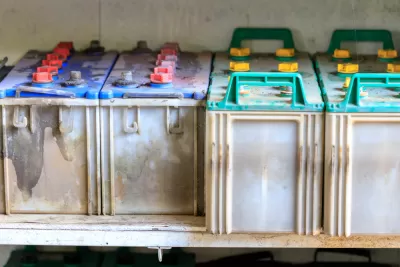
A study from Munich-based automotive consultancy Berylls Strategy Advisor shows that depending on where an electric vehicle (EV) battery is manufactured, it may make more sense to drive a diesel-powered car based on a comparison of total carbon emissions.
"The findings...show that while electric cars are emission-free on the road, they still discharge a lot of the carbon-dioxide that conventional cars do," report Niclas Rolander, Jesper Starn, and Elisabeth Behrmann for Bloomberg News.
Every major carmaker has plans for electric vehicles to cut greenhouse gas emissions, yet their manufacturers are, by and large, making lithium-ion batteries in places with some of the most polluting grids in the world.
Most [battery] supply will come from places like China, Thailand, Germany and Poland that rely on non-renewable sources like coal for electricity.
Furthermore, the larger the battery, the greater the environmental impact. "BMW’s i3 has a 42 kWh battery, Mercedes’s upcoming EQC crossover will have an 80 kWh battery, and Audi’s e-tron will come in at 95 kWh."
The transition of the auto fleet from cars to light trucks, particularly in the U.S., is now well-documented. For EVs to be more widely adopted, there will need to be more battery-powered SUVs, vans and pickup trucks. Just as light trucks have lower fuel efficiency than cars, the Berylls study indicates the same pattern will hold for electric SUVs, with the greater carbon emissions resulting from the battery manufacturing process.
Air quality vs. climate impact
The reporters clarify that regardless of the where the battery is manufactured and the sources of energy to charge the battery when the vehicle is being operated, the benefits of EVs are indisputable:
The benefit of driving battery cars in cities will be immediate: their quiet motors will reduce noise pollution and curb toxins like nitrogen oxide, NOX, a chemical compound spewed from diesel engines that’s hazardous to air quality and human health.
“In downtown Oslo, Stockholm, Beijing or Paris, the most immediate consideration is to improve air quality and the quality of life for the people who live there,” said Christoph Stuermer, the global lead analyst for PricewaterhouseCoopers Autofacts.
Life cycle analysis of EVs
"All vehicles experience three distinct life stages: manufacturing, operation, and end-of-life," states the introduction to the Union of Concerned Scientists' 2015 report, "Cleaner Cars from Cradle to Grave" (posted here). Manufacturing the lithium-ion battery is a significant factor in adding to lifetime emissions, but by how much depends on the size of the battery, where it is manufactured, and who is doing the study.
"Just to build each car battery—weighing upwards of 500 kilograms (1,100 pounds) in size for sport-utility vehicles—would emit up to 74 percent more C02 than producing an efficient conventional car if it’s made in a factory powered by fossil fuels in a place like Germany, according to Berylls’ findings," write Rolander, Starn, and Behrmann.
The 2015 UCS study included a lower-range EV, but the finding for a larger battery was similar to Berylls. Note the wide difference in emissions between long-range batteries and shorter ones.
Manufacturing a mid-sized EV with an 84-mile range results in about 15 percent more emissions than manufacturing an equivalent gasoline vehicle. For larger, longer-range EVs that travel more than 250 miles per charge, the manufacturing emissions can be as much as 68 percent higher.
The International Council on Clean Transportation, the international independent nonprofit organization credited for uncovering Volkswagen's dieselgate scandal, agrees.
"An electric vehicle’s higher emissions during the manufacturing stage are paid off after only 2 years compared to driving an average conventional vehicle, a time frame that drops to about one and a half years if the car is charged using renewable energy," according to their February 2018 briefing
The Berylls study uses Germany, with a grid composed of 40 percent coal-powered generation (per Clean Energy Wire, December 2017), where the combination of a battery and recharging power call into question the environmental friendliness of EVs.
All studies agree that using carbon-free power to manufacture lithium-ion batteries is key to making electric vehicles more climate-friendly.
Correspondent's note: I was unable to find the Berylls study, but did find another battery study by the company: "Battery Production Today And Tomorrow: Too Many Manufacturers, Too Few Customers," [pdf] March 2018.
Related in Planetizen:
-
Report: Electric Vehicles Best Option in Most of U.S., November 18, 2015A new Union of Concerned Scientists report shows that due to considerable gains made in cleaning the electric grid and in producing electric vehicles more efficiently, EVs are the environmentally sensible choice.
-
Paul Stenquist analyzes the surprising influence that geography has on the carbon footprint of electric vehicles.
FULL STORY: The Dirt on Clean Electric Cars

GM's Electric Vehicle Future Arrives Early in Detroit-Hamtramck
GM's first non-internal combustion engine vehicle assembly plant will be in the form of 35-year-old plant straddling the Detroit-Hamtramck border thanks in part to a $2.27 billion state tax credit. Electric pickups, SUVs, and AVs will be produced.

Energy Demand and Carbon Emissions Increased in 2017, Just Not Everywhere
The International Energy Agency found that China and India were responsible for 40 percent of the increased energy demand. The biggest decrease in carbon dioxide emissions came from the U.S., largely due to increased use of renewables.
Inadequate Diesel Vehicle Testing Results in 38,000 Global Fatalities Annually
While the study stems from research that found Volkswagen diesel cars had used 'defeat devices' to pass emissions tests, the new study points to inadequacies in the tests themselves, resulting in 50 percent higher pollution than testing permits.

The state-sanctioned urbicide of Austin
People don’t kill cities. Freeways do.

US to reduce Colorado River water deliveries to Mexico
A new Colorado Treaty amendment reduces Mexico’s Colorado River water allocation by 250,000 acre feet.

New Jersey’s second-largest city bans standalone data centers
Jersey City will continue to allow co-location facilities, such as those meant for research institutions that store their own data.

Amtrak not solely to blame for New Jersey commuter rail's unreliability, report finds
A new study from the Garden State Initiative found that NJ Transit’s budget grew 20% across a 4 year period, but reliability declined significantly over the same period.

EPA erases limits on planet-warming pollution from power plants
Under Monday’s plan, power plants would still have some limits on how much mercury, arsenic and other contaminants they can emit.

Phoenix announces new on-demand transit service, more frequent RAPID buses
Both new services will launch in October, and are part of Phoenix's Project Effective Access Solutions for Easing Congestion.

FREE Course: Walkable City 1: Why Walkability?
After describing his path towards focusing on walkability as the essence of good planning, Jeff Speck marches through his five principal reasons for making more walkable places.
Reinventing Malls: Planning Alchemy—Turning Gray Fields Into Gold
The course focuses on the opportunities and imperatives that shape reinvention of mall sites.

Eagle County Government
Harvard University Graduate School of Design
Nashville Planning Department
The Architects Foundation
University of Cincinnati Online
The Pocatello Development Authority
The Urban Renewal Agency of the City of Pocatello
Journal of the American Planning Association