They range from large traffic circles that reduce congestion to small neighborhood roundabouts designed to slow local traffic.


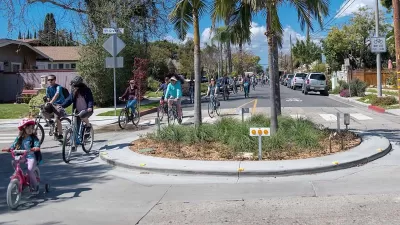
Long Beach, California is becoming a leader in traffic circles, a traffic calming tool that is starting to gain popularity in the United States. “Generally roundabouts increase car traffic throughput (by eliminating a stop sign or a signal), while somewhat slowing driving speeds. They decrease some of the most deadly left-turn ‘T-bone’ crashes.”
According to an article by Joe Linton in Streetsblog LA, “The city has nearly a hundred traffic circles, ranging from a few large-scale roundabouts to scores of small-scale mini raised planters that improve neighborhood intersection safety.”
Linton notes that the city is a pioneer in other sustainable transportation efforts; it was the first in Los Angeles County to install protected bike lanes, outdoor dining parklets, bike boxes, and a ‘bicycle boulevard,’ among other projects.
The Long Beach traffic circles have some hiccups: “Some of the circles include stop signs; some direct people entering to yield to others already in the circle.” Some are too small to slow passing traffic.
Streetsblog staff counted 92 traffic circles in Long Beach, with 79 of them on public streets. While many are the result of the city’s recent safety push, some date back to the 1930s.
FULL STORY: Long Beach Leads in Traffic Circles

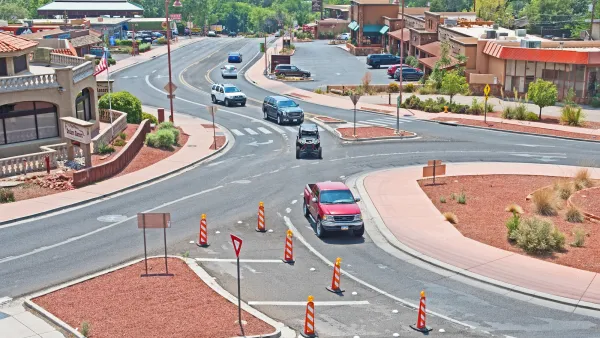
Study: Roundabouts are Primarily in Wealthier Neighborhoods
A North Carolina study sheds light on inequities in road safety interventions.
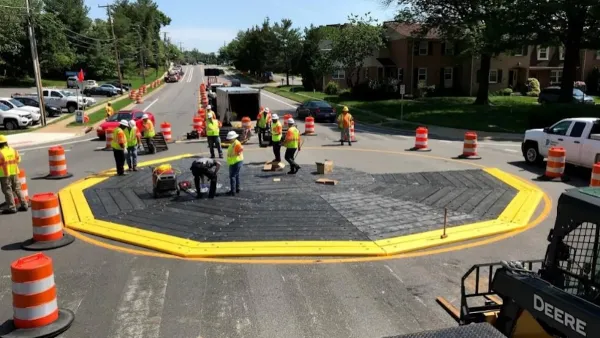
‘Modular Roundabouts’ Offer Quick-Build Traffic Safety Solution
The prefabricated roundabouts can be installed more quickly and at a much lower cost than traditional concrete traffic circles.
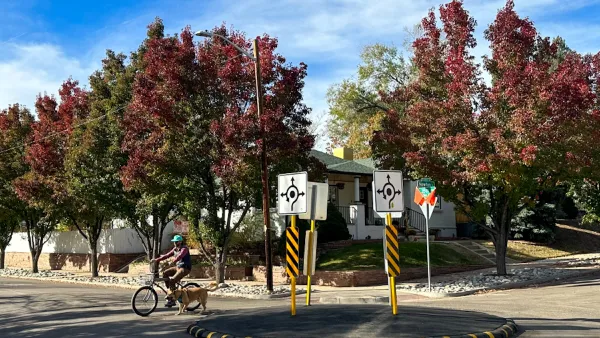
Denver Could Put Pause on New Traffic Circles
The city’s fire department has asked for a moratorium on new traffic circles, installed as a traffic calming mechanism.

Planetizen Federal Action Tracker
A weekly monitor of how Trump’s orders and actions are impacting planners and planning in America.

The state-sanctioned urbicide of Austin
People don’t kill cities. Freeways do.

US to reduce Colorado River water deliveries to Mexico
A new Colorado Treaty amendment reduces Mexico’s Colorado River water allocation by 250,000 acre feet.

5 New England states march closer to 800 megawatt wind energy project
Securing federal approval for the project may be complicated under the Trump administration, which has historically been hostile towards domestic wind power.

Baltimore to break ground on $50 million Transit Priority Project
The project will bring faster bus trips, safer streets and better bike connections to Baltimore.

Airbnb launches $250 million 'last-dollar financing' housing accelerator, makes first investment in Austin
The company will put $6.4 million towards affordable housing development in Texas’ capital.

FREE Course: Walkable City 1: Why Walkability?
After describing his path towards focusing on walkability as the essence of good planning, Jeff Speck marches through his five principal reasons for making more walkable places.
Reinventing Malls: Planning Alchemy—Turning Gray Fields Into Gold
The course focuses on the opportunities and imperatives that shape reinvention of mall sites.

Eagle County Government
Harvard University Graduate School of Design
Nashville Planning Department
The Architects Foundation
University of Cincinnati Online
The Pocatello Development Authority
The Urban Renewal Agency of the City of Pocatello
Journal of the American Planning Association