The key bus corridor serves over 37,000 bus riders daily.


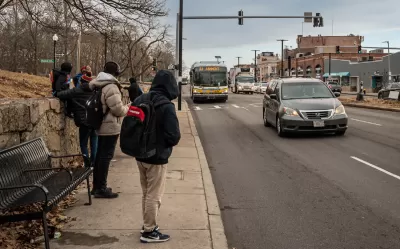
A major Boston street is getting a makeover, complete with a center-running bus lane, reports Zeninjor Enwemeka for WBUR. “The $44 million Blue Hill Avenue redesign project is funded by a $15 million grant from the U.S. Department of Transportation, $11 million from the MBTA and $18 million from the city of Boston.”
Mayor Michelle Wu announced the project this week, noting that the dedicated bus rapid transit (BRT) infrastructure will make bus travel faster and more reliable. “More than half of all travelers on Blue Hill Avenue ride buses, according to the city. And there are more than 37,000 bus riders on the corridor every weekday.”
The project will also add crosswalks, widen sidewalks, and change traffic signal timing for smoother traffic flow. The city says it will “consider” bike lanes. “The city will engage residents and local business owners block-by-block over the next several months to determine the right mix of parking spaces, pedestrian infrastructure, green space and travel lanes.”
Work on the project will begin this year with improved street lighting, refreshed pavement markings, new shade structures on bus shelters, and roadway repairs.
Read the full story: Blue Hill Avenue is getting a $44 million redesign, including a center-running bus lane

Central Ohio Voters Pass Transit Levy
The new sales tax will fund improved bus service, rapid transit projects, and ‘transit -supportive’ infrastructure.

Experts Reject Florida Study That Killed St. Pete Bus Lane as ‘Incomplete,’ ‘Unfair’
A transit activist has filed a suit against FDOT, which used a a one-page study to justify removing a dedicated bus lane.
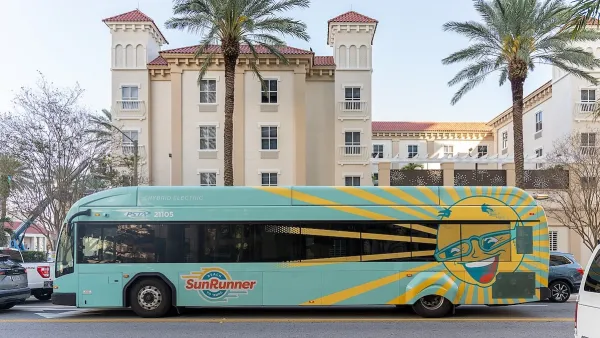
Florida DOT Orders Removal of St. Pete Bus Lane
The state says a popular BRT line has increased crashes and traffic on a state-owned portion of its corridor, prompting it to call for its reversal.

Planetizen Federal Action Tracker
A weekly monitor of how Trump’s orders and actions are impacting planners and planning in America.

California plans to bury El Niño’s downpour
If the state plays its cards right, it may be able to store a billion acre-feet of El Niño’s water in aquifers.

Chicago breaks ground on $3 billion megadevelopment
The new neighborhood, titled Foundry Park, will one day host 3,700 residences.

California High-Speed Rail Authority CEO resigns after $600,000 scandal
Under Ian Choudri, the authority used taxpayer dollars to fund first class flights and trips to nightclubs.

Want to study the Missouri River? Soon, you may need unanimous approval from 10 states
Legislation would require 10 governors’ permission to study or build projects moving water outside the basin.

Desperate measures: Advocates weigh draining Lake Powell to fill Colorado River
Draining the reservoir could reduce evaporation losses by a couple hundred thousand acre-feet.

FREE Course: Walkable City 1: Why Walkability?
After describing his path towards focusing on walkability as the essence of good planning, Jeff Speck marches through his five principal reasons for making more walkable places.
Reinventing Malls: Planning Alchemy—Turning Gray Fields Into Gold
The course focuses on the opportunities and imperatives that shape reinvention of mall sites.

City of Rosemead
Rutgers University, Edward J. Bloustein School of Planning and Public Policy
One Hundred Miles
Hunter College, City University of New York (CUNY)
The Architects Foundation
University of Cincinnati Online
City of Cambridge
Montrose County
The Pocatello Development Authority