A plan to limit the number of automobiles in Oxford and Oxfordshire has provoked a very contemporary form of resistance—online misinformation and threats.


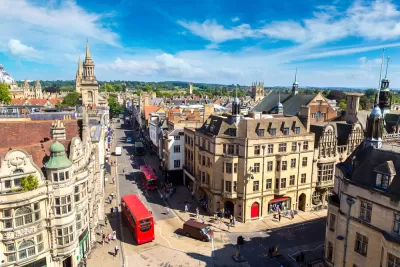
Elected officials and staff in Oxford and Oxfordshire in the United Kingdom are suffering the consequences of proposing a “traffic filtering” plan, intended to create safer places to walk and prioritize non-automotive forms of transportation.
The traffic filtering plan is intended to help the city and county, respectively, as part of the Local Plan 2040, which sets goals to become a 15-minute city.
Viral online misinformation has claimed that the traffic filtering plan “would see parts of the city cut off from each other under a ‘climate lockdown’ and that residents would have to ask the council for permission to travel from one area of the city to another,” according to an article by Christopher Carey.
“The trial scheme, set to be introduced in 2024, will see motorists fined £75 (US$91.85) if they pass through a filter at certain times of the day,” explains Carey. “Residents of the affected areas can apply for permits allowing them to pass through the filters up to 100 days a year, and there will be exemptions for buses, taxis, Blue Badge holders, emergency services, health workers and people receiving frequent hospital treatments.”
More details on the plan and the resulting misinformation can be found at the link below.
FULL STORY: Oxford council staff face threats after traffic scheme misinformation

Congestion Pricing Study Taking Shape in Los Angeles
New York City is the furthest along with a congestion pricing scheme, but San Francisco and Los Angeles are catching up in California.

Congestion Pricing Under Discussion in San Francisco
An expanding number of major U.S. cities are exploring the idea of charging drivers to drive into certain heavily trafficked parts of town. San Francisco is the most recent to explore the idea of congestion pricing (also known as cordon pricing).
Judge Rules to Keep NYC Congestion Pricing, Ending Trump's Legal Challenge
The decision likely deals a fatal blow to efforts to end the program, but the Trump administration says it will explore other avenues for reversing the congestion pricing scheme.

Planetizen Federal Action Tracker
A weekly monitor of how Trump’s orders and actions are impacting planners and planning in America.

The state-sanctioned urbicide of Austin
People don’t kill cities. Freeways do.

US to reduce Colorado River water deliveries to Mexico
A new Colorado Treaty amendment reduces Mexico’s Colorado River water allocation by 250,000 acre feet.

5 New England states march closer to 800 megawatt wind energy project
Securing federal approval for the project may be complicated under the Trump administration, which has historically been hostile towards domestic wind power.

Baltimore to break ground on $50 million Transit Priority Project
The project will bring faster bus trips, safer streets and better bike connections to Baltimore.

Airbnb launches $250 million 'last-dollar financing' housing accelerator, makes first investment in Austin
The company will put $6.4 million towards affordable housing development in Texas’ capital.

FREE Course: Walkable City 1: Why Walkability?
After describing his path towards focusing on walkability as the essence of good planning, Jeff Speck marches through his five principal reasons for making more walkable places.
Reinventing Malls: Planning Alchemy—Turning Gray Fields Into Gold
The course focuses on the opportunities and imperatives that shape reinvention of mall sites.

Eagle County Government
Harvard University Graduate School of Design
Nashville Planning Department
The Architects Foundation
University of Cincinnati Online
The Pocatello Development Authority
The Urban Renewal Agency of the City of Pocatello
Journal of the American Planning Association